Identification of Au-hydrides as key intermediates in the reduction of Au(iii) prodrugs to active Au(i) species under protic conditions
Jasmine Ochs, Nils Metzler-Nolte

TL;DR
This study identifies Au-hydrides as key intermediates in the reduction of Au(III) anticancer drugs to active Au(I) species under biological conditions.
Contribution
The paper reveals the role of Au-hydrides and reductive elimination in the activation of Au(III) prodrugs, a novel insight into their mechanism of action.
Findings
Lipoic acid transfers a hydride to Au(III), forming an Au–H complex detectable by NMR.
Reductive elimination reactions are essential for converting Au–H intermediates to active Au(I) species.
Cysteine derivatives bind to Au(III) but do not form hydrides.
Abstract
Similar to PtIV prodrugs, AuIII anticancer complexes are believed to undergo intracellular reduction, thereby gaining their activity from the resulting AuI species. Unlike for PtIV, the underlying mechanism of this process remains poorly understood for AuIII. To elucidate this mechanism, we investigated the reaction of [Au(ppy)Cl2], a model AuIII complex (ppy: phenylpyridine), with two biologically relevant reductants: lipoic acid (lpa) and N-acetyl-l-cysteine-methyl ester (NAC-OMe). Our findings reveal that lpa transfers a hydride to the Au, while cysteine derivatives only bind to the metal. The Au–H complex, even visible in protic solvents by NMR spectroscopy, produced by lpa is essential for enabling a sequence of oxidative addition and reductive elimination reactions that lead to AuI species eventually. These observations provide valuable insights into the mechanisms by which…
Genes, proteins, chemicals, diseases, species, mutations and cell lines named across the full text — each resolved to its canonical identifier and authoritative record.
Click any figure to enlarge with its caption.
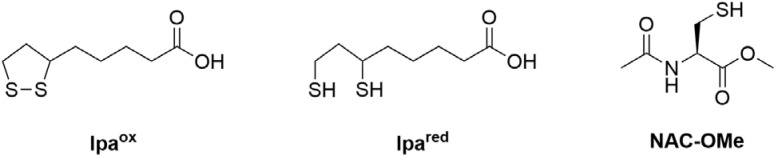 Figure 1
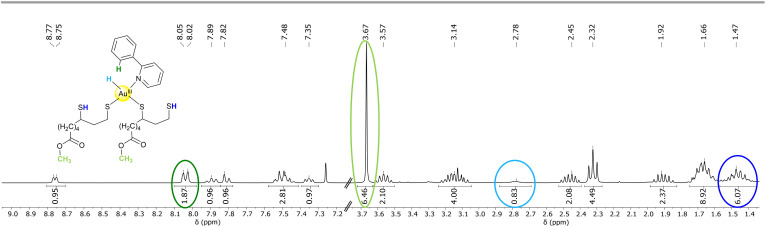 Figure 2
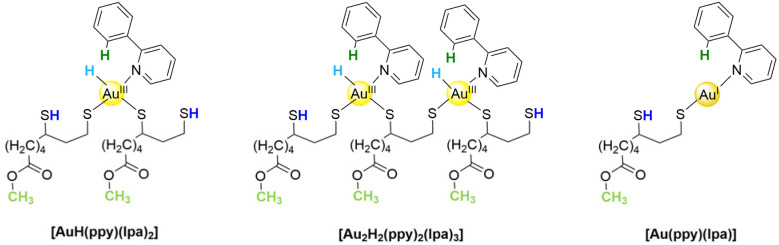 Figure 3
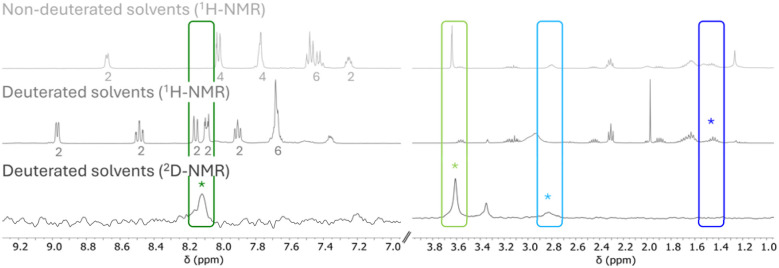 Figure 4
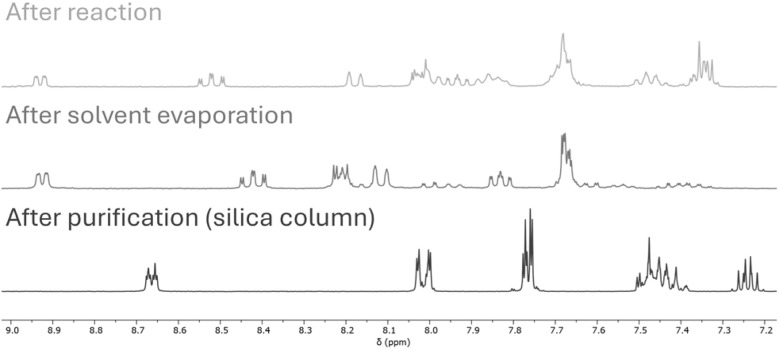 Figure 5
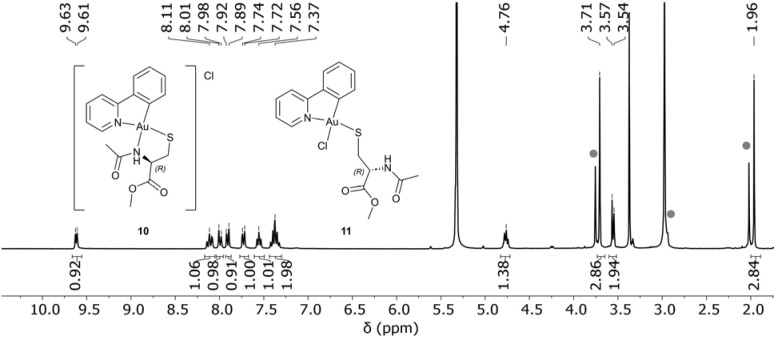 Figure 6
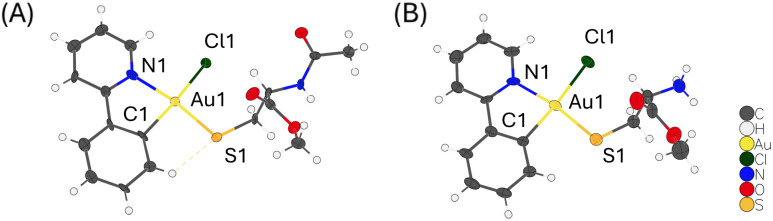 Figure 7
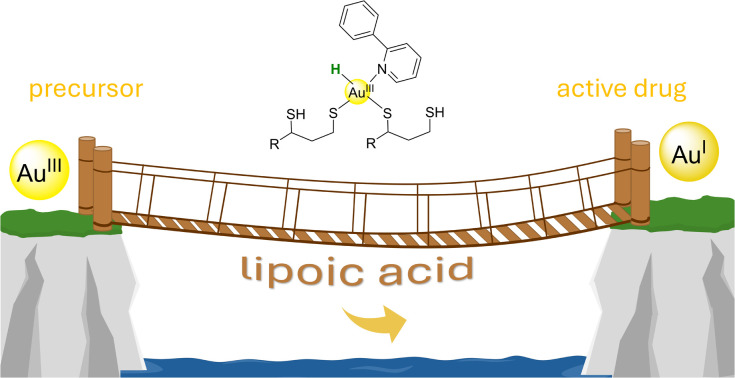 Figure 8
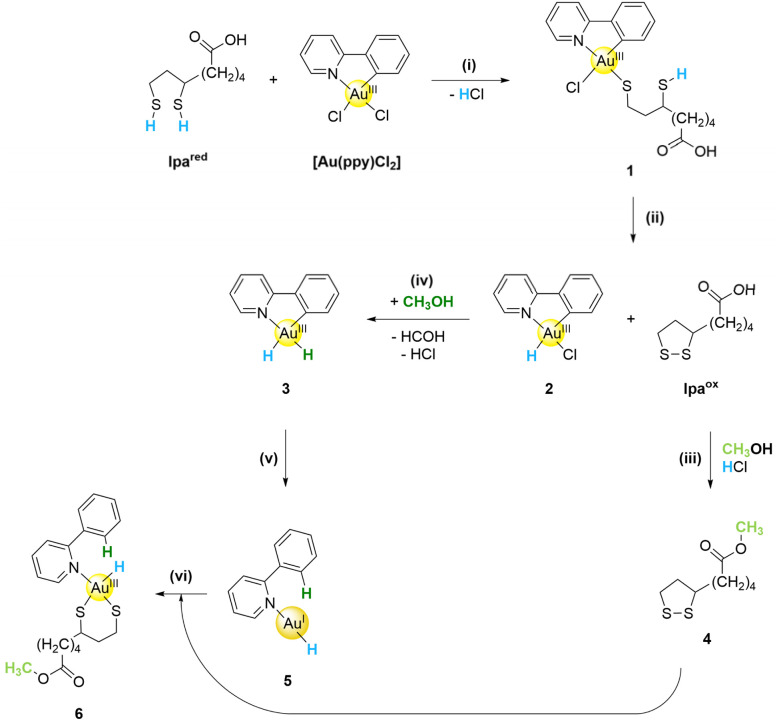 Figure 9
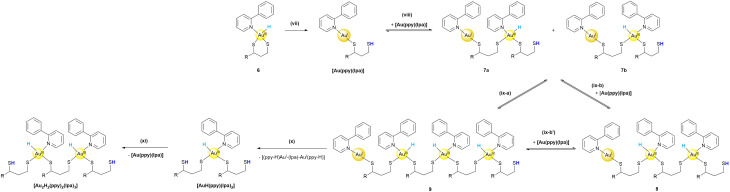 Figure 10
Peer Reviews
No public reviews on file for this paper yet. If you reviewed it on a platform where reviews are public (OpenReview, ICLR, NeurIPS, ICML), you can paste yours below so the community can read it here.
Videos
No videos yet. Explain this paper in a talk, walkthrough, or lecture? Add one.
Taxonomy
TopicsNanocluster Synthesis and Applications · Metal complexes synthesis and properties · Click Chemistry and Applications