Plasma p‐tau217 as a suitable biomarker for monitoring cognitive changes in Alzheimer's disease
Davina Biel, Anna Steward, Anna Dewenter, Amir Dehsarvi, Zeyu Zhu, Sebastian Roemer‐Cassiano, Lukas Frontzkowski, Fabian Hirsch, Matthias Brendel, Nicolai Franzmeier

TL;DR
The study finds that plasma p-tau217 is a good biomarker for tracking cognitive changes in Alzheimer's disease, offering a cost-effective alternative to other methods.
Contribution
The study identifies plasma p-tau217 as a reliable and scalable biomarker for monitoring cognitive decline in Alzheimer's disease.
Findings
Changes in plasma p-tau217 and tau-PET correlate with cognitive decline in Alzheimer's patients.
Amyloid-PET changes do not reliably reflect cognitive decline, limiting their use for treatment monitoring.
MRI-assessed cortical thickness correlates with cognitive changes but is limited by treatment-induced volume loss.
Abstract
With the approval of anti‐amyloid therapies in Alzheimer's disease (AD), surrogate biomarkers are urgently needed to monitor treatment effects that translate into clinical benefits. Candidate biomarkers, including amyloid‐PET, tau‐PET, plasma phosphorylated tau (p‐tau), and MRI‐assessed atrophy, capture core pathophysiological changes in AD. While cross‐sectional biomarker assessments are critical for diagnosis and staging, biomarker change rates may better reflect disease dynamics, making them more suitable for monitoring treatment efficacy. Therefore, we determined which biomarker most effectively tracks cognitive changes in AD, identifying those best suited for efficient monitoring of disease‐modifying treatments. We leveraged ADNI (N = 108) and A4 (N = 151) participants with longitudinal AD biomarker data (global amyloid‐PET, temporal meta tau‐PET, plasma p‐tau217, MRI‐assessed…
Genes, proteins, chemicals, diseases, species, mutations and cell lines named across the full text — each resolved to its canonical identifier and authoritative record.
Click any figure to enlarge with its caption.
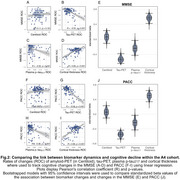 Figure 1
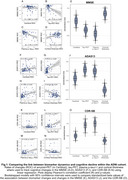 Figure 2
Peer Reviews
No public reviews on file for this paper yet. If you reviewed it on a platform where reviews are public (OpenReview, ICLR, NeurIPS, ICML), you can paste yours below so the community can read it here.
Videos
No videos yet. Explain this paper in a talk, walkthrough, or lecture? Add one.
Taxonomy
TopicsDementia and Cognitive Impairment Research · Alzheimer's disease research and treatments · Functional Brain Connectivity Studies