Mapping tau spread to long‐range functional and structural connections along the major axes of brain organization
Jazlynn Xiu Min Tan, Min Su Kang, Yi‐Hsuan Yeh, Nesrine Rahmouni, Gleb Bezgin, Firoza Z Lussier, Seok Jun Hong, Jonah Isen, JoAnne McLaurin, Boris Bernhardt, Bojana Stefanovic, Jean‐Paul Soucy, Serge Gauthier, Sandra E. Black, Pedro Rosa‐Neto, Maged Goubran, Julie Ottoy

TL;DR
This study explores how tau spreads in Alzheimer's disease by analyzing long-range brain connections using a new framework called connectome gradients.
Contribution
The paper introduces a novel integration of stepwise connectivity and connectome gradients to study tau spread in Alzheimer's.
Findings
In preclinical Alzheimer's, connectivity increases in functional gradient space.
In clinical Alzheimer's, connectivity decreases in the transmodal end of the functional gradient and the posterior end of the structural gradient.
Tau–connectivity correlations shift spatially with disease progression, moving from the DMN/limbic to the frontoparietal system.
Abstract
Prior studies have focused on tau spread from the entorhinal cortex along first‐order (short‐range) connections within anatomical brain space (seed‐to‐target). Here, we explore tau spread along long‐range connections within a novel coordinate space called connectome gradients, which is reflective of the brain's hierarchical organization. Exploring tau spread within this new framework offers insights into long‐range connectivity alterations and network susceptibility in Alzheimer's disease (AD). We included 213 participants from TRIAD (103 A‐ CN, 103 A+ CN, and 75 A+ CI) with diffusion‐weighted MRI, resting‐state functional MRI, and 18F‐MK6240 tau‐PET. First, we employed graph theory‐based stepwise connectivity analyses to unveil long‐range connectivity patterns from the entorhinal cortex to the rest of the brain. Differences in connectivity patterns were compared between A+ vs A‐…
Genes, proteins, chemicals, diseases, species, mutations and cell lines named across the full text — each resolved to its canonical identifier and authoritative record.
Click any figure to enlarge with its caption.
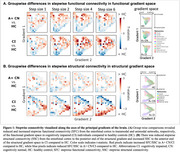 Figure 1
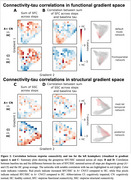 Figure 2
Peer Reviews
No public reviews on file for this paper yet. If you reviewed it on a platform where reviews are public (OpenReview, ICLR, NeurIPS, ICML), you can paste yours below so the community can read it here.
Videos
No videos yet. Explain this paper in a talk, walkthrough, or lecture? Add one.
Taxonomy
TopicsFunctional Brain Connectivity Studies · Memory and Neural Mechanisms · Alzheimer's disease research and treatments