Serum Haptoglobin as a Predictor of Treatment Response in Patients With Chronic Spontaneous Urticaria
Kun‐Woo Park, Boyoun Choi, Da‐Hye Moon, Se‐Min Park, Young‐Min Ye

TL;DR
This study shows that higher levels of haptoglobin in the blood of patients with chronic urticaria predict better treatment outcomes.
Contribution
The study identifies serum haptoglobin as a novel biomarker for predicting treatment response in chronic spontaneous urticaria.
Findings
Serum haptoglobin levels were significantly higher in CSU patients compared to healthy controls.
Baseline haptoglobin levels independently predicted complete control of urticaria after treatment.
Haptoglobin levels decreased significantly following treatment in CSU patients.
Abstract
Chronic spontaneous urticaria (CSU) is a mast cell‐driven disease associated with systemic inflammation and altered immune responses. Haptoglobin (HP), an acute‐phase glycoprotein, exhibits antioxidative and immunomodulatory properties, while zonulin, the precursor of HP‐2, regulates epithelial barrier integrity. We investigated the clinical relevance of serum HP and zonulin in CSU and their association with treatment outcomes. Serum HP and zonulin levels were measured by ELISA in 124 CSU patients and 57 healthy controls (HCs). In 62 CSU patients, follow‐up samples were obtained after 3 months of treatment. Clinical outcomes included the urticaria activity score over 7 days (UAS7) and the urticaria control test (UCT). Serum HP levels were significantly higher in CSU patients than in HCs (median 1145.1 vs. 839.2 μg/mL, p < 0.001), whereas zonulin levels did not differ. HP correlated…
Genes, proteins, chemicals, diseases, species, mutations and cell lines named across the full text — each resolved to its canonical identifier and authoritative record.
Click any figure to enlarge with its caption.
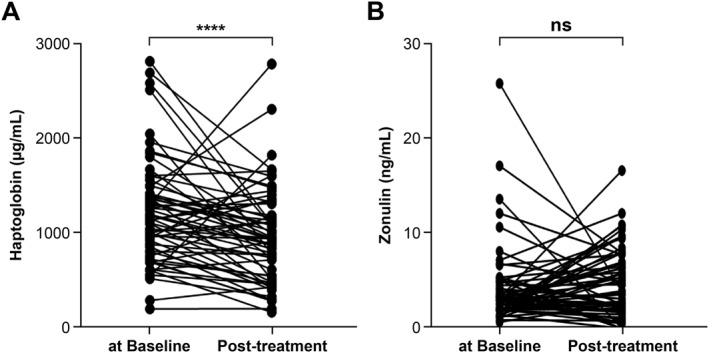 Figure 1
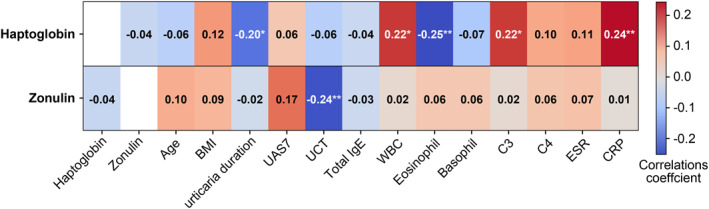 Figure 2
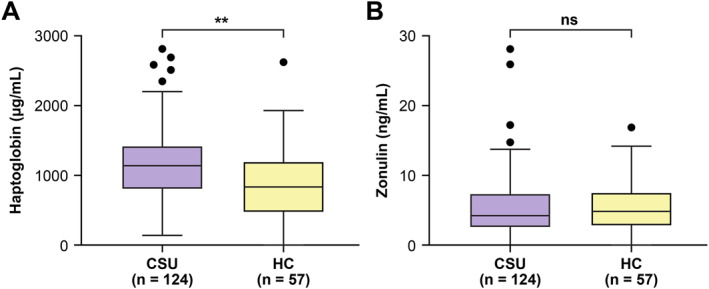 Figure 3
Peer Reviews
No public reviews on file for this paper yet. If you reviewed it on a platform where reviews are public (OpenReview, ICLR, NeurIPS, ICML), you can paste yours below so the community can read it here.
Videos
No videos yet. Explain this paper in a talk, walkthrough, or lecture? Add one.
Taxonomy
TopicsUrticaria and Related Conditions · Mast cells and histamine · Medical and Biological Ozone Research