VeraBIND Tau test, a novel plasma assay for active tau pathology, identifies individuals with positive tau‐PET signal, regardless of amyloid status
Bernard J Hanseeuw, Jean‐Louis Bayart, Emilien Boyer, Lisa Quenon, Pascal Kienlen‐Campard, Renaud Lhommel, Adrian Ivanoiu, Khairul Ansari, Joshua Soldo, Khalid Iqbal

TL;DR
A new blood test called VeraBIND Tau can detect active tau pathology in people with or without amyloid buildup, offering a more accurate way to identify tau-related brain changes.
Contribution
The VeraBIND Tau test is a novel plasma assay that detects active tau pathology independently of amyloid status, improving the identification of tau aggregation.
Findings
VeraBIND Tau achieved 93% sensitivity and 95% specificity in detecting tau pathology using tau-PET as a reference.
The VeraBIND test outperformed pTau217 in identifying tau positivity in cases without amyloid, including some with low tau-PET signals.
VeraBIND Tau is more sensitive to early tau aggregation and can detect discordant A/T PET status in plasma.
Abstract
Plasma assays targeting tau phospho‐epitopes (e.g., pTau217) are frequently observed in the context of isolated amyloid‐β pathology (A+). Developing plasma assays associated with tau aggregation (T+) is an unmet challenge. Here, we present results of the VeraBIND Tau test, a plasma assay measuring how hyperphosphorylated tau (HPT) observed in a sample binds to normal tau, i.e., testing whether tau is pathologically active. VeraBIND Tau is an in vitro bead‐based ELISA that uses chemiluminescence (Figure 1: overview). One hundred thirty‐three participants were recruited from an ongoing study at UCLouvain, Belgium, including 93 clinically normal (CN, 32A+) and 40 clinically impaired (MCI/AD, 36A+). A+ status was determined using either CSF (Aβ42≤544pg/mL) or amyloid‐PET (Centiloid≥20). F18MK6240 Tau‐PET status was determined visually as negative (Braak 0) or positive (Braak≥1). Plasma…
Genes, proteins, chemicals, diseases, species, mutations and cell lines named across the full text — each resolved to its canonical identifier and authoritative record.
Click any figure to enlarge with its caption.
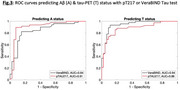 Figure 1
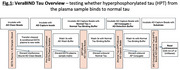 Figure 2
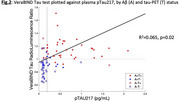 Figure 3
Peer Reviews
No public reviews on file for this paper yet. If you reviewed it on a platform where reviews are public (OpenReview, ICLR, NeurIPS, ICML), you can paste yours below so the community can read it here.
Videos
No videos yet. Explain this paper in a talk, walkthrough, or lecture? Add one.
Taxonomy
TopicsAlzheimer's disease research and treatments · Amyloidosis: Diagnosis, Treatment, Outcomes · Dementia and Cognitive Impairment Research