Developing a Novel Reference Region for PI‐2620‐PET Imaging to Facilitate Assessment of 4‐Repeat Tauopathies
Lukas Frontzkowski, Mattes Gross, Sebastian Roemer‐Cassiano, Carla Palleis, Amir Dehsarvi, Sabrina Katzdobler, Anna Dewenter, Anna Steward, Davina Biel, Fabian Hirsch, Johannes Gnörich, Johannes Levin, Andrew W. Stephens, Andre Mueller, Norman Koglin, Gérard N Bischof

TL;DR
This study identifies a new reference region for PI-2620-PET imaging to better detect 4R tauopathies like progressive supranuclear palsy.
Contribution
The study introduces a novel temporo-orbital white-matter reference region for improved quantification of 4R tau in PET imaging.
Findings
The temporo-orbital white-matter reference region showed strong sensitivity for detecting PSP-RS vs. healthy controls.
Using the new reference region, minimal differences were found in non-tau diseases like Alzheimer's and alpha-synucleinopathies.
Conventional cerebellar reference regions showed minimal group differences compared to the new method.
Abstract
Neurodegenerative 4‐repeat (4R) tauopathies commonly manifest as progressive supranuclear palsy (PSP). PSP patients show elevated PI‐2620‐PET in subcortical 4R tau predilection sites (e.g., globus pallidus), suggesting PI‐2620‐PET as a promising 4R tau neuroimaging candidate. However, optimal quantification of PI‐2620‐PET in 4R tauopathies remains challenging, as conventional cerebellar tau‐PET reference regions also accumulate 4R tau. We aimed to use unbiased image‐derived input function (IDIF) PET data to determine an optimized PET reference region for in vivo quantification of 4R tau. We obtained 60‐minute dynamic PI‐2620‐PET in 54 PSP Richardson Syndrome (PSP‐RS) patients and 19 healthy controls (HC), applying IDIF‐modeling using carotid timeseries to assess unbiased PI‐2620‐PET binding and determine total distribution volume (VT). Through an iterative approach, we…
Genes, proteins, chemicals, diseases, species, mutations and cell lines named across the full text — each resolved to its canonical identifier and authoritative record.
Click any figure to enlarge with its caption.
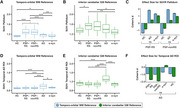 Figure 1
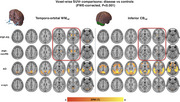 Figure 2
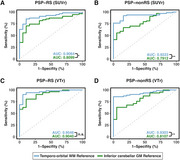 Figure 3
Peer Reviews
No public reviews on file for this paper yet. If you reviewed it on a platform where reviews are public (OpenReview, ICLR, NeurIPS, ICML), you can paste yours below so the community can read it here.
Videos
No videos yet. Explain this paper in a talk, walkthrough, or lecture? Add one.
Taxonomy
TopicsEpilepsy research and treatment · Genetic Neurodegenerative Diseases · Parkinson's Disease Mechanisms and Treatments