Management of hereditary angioedema with normal C1Inh: a series of 163 French patients
Alexis Bocquet, Laurence Bouillet, Gaelle Hardy, Isabelle Boccon-Gibod, Alban Deroux, Mélanie Arnaud, Fabien Pelletier, Aurélie Du Thanh, Nicolas Ozanne, Guillaume Armengol, Pierre Yves Jeandel, Laurent Sailler, Marie Caroline Taquet, David Launay, Olivier Fain, Delphine Gobert

TL;DR
This study examines the clinical features and treatment responses of 163 French patients with hereditary angioedema caused by normal C1Inh, highlighting differences based on genetic variants in FXII and PLG genes.
Contribution
The study provides insights into the management and clinical differences of hereditary angioedema with normal C1Inh based on specific genetic variants.
Findings
Patients with HAE-FXII showed estrogen dependency and later age of first attack compared to HAE-PLG.
Icatibant and lanadelumab showed high efficacy in treating HAE-PLG and HAE-FXII, respectively.
HAE-PLG patients had higher response rates to tranexamic acid and progestin-only contraceptives.
Abstract
The diagnosis of hereditary angioedema with a normal C1Inh was genetic. The two most frequent pathogenic variants are found in the FXII and PLG genes. Their management is similar to that of HAE patients with C1Inh deficiency but without evidence-based medicine. The French Reference Centre for Angioedema (CREAK) Our center identified all patients with HAE with a normal C1Inh to evaluate their therapeutic management. This was a national retrospective study conducted in our center the CREAK network. A total of 287 patients were identified with an F12 pathogenic variant (133 families), 38 with PLG (12 families) and one patient with KNG1. Among these patients, 111 patients with HAE-FXII and 19 patients with HAE-PLG were symptomatic. More women than men were symptomatic (86.3% vs. 30.8%, respectively) (p < 0,0001). The mean age at first attack was 24 ± 12 years. 49% of patients with…
Genes, proteins, chemicals, diseases, species, mutations and cell lines named across the full text — each resolved to its canonical identifier and authoritative record.
Click any figure to enlarge with its caption.
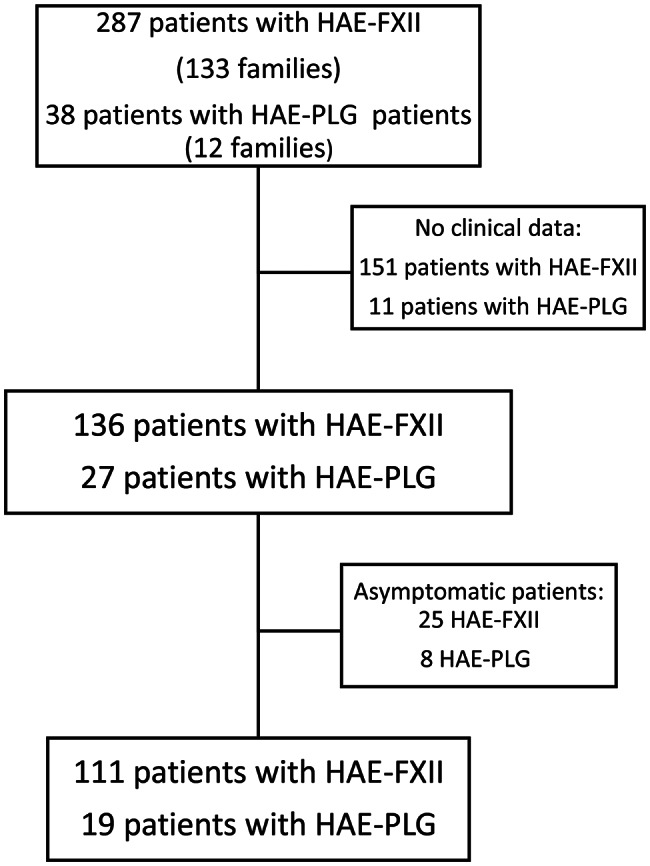 Figure 1
Peer Reviews
No public reviews on file for this paper yet. If you reviewed it on a platform where reviews are public (OpenReview, ICLR, NeurIPS, ICML), you can paste yours below so the community can read it here.
Videos
No videos yet. Explain this paper in a talk, walkthrough, or lecture? Add one.
Taxonomy
TopicsCoagulation, Bradykinin, Polyphosphates, and Angioedema · Urticaria and Related Conditions · Complement system in diseases