Aging-independent decrease of complex multi-spine boutons in hippocampal area CA1 after contextual fear conditioning
Raquel Martinez-Serra, Suji Lee, Igor Kraev, Karl Peter Giese

TL;DR
This study shows that the complexity of multi-spine boutons in the hippocampus decreases after a memory-forming event, and this change is not affected by aging.
Contribution
The study reveals an aging-independent synaptic change in multi-spine bouton complexity after contextual fear conditioning.
Findings
Complex multi-spine boutons decrease in the hippocampal CA1 region 24 hours after contextual fear conditioning.
This decrease occurs in both young and aged mice, showing no effect of aging on the synaptic change.
Reduced MSB complexity may support specific memory recall by altering neuronal connectivity.
Abstract
Long-lasting synaptic changes enable memory storage and regulate recall in the brain. Our previous work established that generation of multi-innervated dendritic spines (MISs), spines with typically two excitatory presynaptic inputs, underlies hippocampal memory formation in aged, but not young mice. The identification of MIS generation was done by ultrastructural analysis in hippocampal CA1 stratum radiatum 24 h after contextual fear conditioning (CFC). However, our analysis did not consider multi-spine boutons (MSBs), which were recently shown to increase in complexity (complex MSBs are pre-synaptic boutons connecting with more than two post-synapses) at a later time point after CFC in young age. Therefore, we re-analyzed our three-dimensional electron microscopy images and show that, unexpectedly, MSB complexity, decreases in CA1 stratum radiatum 24 h after CFC. The decrease in MSB…
Genes, proteins, chemicals, diseases, species, mutations and cell lines named across the full text — each resolved to its canonical identifier and authoritative record.
Click any figure to enlarge with its caption.
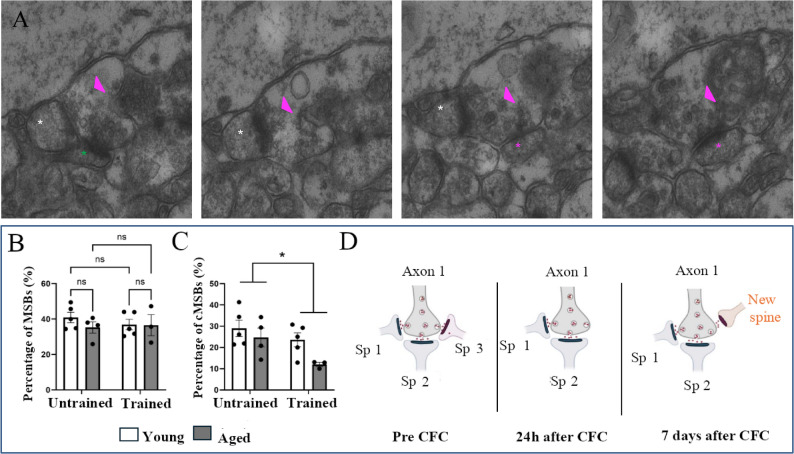 Figure 1
Peer Reviews
No public reviews on file for this paper yet. If you reviewed it on a platform where reviews are public (OpenReview, ICLR, NeurIPS, ICML), you can paste yours below so the community can read it here.
Videos
No videos yet. Explain this paper in a talk, walkthrough, or lecture? Add one.
Taxonomy
TopicsMemory and Neural Mechanisms · Neuroscience and Neuropharmacology Research · Neurogenesis and neuroplasticity mechanisms