Health-seeking behaviour, health service delivery and its perceived impact among stroke survivors in Sierra Leone: a longitudinal qualitative study embedded in the SISLE project
Mamadu Baldeh, Jessica O’Hara, Divya Parmar, Christopher McKevitt, Daniel Youkee, Gibrilla F. Deen, Dimbintsoa Rakotomalala Robinson, Jotham Johnson, Augustine Thomas Mambu Bayoh, Albert Sama, Catherine Sackley

TL;DR
This study explores stroke care experiences in Sierra Leone, highlighting delays in seeking care, financial burdens, and recommendations for improving stroke services in resource-limited settings.
Contribution
The study provides novel insights into stroke care delivery and health-seeking behavior in a low-resource setting through longitudinal qualitative analysis.
Findings
Stroke survivors often delay hospital visits due to traditional treatments and lack of stroke symptom awareness.
Financial burden and out-of-pocket costs are major barriers to accessing stroke care and physiotherapy.
Recommendations include community education, health insurance schemes, and dedicated stroke units to improve care delivery.
Abstract
Stroke is a leading cause of disability and mortality globally. Despite growing awareness of the stroke epidemic, there is limited understanding of the lived experiences and perspectives of stroke care within resource-constrained health systems. This study explored the experiences and perspectives of stroke survivors, primary caregivers and healthcare providers on stroke care in Sierra Leone. This qualitative descriptive study involved face-to-face semi-structured interviews with stroke survivors, informal caregivers, and healthcare providers between December 2020 and August 2021 in Sierra Leone. We purposively sampled participants to capture diverse experiences across the care continuum. Data were analysed thematically using a constant comparative approach and interpretative phenomenological analysis, triangulating perspectives across participant groups. Five interconnected themes…
Genes, proteins, chemicals, diseases, species, mutations and cell lines named across the full text — each resolved to its canonical identifier and authoritative record.
Click any figure to enlarge with its caption.
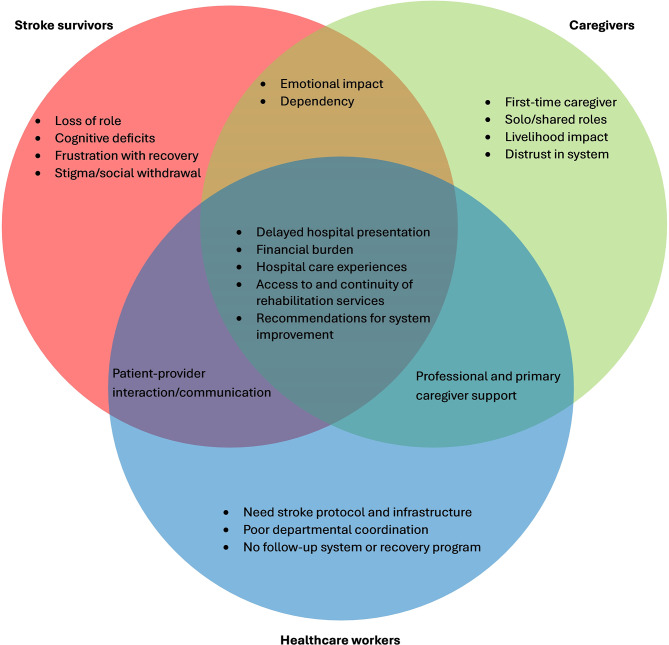 Figure 1
Peer Reviews
No public reviews on file for this paper yet. If you reviewed it on a platform where reviews are public (OpenReview, ICLR, NeurIPS, ICML), you can paste yours below so the community can read it here.
Videos
No videos yet. Explain this paper in a talk, walkthrough, or lecture? Add one.
Taxonomy
TopicsStroke Rehabilitation and Recovery · Acute Ischemic Stroke Management · Dementia and Cognitive Impairment Research