Amyloid quantification in the oldest-old: selecting regions for optimizing correspondence between postmortem pathology and amyloid PET
Jiaxin Yu, Davis C. Woodworth, Evan Fletcher, Dana E. Greenia, Syed Bukhari, Thomas J. Montine, Maria M. Corrada, Claudia H. Kawas, Charles DeCarli, S. Ahmad Sajjadi, Tianchen Qian

TL;DR
This study finds that using specific brain regions in PET scans improves the accuracy of predicting amyloid buildup in the oldest-old individuals.
Contribution
The study identifies optimal PET regions for predicting amyloid pathology in the oldest-old, improving diagnostic accuracy.
Findings
The PC2+WM SUVR method had the best predictive accuracy for amyloid beta and neuritic plaque positivity.
White matter outperformed cerebellar gray matter as a reference region for amyloid prediction.
Using a limited cortical target region improved PET-neuropathology correspondence in older individuals.
Abstract
Positron emission tomography (PET) is the current gold standard for assessing amyloid burden in vivo and is often quantified using standardized uptake value ratios (SUVRs). We evaluated the performance of four SUVR calculation methods for predicting amyloid deposition at autopsy in a group of oldest-old participants. We analyzed data from 165 participants from The 90 + Study with both florbetapir PET and postmortem assessments. PET scans were re-aligned to an older age template using a custom MRI-free pipeline. SUVRs were computed from two target regions—combined posterior cingulate and precuneus (PC2) and an established cortical summary region—and two reference regions—white matter (WM) and cerebellar gray matter. Their predictive performance for amyloid beta positivity (Thal phase ≥ 3) and neuritic plaque positivity (moderate or frequent CERAD score) was evaluated using receiver…
Genes, proteins, chemicals, diseases, species, mutations and cell lines named across the full text — each resolved to its canonical identifier and authoritative record.
Click any figure to enlarge with its caption.
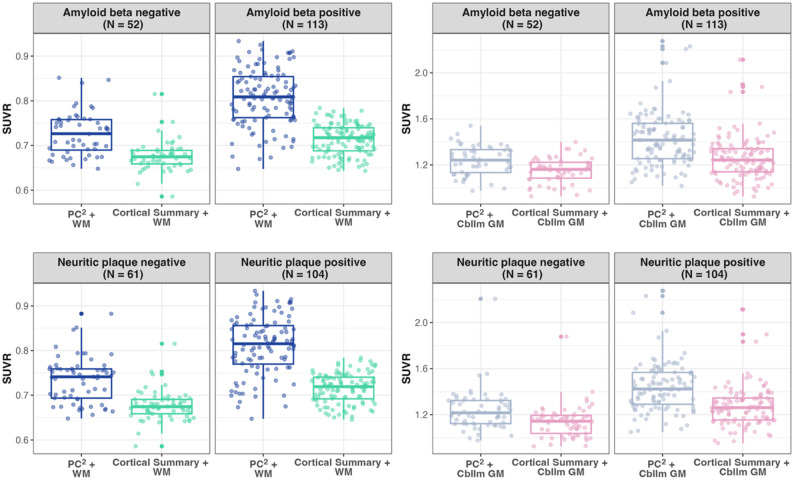 Figure 1
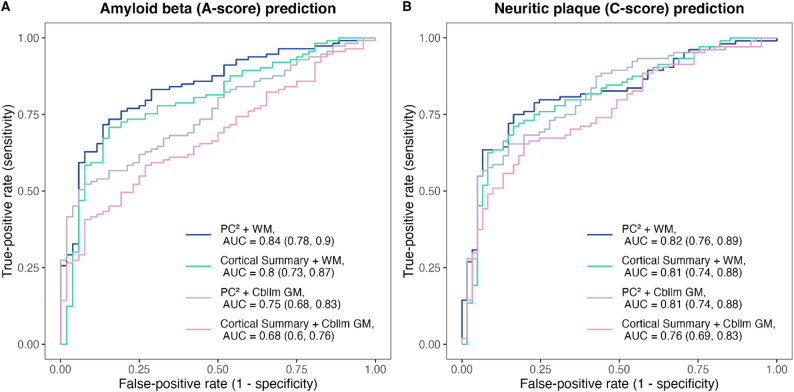 Figure 2
Peer Reviews
No public reviews on file for this paper yet. If you reviewed it on a platform where reviews are public (OpenReview, ICLR, NeurIPS, ICML), you can paste yours below so the community can read it here.
Videos
No videos yet. Explain this paper in a talk, walkthrough, or lecture? Add one.
Taxonomy
TopicsDementia and Cognitive Impairment Research · Autopsy Techniques and Outcomes · Cerebrospinal fluid and hydrocephalus