CSF diversion after aneurysmal sub-arachnoid hemorrhage: towards personalized treatment strategies
Julian Klug, Roland Roelz, Giulia Cossu, Nawfel Ben-Hamouda, Stefan Wolf, Urs Pietsch

TL;DR
This paper discusses how cerebrospinal fluid diversion can be personalized to improve outcomes for patients with aneurysmal subarachnoid hemorrhage.
Contribution
The paper proposes a pragmatic decision-making algorithm for individualized CSF diversion strategies in aSAH patients.
Findings
Lumbar drainage significantly reduces delayed cerebral ischemia and improves functional outcomes in suitable aSAH patients.
External ventricular drains are essential in cases of obstructive hydrocephalus or reduced consciousness.
Personalized selection of CSF diversion techniques is necessary due to the heterogeneity of aSAH presentations.
Abstract
Aneurysmal subarachnoid hemorrhage (aSAH) is a life-threatening condition associated with high morbidity and mortality, with survivors often experiencing long-term neurological and functional deficits. Cerebrospinal fluid (CSF) diversion plays a pivotal role in the acute management of aSAH, both for the treatment of hydrocephalus and for the prevention of delayed cerebral ischemia (DCI) through clearance of blood breakdown products. Four principal modalities are currently employed: lumbar puncture, lumbar, cisternal, and external ventricular drain. Each technique differs in its mechanism of drainage, monitoring capacity, complication profile, and influence on shunt dependency and long-term outcome. High-quality evidence from randomized controlled trials now supports lumbar drainage as the only intervention that significantly reduces the incidence of DCI and has been shown to improve…
Genes, proteins, chemicals, diseases, species, mutations and cell lines named across the full text — each resolved to its canonical identifier and authoritative record.
Click any figure to enlarge with its caption.
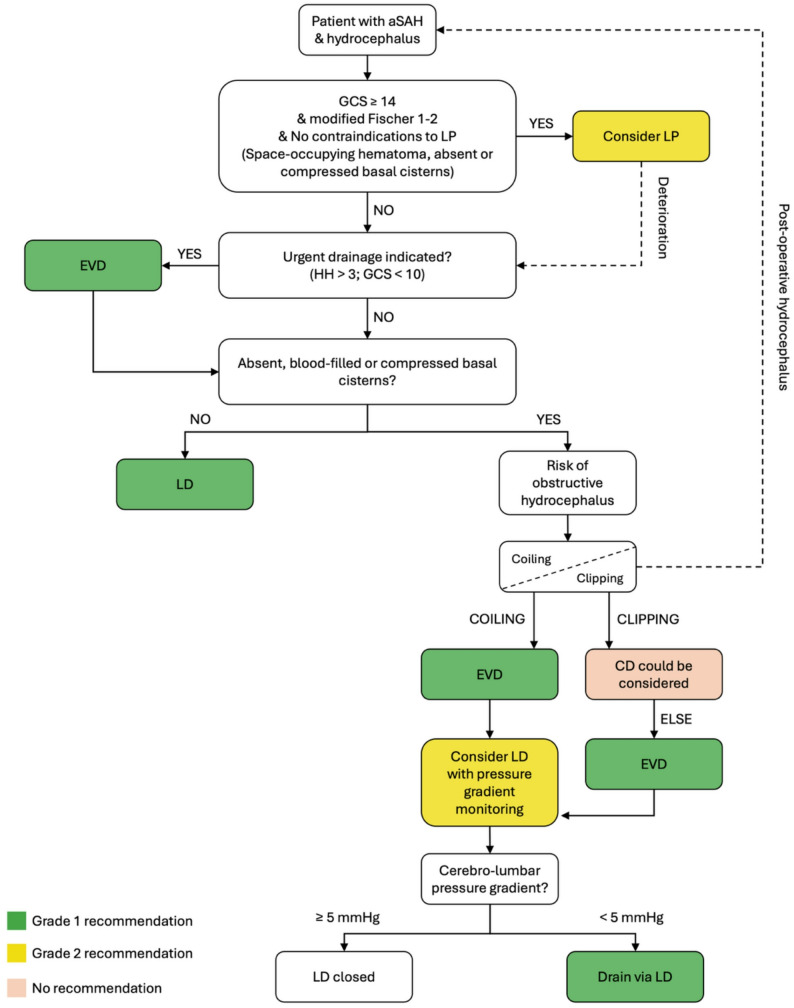 Figure 1
Peer Reviews
No public reviews on file for this paper yet. If you reviewed it on a platform where reviews are public (OpenReview, ICLR, NeurIPS, ICML), you can paste yours below so the community can read it here.
Videos
No videos yet. Explain this paper in a talk, walkthrough, or lecture? Add one.
Taxonomy
TopicsCerebrospinal fluid and hydrocephalus · Intracranial Aneurysms: Treatment and Complications · Intracerebral and Subarachnoid Hemorrhage Research