An Open‐Label Randomized Controlled Trial Comparing the Efficacy and Safety of a 7‐Day Triple Therapy With Bismuth Versus 14‐Day Standard Triple Therapy for Helicobacter pylori Eradication in Children and Adolescents
Anja Šterbenc, Bor Vratanar, Eva Miler Mojškerc, Matjaž Homan

TL;DR
A 7-day triple therapy with bismuth is as effective and safe as a 14-day standard treatment for Helicobacter pylori in children.
Contribution
Demonstrates that a shorter 7-day bismuth-based regimen achieves high eradication rates in children with H. pylori.
Findings
7-day triple therapy with bismuth achieved 91% eradication compared to 87% for 14-day standard therapy.
No serious adverse events occurred, and most were mild to moderate.
Bismuth therapy was associated with fewer metallic taste complaints than standard therapy.
Abstract
To achieve eradication rates > 90%, the ESPGHAN/NASPGHAN guidelines for pediatric Helicobacter pylori infection recommend tailored antimicrobial therapy using sufficiently high doses over 10–14 days. However, prolonged treatment often leads to suboptimal compliance in children, which is a major contributor to reduced eradication rates. To address this, we evaluated the efficacy and safety of a shorter, 7 day triple therapy with bismuth compared with the 14 day standard triple therapy without bismuth in H. pylori infected children. From 2020 to 2024, we carried out a randomized controlled trial involving treatment‐naïve children and adolescents (5–18 years old) with confirmed H. pylori infection. Eligible participants were randomly allocated to receive either a 7 day triple therapy with bismuth (bismuth subcitrate, a proton pump inhibitor [PPI], amoxicillin, plus…
Genes, proteins, chemicals, diseases, species, mutations and cell lines named across the full text — each resolved to its canonical identifier and authoritative record.
Click any figure to enlarge with its caption.
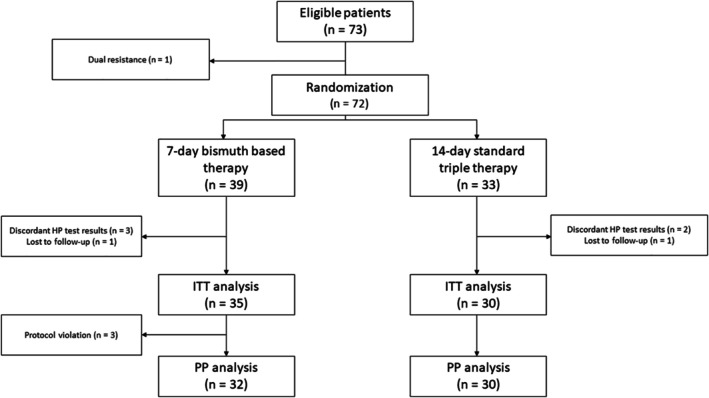 Figure 1
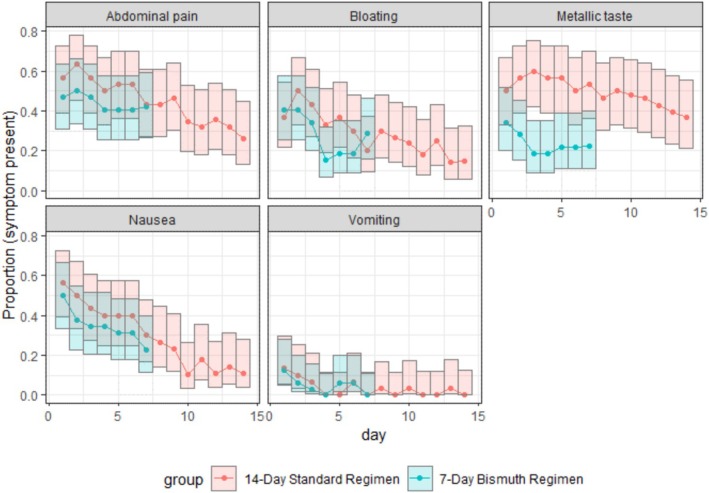 Figure 2
Peer Reviews
No public reviews on file for this paper yet. If you reviewed it on a platform where reviews are public (OpenReview, ICLR, NeurIPS, ICML), you can paste yours below so the community can read it here.
Videos
No videos yet. Explain this paper in a talk, walkthrough, or lecture? Add one.
Taxonomy
TopicsHelicobacter pylori-related gastroenterology studies · Microscopic Colitis · Clostridium difficile and Clostridium perfringens research