Sleep macro‐architecture, nocturnal hypoxemia, and Alzheimer's Disease‐related MRI patterns among diverse older adults
Dillys Xiaodi Liu, Meredith N. Braskie, Clémence Cavaillès, Carrie B. Peltz, Susan Redline, Kristine Yaffe

TL;DR
This study finds that poor sleep patterns and low nighttime oxygen levels are linked to brain changes associated with Alzheimer's disease in a diverse group of older adults.
Contribution
The study provides novel evidence on how sleep macro-architecture and hypoxemia relate to Alzheimer's-related MRI patterns across ethnoracial groups.
Findings
Higher light sleep and longer REM latency are linked to thinner cortex in Alzheimer's-related brain regions.
Lower deep sleep and REM sleep apnea are associated with increased white matter hyperintensities.
Nocturnal hypoxemia is independently linked to greater white matter hyperintensity volume.
Abstract
Increasing evidence has linked sleep quality and sleep apnea to poorer brain health, yet the association between sleep macro‐architecture, nocturnal hypoxemia and Alzheimer's Disease (AD)‐related patterns on neuroimaging remains less known, especially across older adults from diverse ethnoracial groups. The recently completed Health and Aging Brain Study‐Health Disparities (HABS‐HD)‐Dormir Study recruited community‐dwelling non‐Hispanic White (NHW), Hispanic, and Black participants who underwent an in‐home sleep apnea assessment (WatchPAT, Itamar, IS) and brain magnetic resonance imaging (MRI) to evaluate sleep and AD‐related MRI biomarkers. Sleep stages were estimated using a validated proprietary algorithm. Our primary outcomes are AD‐signature cortical thickness (in individual regions of interests, including entorhinal cortex, fusiform gyrus, inferior temporal gyrus, and middle…
Genes, proteins, chemicals, diseases, species, mutations and cell lines named across the full text — each resolved to its canonical identifier and authoritative record.
Click any figure to enlarge with its caption.
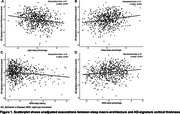 Figure 1
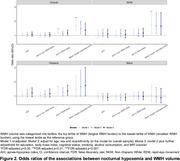 Figure 2
Peer Reviews
No public reviews on file for this paper yet. If you reviewed it on a platform where reviews are public (OpenReview, ICLR, NeurIPS, ICML), you can paste yours below so the community can read it here.
Videos
No videos yet. Explain this paper in a talk, walkthrough, or lecture? Add one.
Taxonomy
TopicsObstructive Sleep Apnea Research · Neuroscience of respiration and sleep · Sleep and related disorders