Experimental Nonevidence of Fragile-to-Strong Crossover
Petr Koštál, Jaroslav Barták, Michaela Včeláková, Stanislav Slang, Torsten Wieduwilt, Markus A. Schmidt, Jiří Málek

TL;DR
This study examines the viscosity of Ge-Se glasses and finds no evidence of a fragile-to-strong crossover in any composition.
Contribution
The study provides experimental evidence against the fragile-to-strong crossover in Ge–Se glass-forming systems.
Findings
No fragile-to-strong crossover was observed in any of the four Ge–Se compositions.
Viscosity measurements spanned 13 orders of magnitude across different techniques.
Abstract
This study explores the viscosity behavior of the Ge–Se chalcogenide glass-forming system. Four compositions containing 5, 10, 15, and 20 at. % germanium were examined. Viscosity measurements were performed over a broad range, spanning approximately 13 orders of magnitude, by combining the pressure-assisted melt filling technique with penetration and parallel-plate viscometry. The results demonstrate that no fragile-to-strong crossover occurs in any of the studied compositions.
Genes, proteins, chemicals, diseases, species, mutations and cell lines named across the full text — each resolved to its canonical identifier and authoritative record.
Click any figure to enlarge with its caption.
 Figure 1
 Figure 2
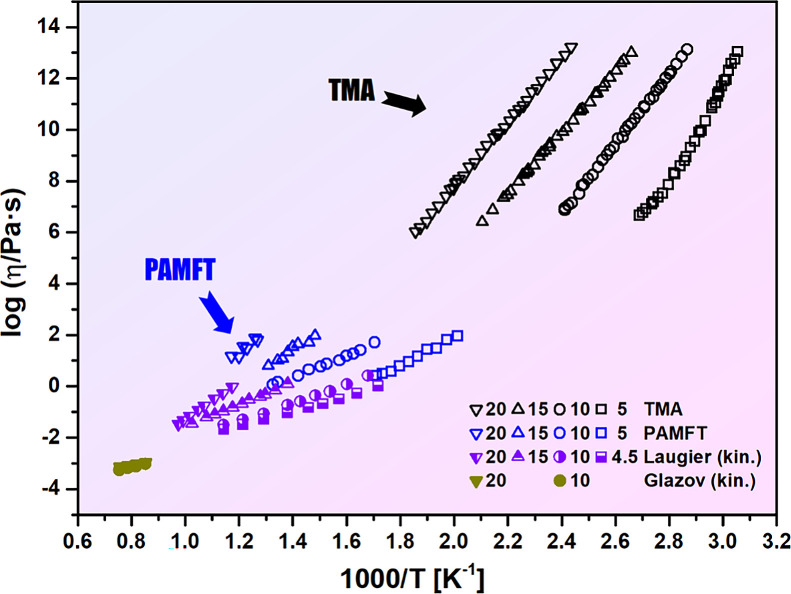 Figure 3
 Figure 4
 Figure 5
 Figure 6
 Figure 7
Peer Reviews
No public reviews on file for this paper yet. If you reviewed it on a platform where reviews are public (OpenReview, ICLR, NeurIPS, ICML), you can paste yours below so the community can read it here.
Videos
No videos yet. Explain this paper in a talk, walkthrough, or lecture? Add one.
Taxonomy
TopicsPhase-change materials and chalcogenides · Material Dynamics and Properties · Metallic Glasses and Amorphous Alloys