Acceptability, Feasibility, and Perceived Usefulness of the School eHealth Education Program Pakistan (eSHEPP) for Improving Adolescents’ Awareness of Noncommunicable Diseases in Secondary and Higher Secondary Schools
Muhammad Shahid Khan, Aysha Almas, Zainab Samad, Kanecia Obie Zimmerman, Tazeen Saeed Ali

TL;DR
A multimedia health education program for Pakistani schools was found to be well-accepted and effective in improving adolescents' awareness of noncommunicable diseases.
Contribution
The eSHEPP program is a novel, app-supported, and culturally adapted intervention for promoting NCD awareness in low-resource school settings.
Findings
Students found eSHEPP acceptable, user-friendly, and effective in increasing awareness of NCDs and related risk factors.
The program was feasible to implement with minimal resource demands and successfully integrated into school schedules.
Participants suggested improvements like adding interactive features and expanding health topics for better engagement.
Abstract
Noncommunicable diseases (NCDs) are a leading cause of premature morbidity and mortality, and many risk behaviors emerge during adolescence. In Pakistan, school health education remains limited and primarily didactic, leaving adolescents insufficiently equipped to adopt healthy behaviors. To address this gap, the School eHealth Education Program Pakistan (eSHEPP), a multimedia, app-supported intervention, was developed. This study aimed to explore secondary and higher secondary students’ perceptions of eSHEPP’s acceptability, feasibility, and perceived usefulness in increasing awareness of NCDs following program delivery in school settings. A qualitative explanatory study, guided by an integrated Technology Acceptance Model (TAM) and Task–Technology Fit (TTF) framework, was conducted in four schools (two secondary, two higher secondary; two all-girls, two all-boys) in Karachi. eSHEPP…
Genes, proteins, chemicals, diseases, species, mutations and cell lines named across the full text — each resolved to its canonical identifier and authoritative record.
Click any figure to enlarge with its caption.
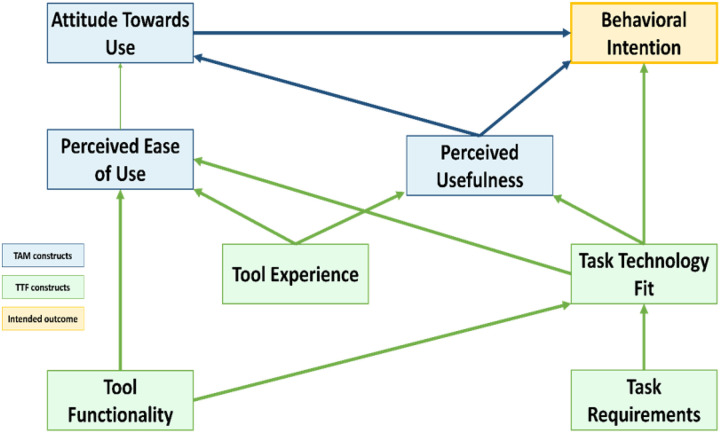 Figure 1
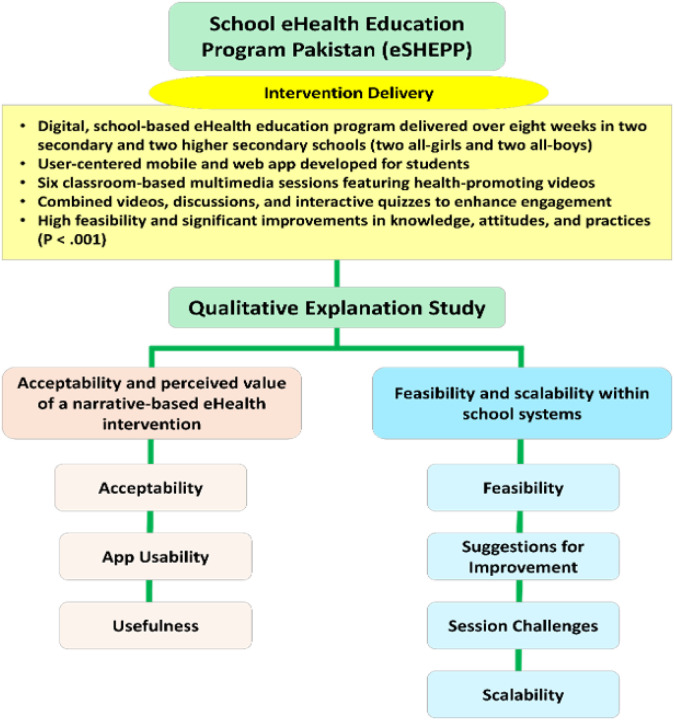 Figure 2
 Figure 3
Peer Reviews
No public reviews on file for this paper yet. If you reviewed it on a platform where reviews are public (OpenReview, ICLR, NeurIPS, ICML), you can paste yours below so the community can read it here.
Videos
No videos yet. Explain this paper in a talk, walkthrough, or lecture? Add one.
Taxonomy
TopicsSchool Health and Nursing Education · Adolescent Sexual and Reproductive Health · Health Literacy and Information Accessibility