Differences in “minty” flavor compound and synthetic cooling agent presence in US-marketed menthol-mint e-liquids and devices between 2019–2023
Hanno C. Erythropel, Momoko Ishii, Deyri Garcia Torres, Mihnea-Andrei Petrescu, Penelope Venot-Medina, Remi A. Mellinghoff, Elena M. Bouldin, Paul T. Anastas, Barry G. Green, Stephanie S. O’Malley, Suchitra Krishnan-Sarin, Julie B. Zimmerman

TL;DR
This study shows a shift from menthol to synthetic cooling agents in U.S. menthol/mint e-liquids from 2019 to 2023, especially in disposable devices.
Contribution
The study provides empirical evidence of changing chemical composition in menthol/mint e-liquids and highlights regulatory implications for TRPM8-activating compounds.
Findings
Menthol concentrations decreased from 15.6 mg/g in 2019 to 8.3 mg/g in 2023.
Synthetic cooling agents WS-23 and WS-3 became widespread in 2023, especially in disposable devices.
Label-based flavor categorization was unreliable due to overlapping flavorant profiles.
Abstract
Menthol and mint flavors consistently rank among the most popular flavor categories in electronic nicotine delivery systems (ENDS). While menthol/mint is often as a combined flavor category, different distinct “minty” flavors arise from a range of chemically distinct compounds to produce peppermint aroma (menthol, menthone, menthyl acetate, eucalyptol), spearmint aroma (L-carvone), and wintergreen aroma (methyl salicylate). In addition, the synthetic cooling agents WS-23 and WS-3 have gained popularity since 2019. This study analytically characterized menthol/mint ENDS products marketed in the United States in 2019 and 2023 for these compounds, alongside ancillary nicotine analysis. A total of 104 refill e-liquids purchased from online vendors in 2019 and 63 products purchased from online vendors in 2023 (including refill e-liquids, disposable devices, and pod-based products) were…
Genes, proteins, chemicals, diseases, species, mutations and cell lines named across the full text — each resolved to its canonical identifier and authoritative record.
Click any figure to enlarge with its caption.
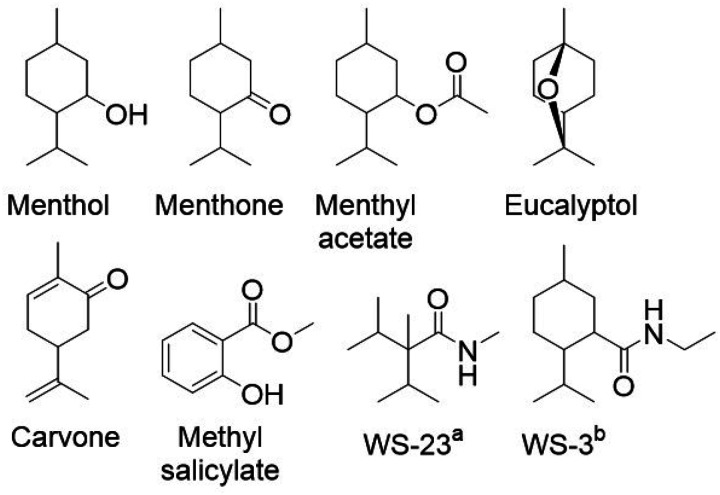 Figure 1
Peer Reviews
No public reviews on file for this paper yet. If you reviewed it on a platform where reviews are public (OpenReview, ICLR, NeurIPS, ICML), you can paste yours below so the community can read it here.
Videos
No videos yet. Explain this paper in a talk, walkthrough, or lecture? Add one.
Taxonomy
TopicsCoffee research and impacts · Ion Channels and Receptors · Smoking Behavior and Cessation