ARHGEF2 Isoform Switching Couples Intestinal Epithelial Barrier Function with Autophagic Response to Pathogens
Shuyuan Chen, Alka Diwaker, Xi Li, Abdulmajeed Salamah, Lei Guo, Neethu S. Alex, Ashutosh Shukla, Mary-Joe Touma, Yassin EL-Najjar, Lin Xu, Jianyi Yin, Ezra Burstein, Marcel Mettlen, Andrew Lemoff, Suraj Patel, Josephine Ni, Hans-Christian Reinecker

TL;DR
This study reveals how a protein isoform switch in intestinal cells connects tissue barrier function to autophagy, a key defense mechanism against pathogens.
Contribution
The paper identifies a novel pathway linking junctional perturbation to autophagy and immune activation via ARHGEF2 isoform switching.
Findings
Conditional deletion of Arhgef2-207 in intestinal epithelium causes barrier loss, autophagy activation, and inflammation.
Infection with Listeria monocytogenes triggers an ARHGEF2 isoform switch, inducing autophagy through STING and LC3.
The isoform switch correlates with loss of Na+/K+-ATPase and epithelial polarity.
Abstract
Maintenance of intestinal epithelial integrity is essential for host defence, yet how epithelial junctional scaffolds connect to antimicrobial autophagy remains unclear. Here we show that distinct isoforms of the guanine nucleotide exchange factor GEF-H1 (mouse Arhgef2-207; human ARHGEF2–219) localize to adherens junctions in polarized intestinal epithelial cells through interaction with the adhesion molecule Nectin-3 and the cytoskeletal scaffold Afadin. Conditional deletion of Arhgef2-207 in the intestinal epithelium induces compensatory expression of the shorter Arhgef2-201, leading to loss of barrier integrity, activation of autophagy, and small-intestinal inflammation. In human intestinal organoids, infection with Listeria monocytogenes selectively targets the junction-associated ARHGEF2–219 isoform, triggering an isoform switch to ARHGEF2-201 and induction of autophagy through…
Genes, proteins, chemicals, diseases, species, mutations and cell lines named across the full text — each resolved to its canonical identifier and authoritative record.
Click any figure to enlarge with its caption.
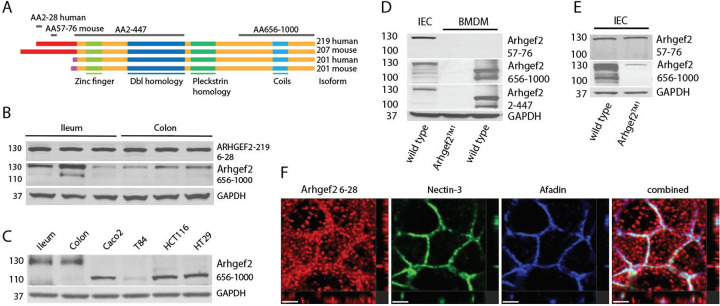 Figure 1
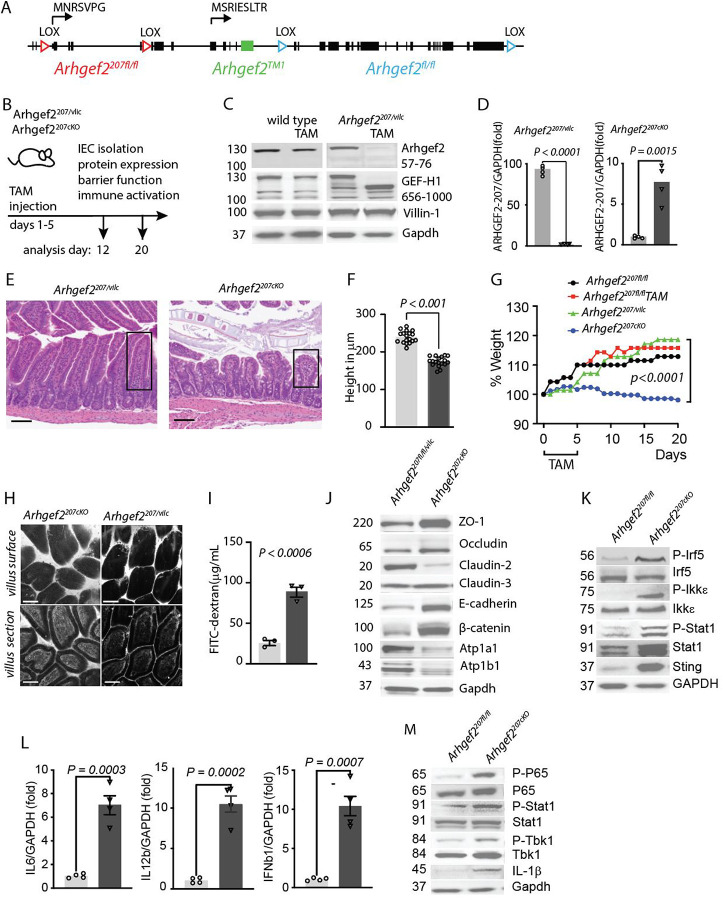 Figure 2
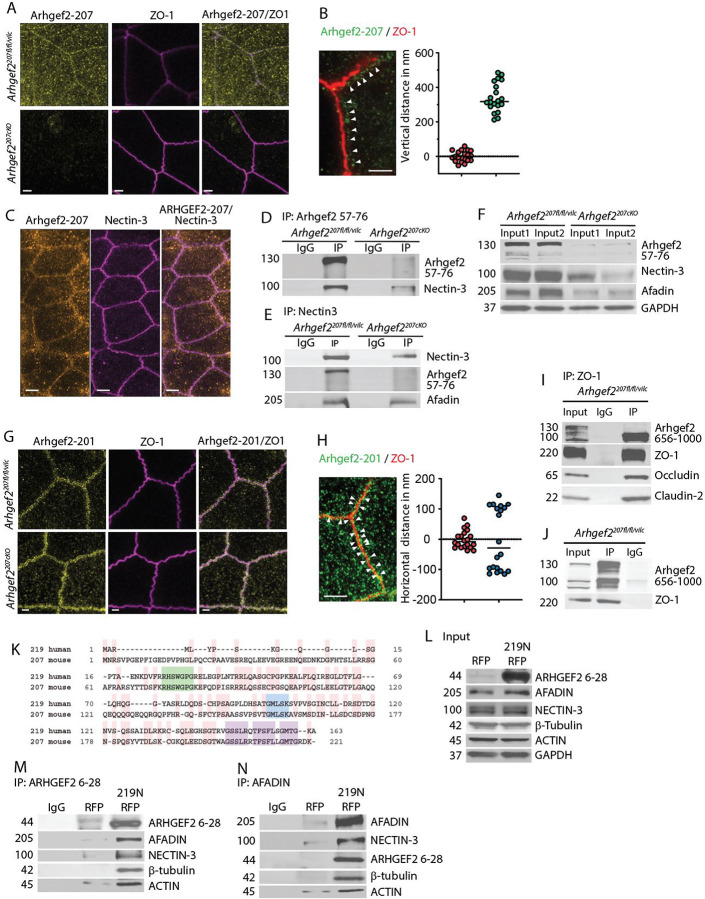 Figure 3
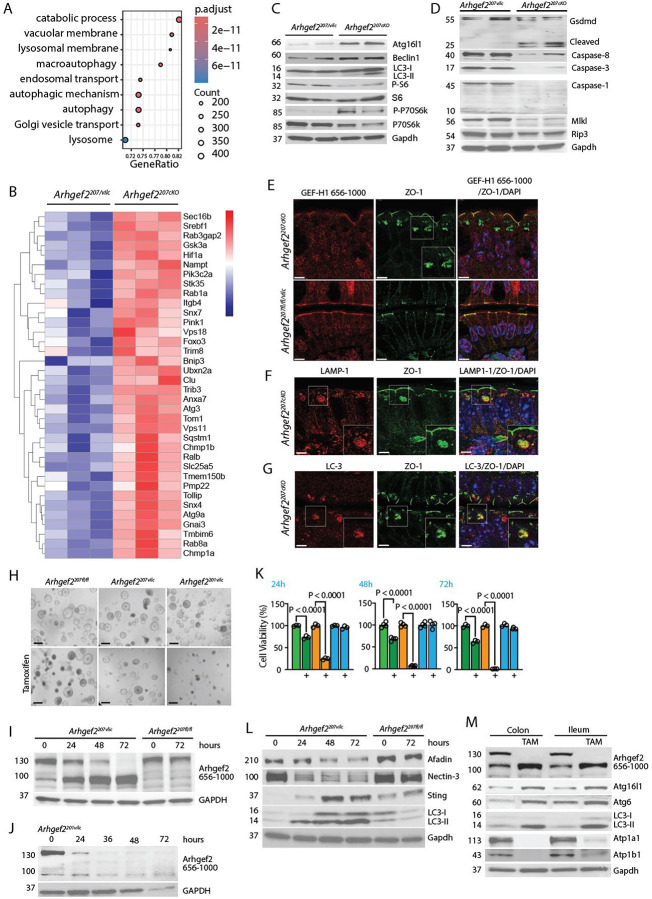 Figure 4
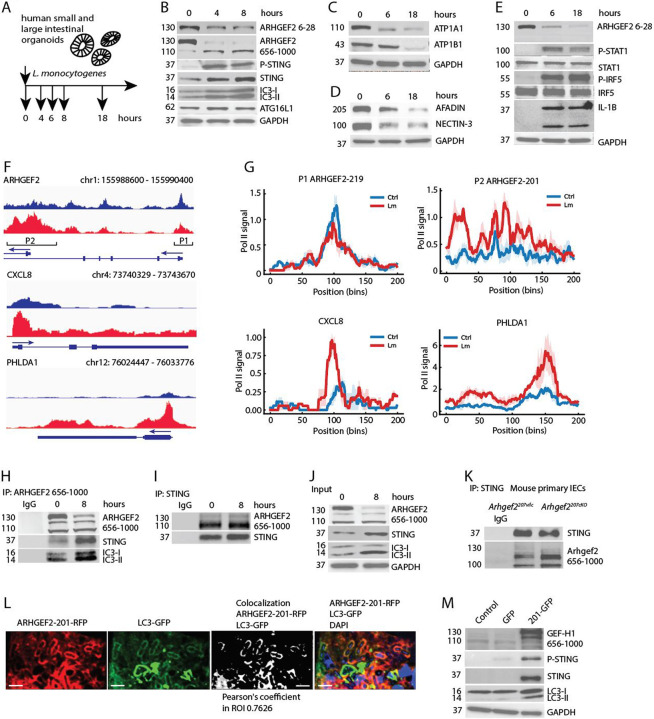 Figure 5
Peer Reviews
No public reviews on file for this paper yet. If you reviewed it on a platform where reviews are public (OpenReview, ICLR, NeurIPS, ICML), you can paste yours below so the community can read it here.
Videos
No videos yet. Explain this paper in a talk, walkthrough, or lecture? Add one.
Taxonomy
Topicsinterferon and immune responses · Autophagy in Disease and Therapy · Endoplasmic Reticulum Stress and Disease