A new LUCApedia database for data-driven research on early evolutionary history
Zahra Nikfarjam, Ishaan Thota, Alireza Nikfarjam, Freya Kailing, Aaron D Goldman

TL;DR
This paper introduces a significantly updated LUCApedia database to support computational research on the early evolution of life.
Contribution
The paper presents a redesigned LUCApedia with 17 datasets mapped onto a common framework for early evolutionary studies.
Findings
The database integrates datasets from previous studies on the last universal common ancestor and its predecessors.
The updated LUCApedia allows users to search, browse, and download data through its web server.
Abstract
Many topics within the study of the origin and early evolution of life are amenable to computational research strategies. Over a decade ago, the original LUCApedia was developed in order to facilitate such research. Here we describe a massively overhauled LUCApedia database and web server. The database is composed of 17 different datasets based on previous studies or published hypotheses about the last universal common ancestor and its evolutionary predecessors. Similar to the original LUCApedia database, these datasets are mapped onto a common framework so that they can be corroborated with one another and used to examine continuity across different stages of early evolution. The database can be searched, browsed, and downloaded from the LUCApedia web server, https://lucapedia.org/.
Genes, proteins, chemicals, diseases, species, mutations and cell lines named across the full text — each resolved to its canonical identifier and authoritative record.
Click any figure to enlarge with its caption.
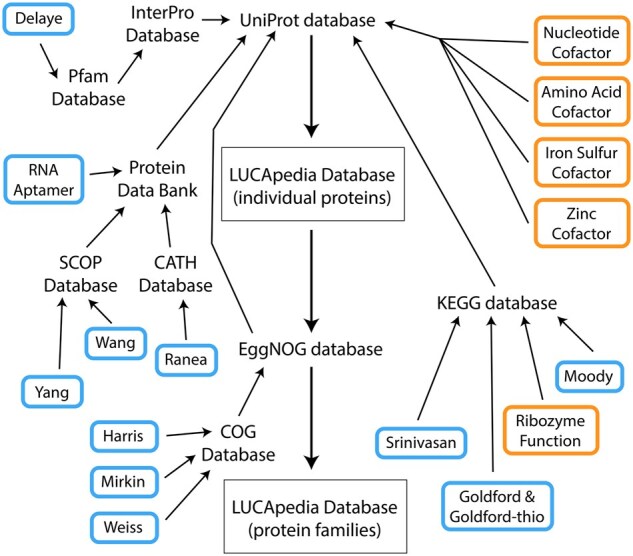 Figure 1
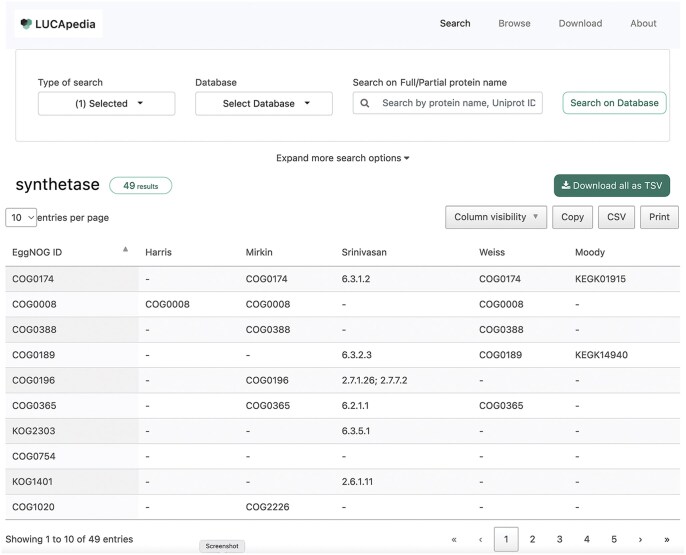 Figure 2
Peer Reviews
No public reviews on file for this paper yet. If you reviewed it on a platform where reviews are public (OpenReview, ICLR, NeurIPS, ICML), you can paste yours below so the community can read it here.
Videos
No videos yet. Explain this paper in a talk, walkthrough, or lecture? Add one.
Taxonomy
TopicsLanguage and cultural evolution · Evolution and Paleontology Studies · Pleistocene-Era Hominins and Archaeology