Colony: a framework for reproducible and easy-to-use data analysis pipelines for biomedical research with singularity containers
Sebastian Eschner, Mohammad Alabdullah, Martin Dugas

TL;DR
Colony is a user-friendly tool that allows biologists to use containerized software without needing command line skills, promoting reproducible biomedical research.
Contribution
The novelty is a graphical interface for Singularity containers, making containerized software accessible to non-programmers in biomedical research.
Findings
Colony provides a graphical user interface for interacting with Singularity containers.
The tool was evaluated for feasibility using software from the TRR156 project.
Colony is freely available and open-source for use and modification.
Abstract
Bioinformatics pipelines should meet the FAIR criteria to enable reproducible analysis. FAIR describes four key requirements for reproducible research: findability, accessibility, interoperability and reusability. Software containers such as Singularity are widely used tools that facilitate the reuse of software across different computing environments. However, many biologists and other researchers find command line tools such as Singularity unfamiliar and do not feel productive when using software via the command line. We present a graphical user interface that allows biologists without programming experience to interact with containerized software. We evaluate the feasibility of our approach with software used at the TRR156. Colony can be freely downloaded on its project page: https://clipc-jpg.github.io/ColonyWebsite/. The Colony launcher’s code is MIT-licensed and freely available…
Click any figure to enlarge with its caption.
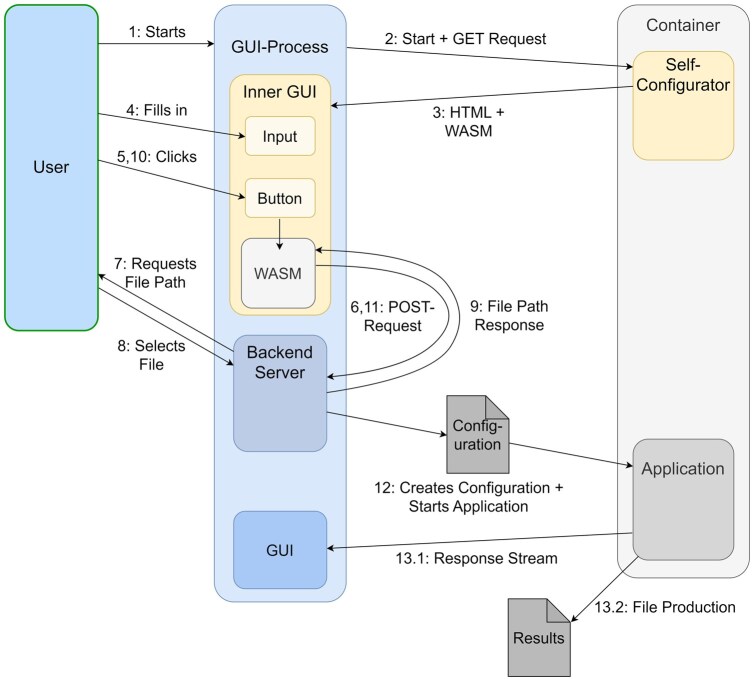 Figure 1
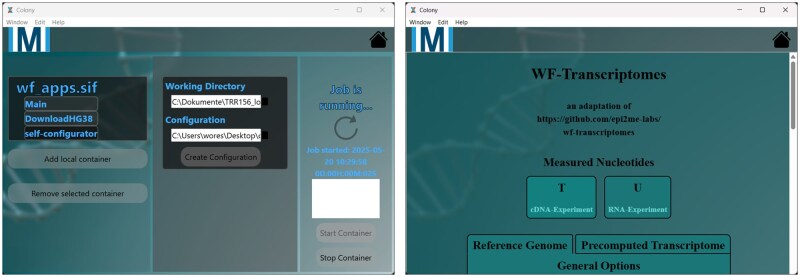 Figure 2
Peer Reviews
No public reviews on file for this paper yet. If you reviewed it on a platform where reviews are public (OpenReview, ICLR, NeurIPS, ICML), you can paste yours below so the community can read it here.
Videos
No videos yet. Explain this paper in a talk, walkthrough, or lecture? Add one.
Taxonomy
TopicsSingle-cell and spatial transcriptomics · Cell Image Analysis Techniques · Gene expression and cancer classification