AI-powered rapid detection of multidrug-resistant Klebsiella pneumoniae with informative peaks of MALDI-TOF MS
Jang-Jih Lu, Chia-Ru Chung, Hsin-Yao Wang, Yun Tang, Ming-Chien Chiang, Li-Ching Wu, Justin Bo-Kai Hsu, Tzong-Yi Lee, Jorng-Tzong Horng

TL;DR
This study uses AI and mass spectrometry to quickly predict antibiotic resistance in Klebsiella pneumoniae, a dangerous bacteria, using interpretable spectral markers.
Contribution
The novel contribution is the development of interpretable machine learning models using MALDI-TOF MS data to predict resistance to specific antibiotics in K. pneumoniae.
Findings
Machine learning models achieved 78.58% accuracy in predicting resistance to ciprofloxacin, cefuroxime, and ceftriaxone in K. pneumoniae isolates.
Resistance-associated m/z signals like 3657, 4341, and others were consistently enriched in resistant isolates, providing interpretable spectral markers.
Model performance was stable over time but declined across hospitals, indicating geographic variability in resistance profiles.
Abstract
Klebsiella pneumoniae is a highly virulent superbug with rising antibiotic resistance worldwide. While matrix-assisted laser desorption/ionization time-of-flight mass spectrometry (MALDI-TOF MS) has transformed microbial identification, its application to antimicrobial resistance prediction remains underexplored, particularly for large clinical cohorts. In this study, we developed machine-learning models with feature-level interpretability using MALDI-TOF MS data to rapidly predict resistance to ciprofloxacin (CIP), cefuroxime (CXM), and ceftriaxone (CRO) in K. pneumoniae. Using more than 28 000 isolates from two hospitals, the best-performing models reached an independent test accuracy of 0.7858, with sensitivity of 0.7289 and specificity of 0.8127. Several resistance-associated m/z signals—including 3657, 4341, 4519, 4709, 5070, 5409, 5921, 5939, and 6516—were consistently enriched…
Genes, proteins, chemicals, diseases, species, mutations and cell lines named across the full text — each resolved to its canonical identifier and authoritative record.
Click any figure to enlarge with its caption.
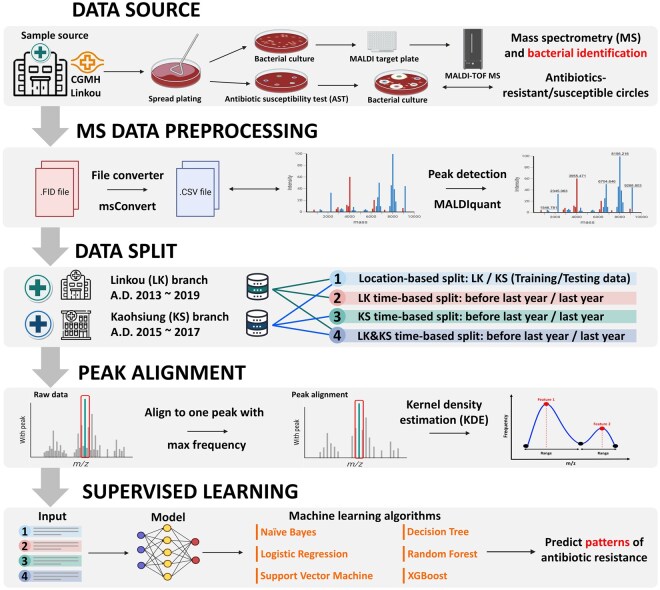 Figure 1
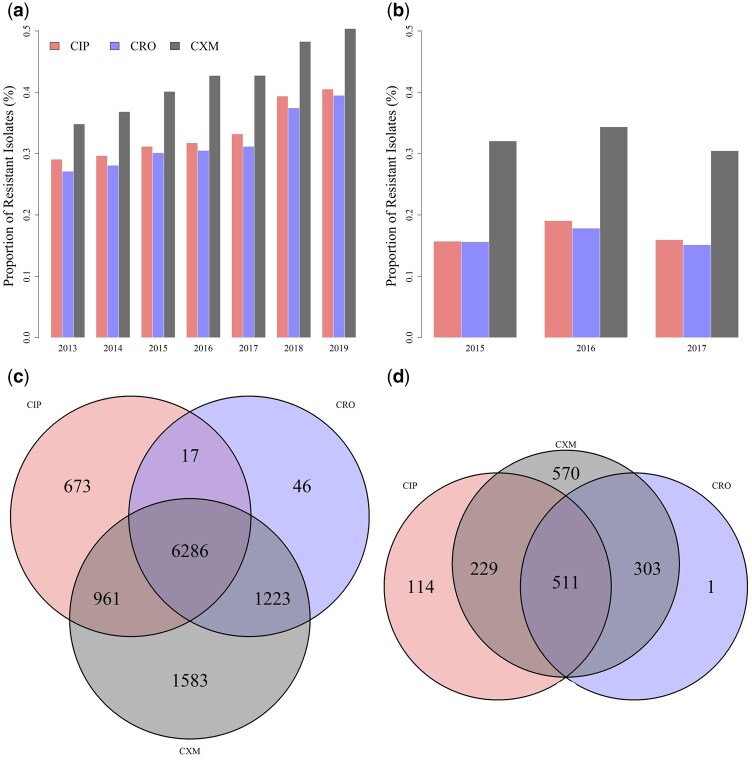 Figure 2
 Figure 3
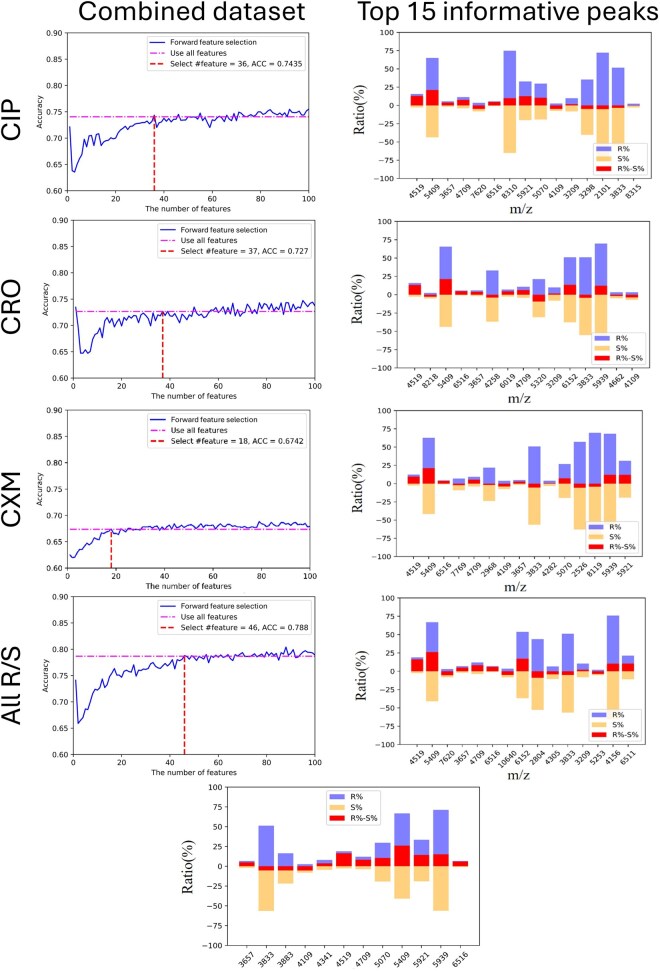 Figure 4
Peer Reviews
No public reviews on file for this paper yet. If you reviewed it on a platform where reviews are public (OpenReview, ICLR, NeurIPS, ICML), you can paste yours below so the community can read it here.
Videos
No videos yet. Explain this paper in a talk, walkthrough, or lecture? Add one.
Taxonomy
TopicsBacterial Identification and Susceptibility Testing · Antibiotic Resistance in Bacteria · Mass Spectrometry Techniques and Applications