Sex, not yeast or atrazine concentration, affects virgin adult Drosophila melanogaster longevity
Rachel A. Tejiram, Pamela C. Lovejoy

TL;DR
This study found that sex, not diet or atrazine exposure, influences the lifespan of fruit flies.
Contribution
The novel finding is that sex, rather than dietary yeast or atrazine concentration, strongly affects longevity in Drosophila.
Findings
Atrazine exposure and yeast concentration did not affect adult Drosophila longevity.
Male flies had greater survival than females, indicating a strong sex effect.
Dietary yeast and atrazine did not alter lifespan despite prior assumptions.
Abstract
In Drosophila melanogaster , the herbicide atrazine is known to alter longevity, accelerate development time, and cause modifications in protein production and gene expression related to oxidative stress. A low protein diet can affect fecundity and increase lifespan in flies. The present study investigated if and how different concentrations of dietary yeast, the main protein source for lab-reared flies, affect the lifespan of D. melanogaster exposed to atrazine. Atrazine exposure and yeast concentration did not affect adult longevity; however, there was a strong sex effect in that males displayed greater survival than females.
Genes, proteins, chemicals, diseases, species, mutations and cell lines named across the full text — each resolved to its canonical identifier and authoritative record.
Click any figure to enlarge with its caption.
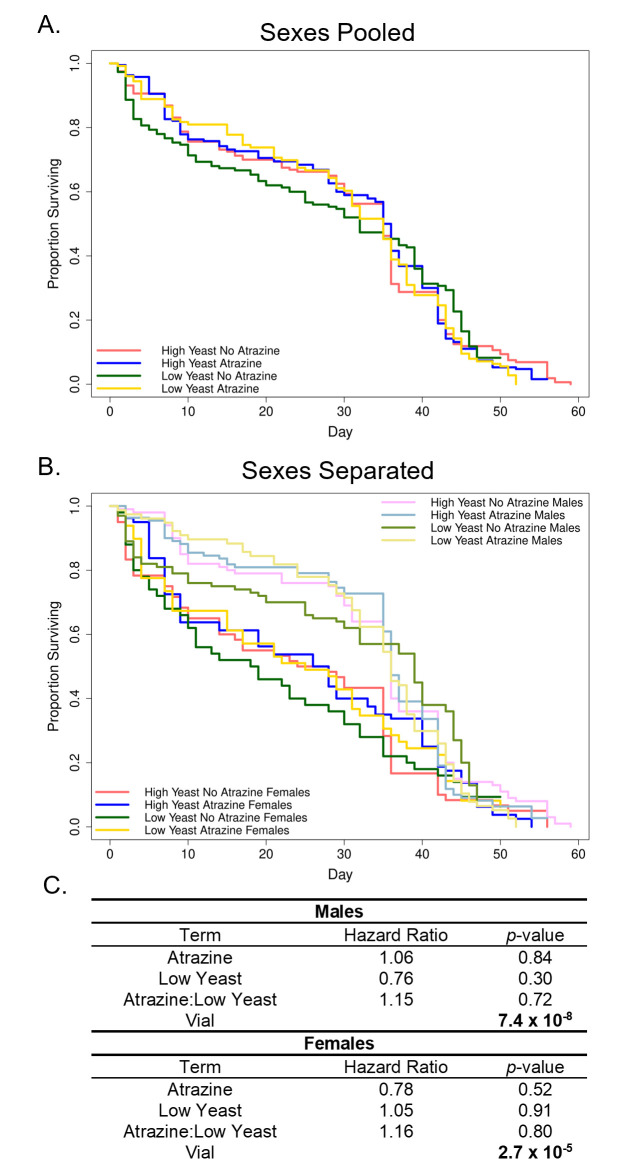 Figure 1
Peer Reviews
No public reviews on file for this paper yet. If you reviewed it on a platform where reviews are public (OpenReview, ICLR, NeurIPS, ICML), you can paste yours below so the community can read it here.
Videos
No videos yet. Explain this paper in a talk, walkthrough, or lecture? Add one.
Taxonomy
TopicsEnvironmental Toxicology and Ecotoxicology · Pesticide and Herbicide Environmental Studies · Genetics, Aging, and Longevity in Model Organisms