Perceived stress precedes declines in Well-being: A prospective study of stress, well-being, hair cortisol, and low-grade inflammation in hospital employees
Monica T. Jones, Rachael A. Cronin, Mathew D. Marques, Matthias Weigl, Nicolas Rohleder, Linda Becker, Helena C. Kaltenegger, Bradley J. Wright

TL;DR
This study finds that higher perceived stress in hospital employees predicts lower well-being six months later, but not changes in stress or inflammation markers.
Contribution
This is the first prospective study to examine the temporal links between stress, well-being, hair cortisol, and inflammation in hospital employees.
Findings
Increases in perceived stress predicted later decreases in well-being.
No causal links were found between stress or well-being and hair cortisol or C-reactive protein.
Well-being declined for nearly half of participants over six months.
Abstract
Chronic low-grade inflammation may help explain the relationship between stress, well-being, and disease, but the pathway and temporal order have not yet been tested prospectively. To understand the pathways between perceived stress, well-being, C-reactive protein, and hair cortisol, we investigated the temporal ordering of these variables in a sample of hospital employees. Random-intercepts cross-lagged panel models were conducted using three 6-monthly waves of data collected from new employees at a German hospital (N = 296, 77.7 % female, M age = 28.59) in a prospective cohort study. Self-reported data on perceived stress and well-being, hair strands for hair cortisol concentration, and capillary blood samples for C-reactive protein were collected for analysis. While our study did not support a causal relationship between changes in stress levels and later changes in either hair…
Genes, proteins, chemicals, diseases, species, mutations and cell lines named across the full text — each resolved to its canonical identifier and authoritative record.
Click any figure to enlarge with its caption.
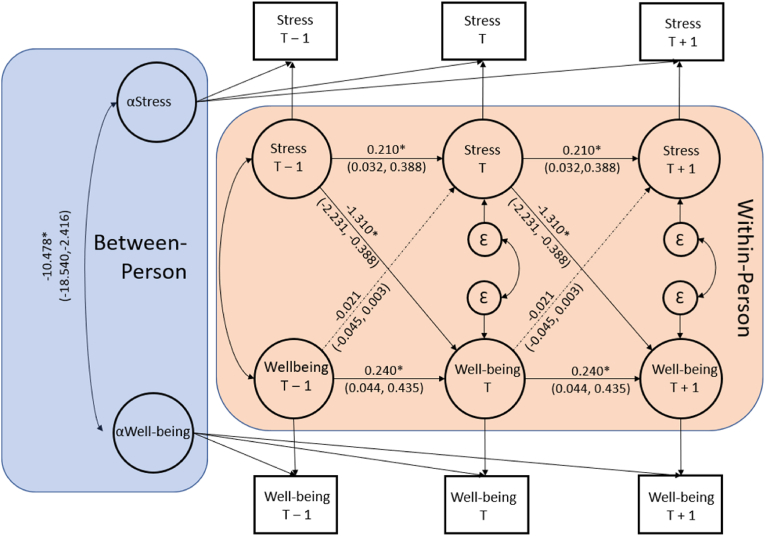 Figure 1
Peer Reviews
No public reviews on file for this paper yet. If you reviewed it on a platform where reviews are public (OpenReview, ICLR, NeurIPS, ICML), you can paste yours below so the community can read it here.
Videos
No videos yet. Explain this paper in a talk, walkthrough, or lecture? Add one.
Taxonomy
TopicsStress Responses and Cortisol · Dermatology and Skin Diseases · Tryptophan and brain disorders