Standardized Mortality Ratio and Long-Term Stroke Incidence After PFO Closure: A Register Study
Maria Angerbjörn, Bengt Johansson, Elisabeth Hahlin, Daniel Rinnström, Camilla Sandberg, Christina Christersson, Peder Sörensson, Mikael Dellborg, Ulf Thilén, Signild Åsberg, Johanna Pennlert

TL;DR
This study finds that PFO closure is linked to lower mortality and identifies new risk factors for future strokes.
Contribution
The study provides real-world long-term data on PFO closure outcomes and identifies modifiable stroke risk factors.
Findings
PFO closure was associated with a 35% lower mortality rate compared to the general population.
New-onset atrial fibrillation after PFO closure significantly increased stroke risk.
Smoking was identified as a modifiable risk factor for subsequent ischemic stroke.
Abstract
Closure of a patent foramen ovale (PFO) is frequently recommended in patients with cryptogenic stroke. Long-term outcomes in real-world settings remain unknown. This study analyzed standardized mortality ratio (SMR), subsequent stroke, and associated risk factors after PFO closure. National registers on congenital heart disease and stroke were cross-linked to identify individuals who underwent PFO closure between 2001 and 2018. The ratio of observed to expected deaths was calculated (SMR). Data were analyzed using survival analysis and Cox regression. A total of 827 patients (60.5% males, median age 47.9 years, IQR: 40.0-55.6 at the time of PFO closure) were included and observed for a median duration of 8.0 years (IQR: 4.8-11.0). During follow-up, 23 patients died, SMR was 0.65 (95% CI: 0.41-0.98). A total of 34 ischemic strokes occurred, yielding an incidence rate of 0.51 events…
Genes, proteins, chemicals, diseases, species, mutations and cell lines named across the full text — each resolved to its canonical identifier and authoritative record.
Click any figure to enlarge with its caption.
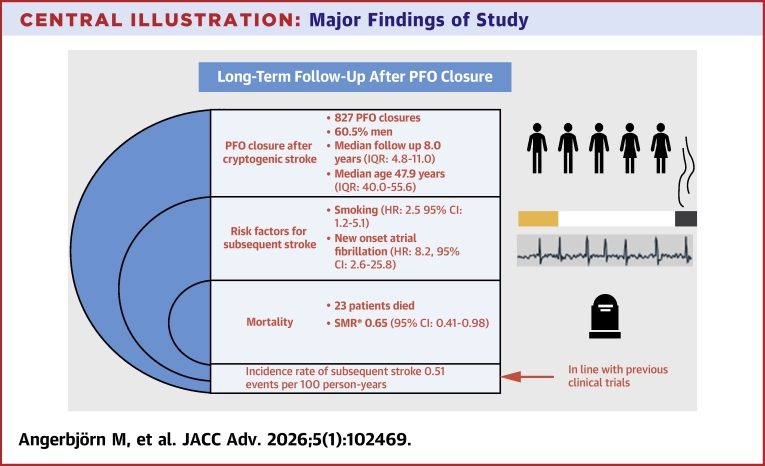 Figure 1
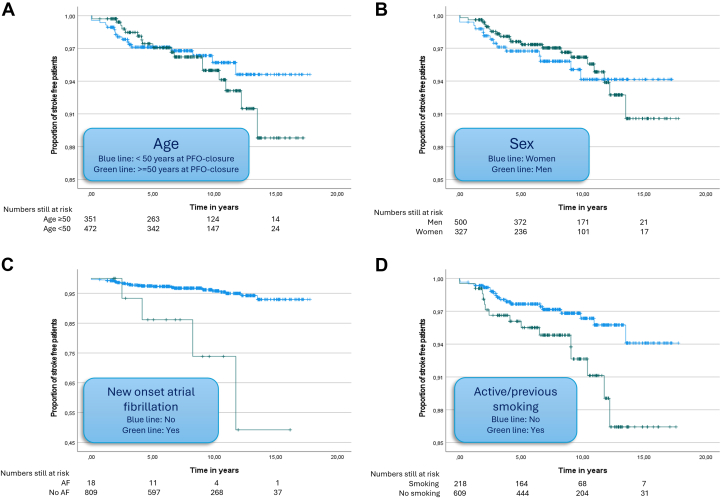 Figure 2
 Figure 3
Peer Reviews
No public reviews on file for this paper yet. If you reviewed it on a platform where reviews are public (OpenReview, ICLR, NeurIPS, ICML), you can paste yours below so the community can read it here.
Videos
No videos yet. Explain this paper in a talk, walkthrough, or lecture? Add one.
Taxonomy
TopicsCardiovascular and Diving-Related Complications · Aortic aneurysm repair treatments · Aortic Disease and Treatment Approaches