Betaherpesvirus Incidence in Saliva Samples From Patients With Hematological Neoplasms: Frequency, Clinic and Diagnostic Insights
Ana Carolina Silva Guimarães, Jéssica Pereira Gonçalves, Nathália de Sousa Pereira, Flávia Freitas de Oliveira Bonfim, Katrini Guidolini Martinelli, Marla Karine Amarante, Sueli Fumie Yamada‐Ogatta, Laura Cinquini Franco, Ligia Carla Faccin Galhardi, Vanessa Salete de Paula

TL;DR
This study found that betaherpesviruses, especially HHV-7, are more commonly detected in saliva samples from patients with blood cancers compared to healthy controls.
Contribution
The study provides new insights into the frequency and clinical relevance of betaherpesviruses in hematological neoplasms.
Findings
HHV-7 was detected in 15.8% of patients with hematological neoplasms compared to 8.8% in controls.
HCMV detection showed a significant difference between patients with Hodgkin lymphoma and multiple myeloma.
The presence of betaherpesviruses in saliva was more frequent in patients with hematologic malignancies.
Abstract
Hematological neoplasms (HN) are disorders originating in blood cells that hold significant epidemiological importance. Treatments available for these conditions can induce immunosuppression, and it increases the risk of viral infections and reactivations, mainly by Human betaherpesviruses (HCMV, HHV‐6, and HHV‐7). Studies have suggested that these viruses play potential oncogenic role in hematological neoplasms, although results remain inconclusive. This study aimed to evaluate the frequency and viral load of betaherpesviruses in saliva samples from patients with hematological neoplasms, and to explore their relevance to clinicopathological characteristics. In total, 260 saliva samples collected from patients with Hodgkin lymphoma (HL) (n = 29), non‐Hodgkin lymphoma (NHL) (n = 106), leukemia (n = 85) and multiple myeloma (MM) (n = 40) were analyzed in multiplex qPCR. The result was…
Genes, proteins, chemicals, diseases, species, mutations and cell lines named across the full text — each resolved to its canonical identifier and authoritative record.
Click any figure to enlarge with its caption.
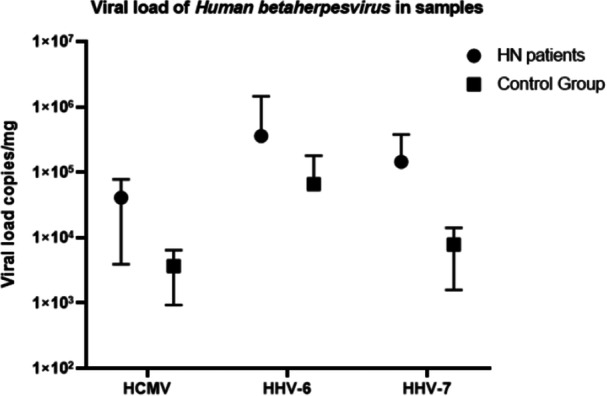 Figure 1
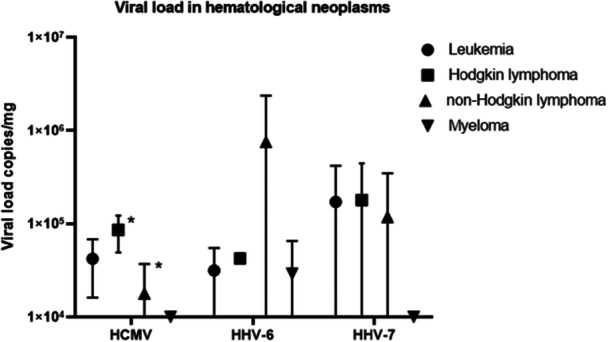 Figure 2
Peer Reviews
No public reviews on file for this paper yet. If you reviewed it on a platform where reviews are public (OpenReview, ICLR, NeurIPS, ICML), you can paste yours below so the community can read it here.
Videos
No videos yet. Explain this paper in a talk, walkthrough, or lecture? Add one.
Taxonomy
TopicsViral-associated cancers and disorders · Cytomegalovirus and herpesvirus research · Head and Neck Cancer Studies