Evaluation of Midwife‐Led Colposcopy for Female Genital Schistosomiasis Screening at Primary Level of Care in Rural Madagascar: A Cross‐Sectional Study
Pia Rausche, Jean‐Marc Kutz, Zoly Rakotomalala, Bodo Sahondra Randrianasolo, Paule Donven, Rivo Solotiana Rakotomalala, Alexina Olivasoa Tsiky Zafinimampera, Olivette Totofotsy, Sonya Ratefiarisoa, Ravo Razafindrakoto, Nantenaina Matthieu Razafindralava

TL;DR
Midwives in rural Madagascar can effectively detect genital schistosomiasis with high accuracy, but their results vary depending on training and environment.
Contribution
This study evaluates midwife-led colposcopy for genital schistosomiasis in low-resource settings, showing its feasibility with needed quality measures.
Findings
Midwife-led colposcopy showed high sensitivity (96.4%) but low specificity (28.7%) for detecting genital schistosomiasis.
Midwife experience and healthcare environment significantly influenced diagnostic accuracy and agreement with gynaecologists.
The study suggests midwife-led screening is feasible but requires quality assurance to ensure reliable results.
Abstract
Female genital schistosomiasis is a condition with a complex diagnosis and severe consequences such as infertility. In the absence of a reliable biomarker, in endemic settings the World Health Organization recommends colposcopy as a diagnostic tool for the detection of female genital schistosomiasis lesions. Nevertheless, it is seldom performed in low‐resource contexts due to a lack of expertise or insufficient infrastructure. This study aims to assess Female Genital Schistosomiasis colposcopy at the primary level of care, evaluating its diagnostic accuracy in reference to gynaecologist diagnosis in a highly endemic context. This is a secondary analysis of a cross‐sectional study conducted in the Boeny region of Madagascar, which collected colposcopy images and Female Genital Schistosomiasis decision at the primary health care level with re‐evaluation by gynaecologists. Statistical…
Genes, proteins, chemicals, diseases, species, mutations and cell lines named across the full text — each resolved to its canonical identifier and authoritative record.
Click any figure to enlarge with its caption.
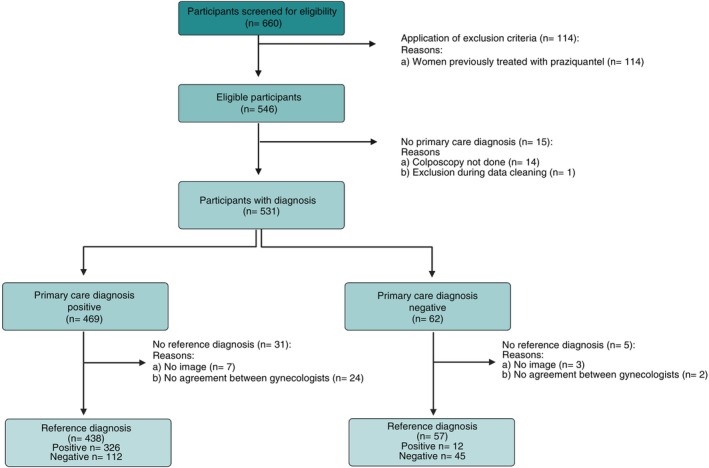 Figure 1
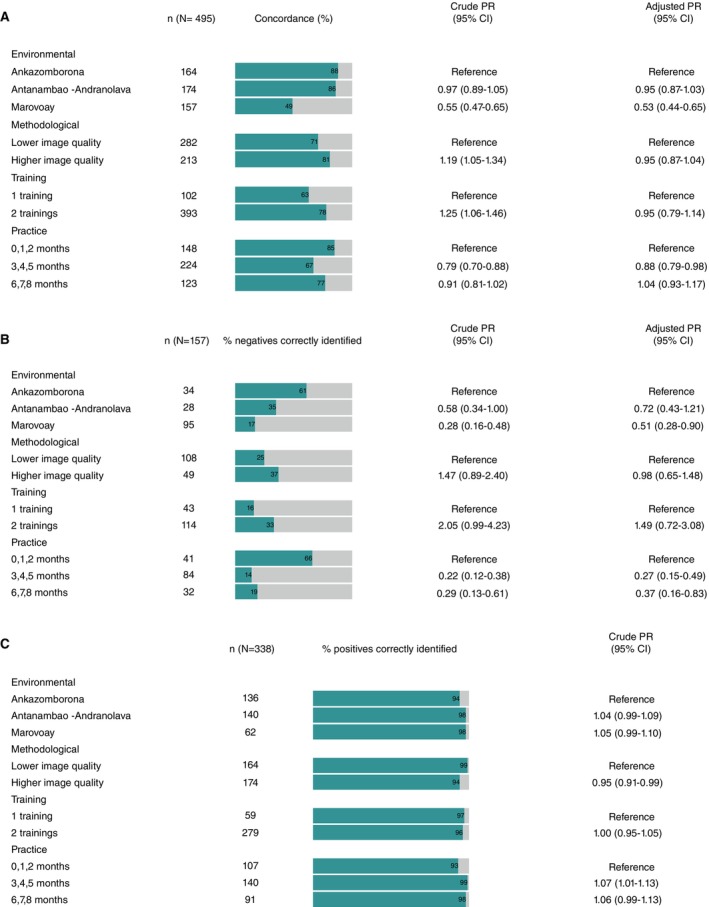 Figure 2
Peer Reviews
No public reviews on file for this paper yet. If you reviewed it on a platform where reviews are public (OpenReview, ICLR, NeurIPS, ICML), you can paste yours below so the community can read it here.
Videos
No videos yet. Explain this paper in a talk, walkthrough, or lecture? Add one.
Taxonomy
TopicsParasites and Host Interactions · Reproductive tract infections research · Global Maternal and Child Health