Statistical Evidence for Bimodal Age Distribution in Pediatric Orchiopexy: Support for Congenital and Acquired Cryptorchidism Subtypes
Kensuke Ohashi, Shinsuke Yoshizawa, Keita Kogure

TL;DR
This study finds evidence that the age distribution of orchiopexy surgeries in children is bimodal, suggesting two possible subtypes of cryptorchidism.
Contribution
The study provides statistical evidence for a bimodal age distribution in pediatric orchiopexy, supporting the hypothesis of congenital and acquired cryptorchidism subtypes.
Findings
The dip test rejected unimodality with strong statistical significance.
Gaussian mixture modeling identified two distinct age components for orchiopexy procedures.
A bimodal age distribution was confirmed with an intersection point at 3.8 years.
Abstract
Objective: This study aims to characterize the age distribution of orchiopexy procedures and assess whether bimodal patterns exist that may correlate with hypothesized congenital and acquired cryptorchidism subtypes. Materials and methods: We analyzed age-at-orchiopexy data from 659 consecutive patients (ages zero to 18 years) at a single tertiary pediatric center. Bimodality was assessed using (1) Hartigan's dip test for unimodality, (2) kernel density estimation with bootstrap mode stability analysis, and (3) Gaussian mixture modeling with information criterion-based model selection. Results: The dip test decisively rejected unimodality (dip = 0.134, p < 0.001). Gaussian mixture modeling strongly favored a two-component model over unimodal (ΔBIC = 407.7). The optimal model identified an early component (mean = 1.31 years, SD = 0.80, weight = 54.2%) and a late component (mean = 6.28…
Genes, proteins, chemicals, diseases, species, mutations and cell lines named across the full text — each resolved to its canonical identifier and authoritative record.
Click any figure to enlarge with its caption.
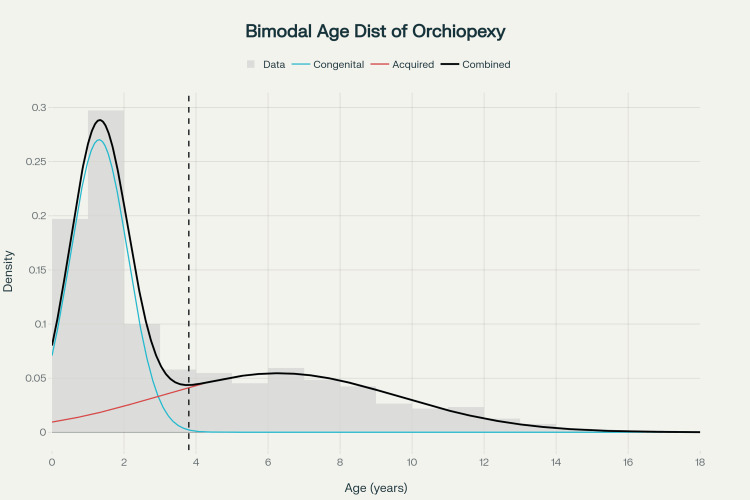 Figure 1
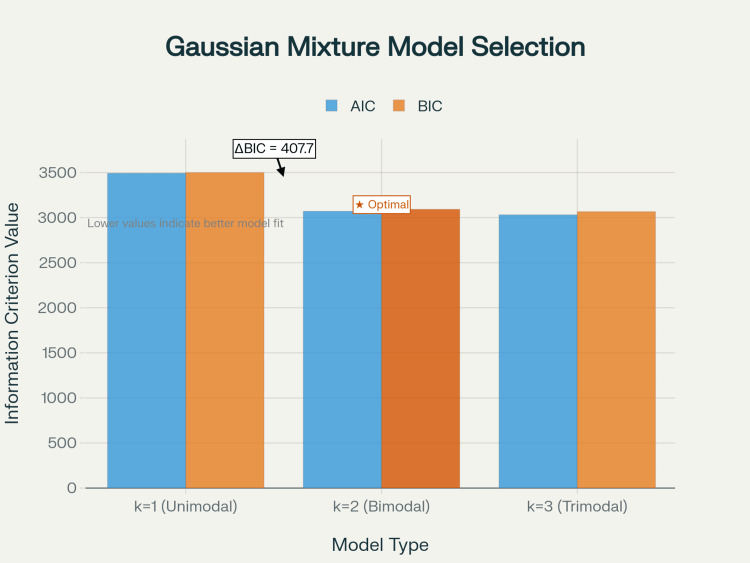 Figure 2
Peer Reviews
No public reviews on file for this paper yet. If you reviewed it on a platform where reviews are public (OpenReview, ICLR, NeurIPS, ICML), you can paste yours below so the community can read it here.
Videos
No videos yet. Explain this paper in a talk, walkthrough, or lecture? Add one.
Taxonomy
TopicsTesticular diseases and treatments · Urological Disorders and Treatments · Pelvic floor disorders treatments