Preliminary Findings From an Augmented Reality (AR) App Delivering Recovery‐Oriented Cognitive Therapy for Negative Symptoms in Schizophrenia
Sunny X. Tang, Moein Foroughi, Aaron P. Brinen, Michael L. Birnbaum, Sarah A. Berretta, Leily M. Behbehani, John M. Kane, Edward Yoon, William F. Cronin

TL;DR
A new AR app called NST-SPARK was tested for helping people with schizophrenia by improving their negative symptoms through recovery-focused therapy.
Contribution
The study introduces a novel AR-based digital therapeutic prototype for schizophrenia negative symptoms and evaluates its feasibility and acceptability.
Findings
NST-SPARK was found to be feasible and acceptable to participants with schizophrenia spectrum disorders.
Participants showed improvements in defeatist beliefs, self-esteem, and attitudes toward goal-oriented activities.
Most participants used the app independently and made progress toward their goals in 90% of cases.
Abstract
NST‐SPARK is a novel digital therapeutic targeting negative symptoms in schizophrenia spectrum disorders (SSD). It is a smartphone application delivering recovery‐oriented cognitive therapy (CT‐R), via gamified augmented reality (AR) experiences. The primary objective was to determine the acceptability and feasibility of a single‐session prototype. Secondary objectives were to generate descriptive findings for changes in defeatist beliefs, self‐esteem and attitudes toward goal‐oriented activities. Twenty participants with schizophrenia or schizoaffective disorder enrolled. Participants completed self‐reports on the acceptability and feasibility of NST‐SPARK v.1.5 and provided open‐ended feedback. Self‐report scales on defeatist beliefs, self‐esteem and attitudes toward goal‐oriented activities were completed before and after participants were introduced to NST‐SPARK, and at 1‐week…
Genes, proteins, chemicals, diseases, species, mutations and cell lines named across the full text — each resolved to its canonical identifier and authoritative record.
Click any figure to enlarge with its caption.
 Figure 1
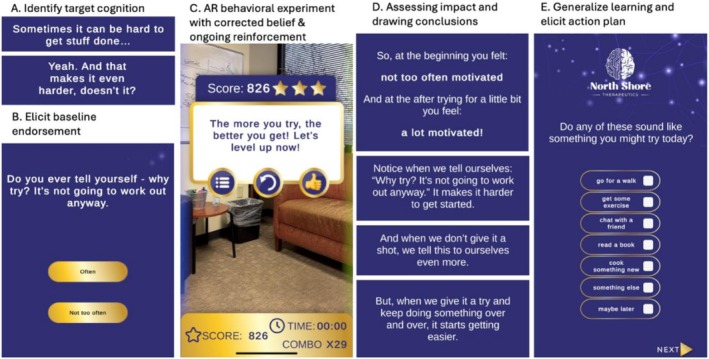 Figure 2
Peer Reviews
No public reviews on file for this paper yet. If you reviewed it on a platform where reviews are public (OpenReview, ICLR, NeurIPS, ICML), you can paste yours below so the community can read it here.
Videos
No videos yet. Explain this paper in a talk, walkthrough, or lecture? Add one.
Taxonomy
TopicsSchizophrenia research and treatment · Digital Mental Health Interventions · Mental Health and Patient Involvement