Integrative analysis of AT classification, plasma biomarkers, and cognitive trajectories across diverse dementia syndromes
Jihwan Yun, Min Young Chun, Henrik Zetterberg, Kaj Blennow, Fernando Gonzalez-Ortiz, Nicholas J. Ashton, Daeun Shin, Soyeon Yoon, Heejin Yoo, Jun Pyo Kim, Hongki Ham, Yuna Gu, Hee Jin Kim, Seung Hwan Moon, Hanna Cho, Jae Yong Choi, Byung Hyun Byun, Su Yeon Park, Jeong Ho Ha

TL;DR
This study compares how amyloid and tau brain changes, blood markers, and cognitive decline differ across types of dementia.
Contribution
The study reveals distinct biomarker and cognitive patterns in Alzheimer's, vascular, and frontotemporal dementia across amyloid-tau stages.
Findings
SVCI and FTD show more advanced clinical stages than ADCI at similar amyloid-tau stages.
SVCI and FTD have higher plasma biomarkers and faster cognitive decline than controls in early amyloid-tau stages.
ADCI shows faster decline than controls only in later amyloid-tau stages.
Abstract
This study aimed to examine amyloid-β (Aβ) and tau (AT) biological stages, plasma biomarkers, and cognitive trajectories according to AT stages in Alzheimer’s disease-related cognitive impairment (ADCI), subcortical vascular cognitive impairment (SVCI), and frontotemporal dementia (FTD). A total of 275 participants (42 cognitively unimpaired [CU], 132 ADCI, 73 SVCI, and 28 FTD) underwent Aβ and tau positron emission tomography for assessment of AT stages. Participants with cognitive impairment (ADCI, SVCI, and FTD) were classified according to clinical stages of mild cognitive impairment or dementia. Plasma biomarkers were analysed, and cognitive trajectories were assessed using mixed-effects models over 6.1 years. SVCI and FTD showed more advanced clinical stages than ADCI at equivalent AT stages. SVCI participants had higher plasma glial fibrillary acidic protein (P = 0.012) and…
Genes, proteins, chemicals, diseases, species, mutations and cell lines named across the full text — each resolved to its canonical identifier and authoritative record.
Click any figure to enlarge with its caption.
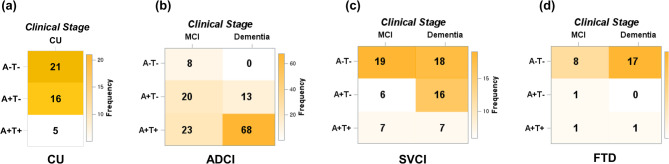 Figure 1
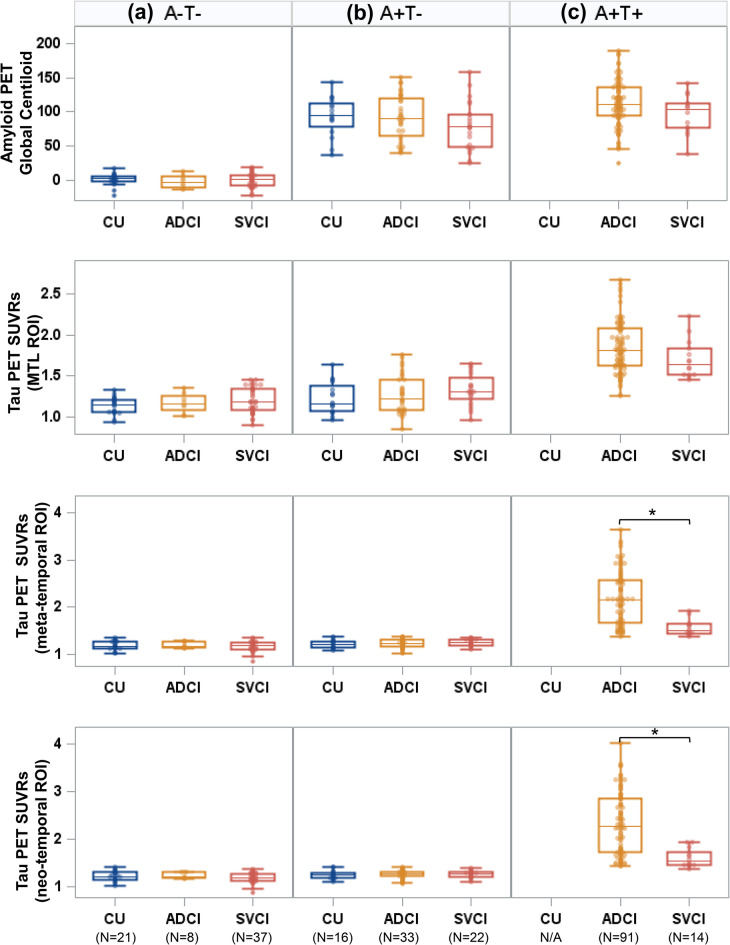 Figure 2
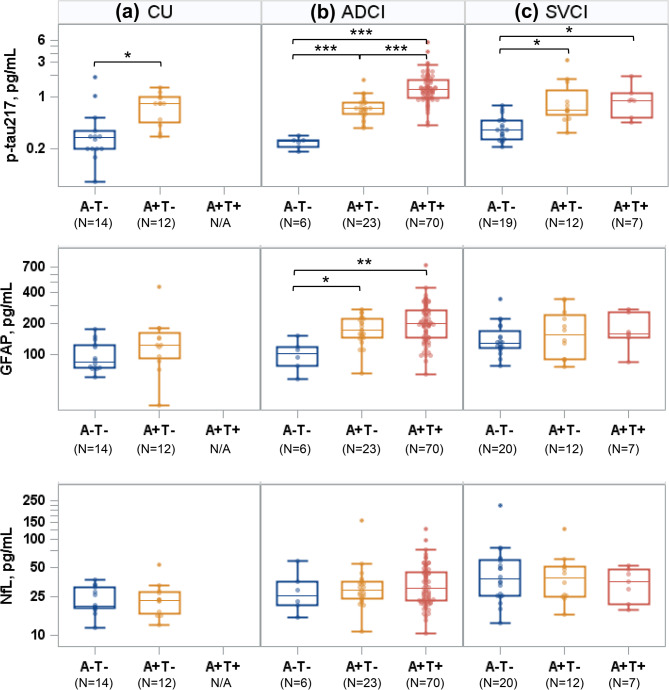 Figure 3
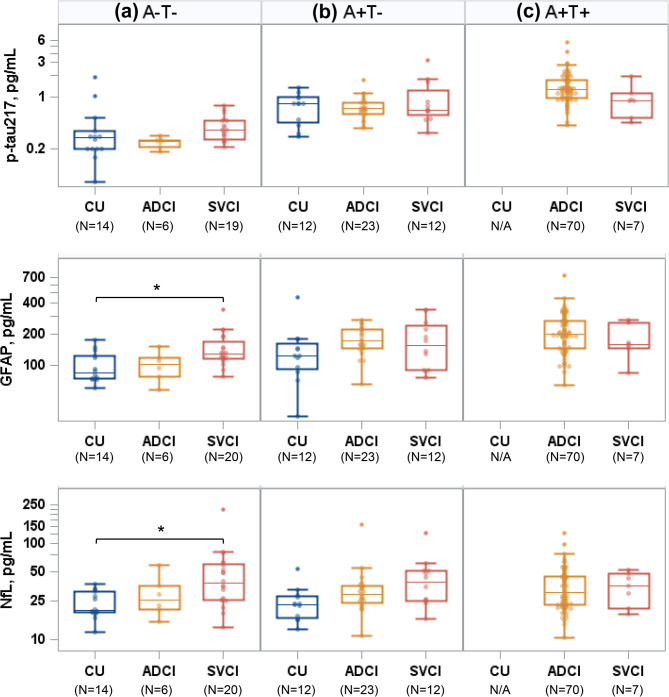 Figure 4
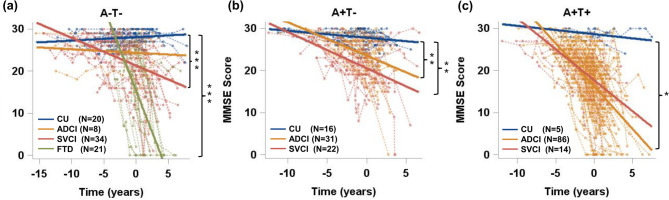 Figure 5
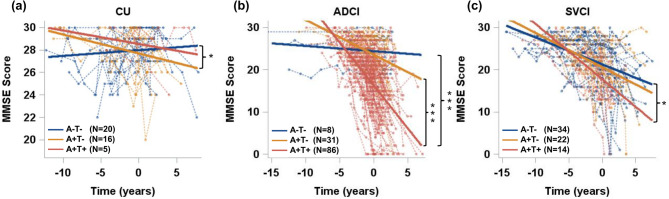 Figure 6
Peer Reviews
No public reviews on file for this paper yet. If you reviewed it on a platform where reviews are public (OpenReview, ICLR, NeurIPS, ICML), you can paste yours below so the community can read it here.
Videos
No videos yet. Explain this paper in a talk, walkthrough, or lecture? Add one.
Taxonomy
TopicsDementia and Cognitive Impairment Research · Alzheimer's disease research and treatments · Neurological Disease Mechanisms and Treatments