Early detection and management of mesenteric traction syndrome using the hypotension prediction index: a case report
Rui Yajima, Takayuki Sugai, Kei Inoue, Takashi Ouchi, Toshiya Koitabashi

TL;DR
A case report shows how an AI-based system detected early signs of a rare surgical complication before severe symptoms occurred.
Contribution
Demonstrates the use of hypotension prediction index for early detection of mesenteric traction syndrome during surgery.
Findings
The hypotension prediction index detected early vasodilatory changes before visible symptoms of MTS occurred.
Timely intervention with phenylephrine and colloid infusions prevented severe hypotension in the patient.
Facial flushing confirmed the diagnosis, and flurbiprofen helped stabilize circulation.
Abstract
Mesenteric traction syndrome (MTS) is a transient circulatory disturbance characterized by sudden hypotension, tachycardia, and facial flushing following mesenteric manipulation during abdominal surgery. Early recognition is essential; however, conventional monitoring often detects these events only after hemodynamic deterioration. We report a 68-year-old man who underwent distal pancreatectomy and splenectomy under combined general and thoracic epidural anesthesia. Sixteen minutes after the start of surgery, the hypotension prediction index (HPI)—an artificial intelligence–based monitoring system—abruptly increased to > 85 despite stable vital signs. The systemic vascular resistance index decreased, suggesting early vasodilatory change. Prompt intravenous phenylephrine boluses were administered, and rapid colloid infusions were initiated to minimize hypotension. Recognition of facial…
Genes, proteins, chemicals, diseases, species, mutations and cell lines named across the full text — each resolved to its canonical identifier and authoritative record.
Click any figure to enlarge with its caption.
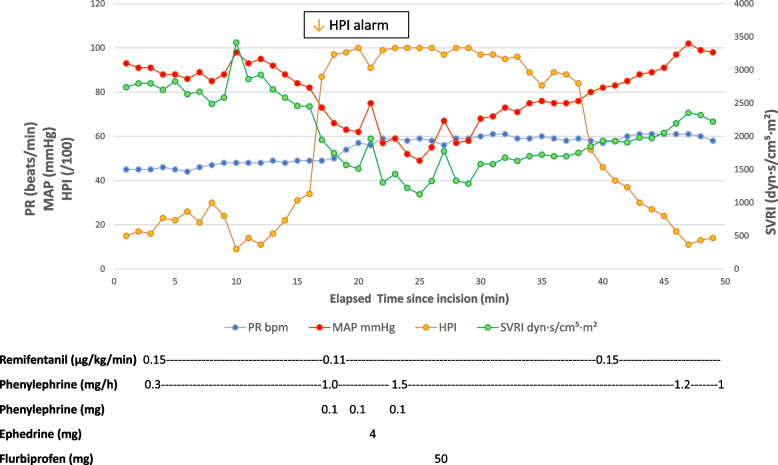 Figure 1
Peer Reviews
No public reviews on file for this paper yet. If you reviewed it on a platform where reviews are public (OpenReview, ICLR, NeurIPS, ICML), you can paste yours below so the community can read it here.
Videos
No videos yet. Explain this paper in a talk, walkthrough, or lecture? Add one.
Taxonomy
TopicsHemodynamic Monitoring and Therapy · Abdominal Surgery and Complications · Abdominal vascular conditions and treatments