Exiting the ground state: the broad spectrum of cell fates accessible from naïve human pluripotent stem cells
Kyoung-mi Park, Richard Yin, Thorold W. Theunissen

TL;DR
This paper shows that naïve human pluripotent stem cells can differentiate into a wide range of cell types, including those found in early embryos and extraembryonic tissues.
Contribution
The study highlights the expanded lineage potential of naïve hPSCs and their ability to form blastoid structures resembling pre-implantation embryos.
Findings
Naïve hPSCs can differentiate into embryonic and extraembryonic cell fates.
They can self-organize into blastoid structures that model all three pre-implantation lineages.
These cells can be cultured to post-implantation stages, demonstrating broad developmental potential.
Abstract
Naïve human pluripotent stem cells (hPSCs) represent an in vitro analog of the pre-implantation epiblast – the founder tissue of the embryo proper. A widely held assumption, based on prior studies in the mouse system, was that naïve hPSCs are restricted in their differentiation potential toward more mature stages of epiblast development, as a prelude to gastrulation. However, over the past 5 years, a growing body of literature has demonstrated that naïve hPSCs have an expanded lineage potential toward a broad range of embryonic and extraembryonic fates and can even be used as a starting point for generating 8-cell-like cells. The most emphatic demonstration of the broad lineage potential of naïve hPSCs is their remarkable capacity to self-organize into blastocyst-like structures (“blastoids”) that model all three lineages of the pre-implantation embryo and can be cultured to…
Genes, proteins, chemicals, diseases, species, mutations and cell lines named across the full text — each resolved to its canonical identifier and authoritative record.
Click any figure to enlarge with its caption.
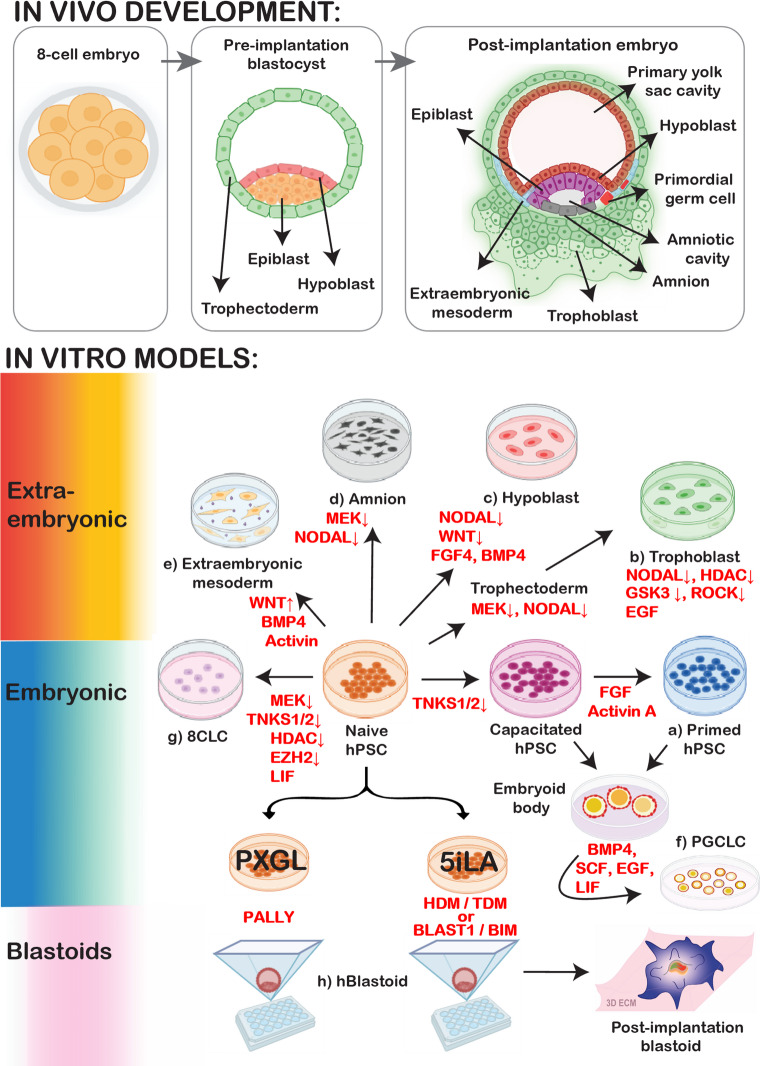 Figure 1
Peer Reviews
No public reviews on file for this paper yet. If you reviewed it on a platform where reviews are public (OpenReview, ICLR, NeurIPS, ICML), you can paste yours below so the community can read it here.
Videos
No videos yet. Explain this paper in a talk, walkthrough, or lecture? Add one.
Taxonomy
TopicsPluripotent Stem Cells Research · Reproductive Biology and Fertility · CRISPR and Genetic Engineering