Clonal outbreak of an extensively drug-resistant NDM-1 producing Pseudomonas aeruginosa in a local hospital in the Czech Republic
Katerina Chudejova, Tsolaire Sourenian, Marc Finianos, Anna Sramkova, Costas C. Papagiannitsis, Jaroslav Hrabak, Ibrahim Bitar

TL;DR
A drug-resistant Pseudomonas aeruginosa outbreak in a Czech hospital is traced to international travel, highlighting the spread of antibiotic resistance.
Contribution
First detection of NDM-1 producing Pseudomonas aeruginosa ST773 in the Czech Republic, linking international travel to a hospital outbreak.
Findings
18 ST773 NDM-1 producing Pseudomonas aeruginosa strains caused a clonal outbreak in the Czech Republic.
The strains were extensively drug-resistant and resistant to serum killing.
Genomic analysis showed minimal variation among isolates, indicating a persistent and virulent clone.
Abstract
A clonal outbreak of 18 ST773 NDM-1 producing Pseudomonas aeruginosa strains has been detected for the first time in the Czech Republic. The strains were extremely drug-resistant (XDR) and resistant to serum killing. SNP-based phylogeny and CRISPR assay typing showed minimal genomic variations among the isolates. The results suggest a high-risk, persistent, virulent clone causing the hospital outbreak, with the possibility of a nationwide outbreak. Our research on the novel detection of the NDM-1 gene in carbapenem-resistant Pseudomonas aeruginosa ST773 in the Czech Republic is of great significance for public health and infection control. Until now, the emergence of this gene in P. aeruginosa strains was uncommon in this region, as carbapenem resistance was primarily associated with IMP and VIM types of MBLs. This nosocomial outbreak was triggered by an index case patient repatriated…
Genes, proteins, chemicals, diseases, species, mutations and cell lines named across the full text — each resolved to its canonical identifier and authoritative record.
Click any figure to enlarge with its caption.
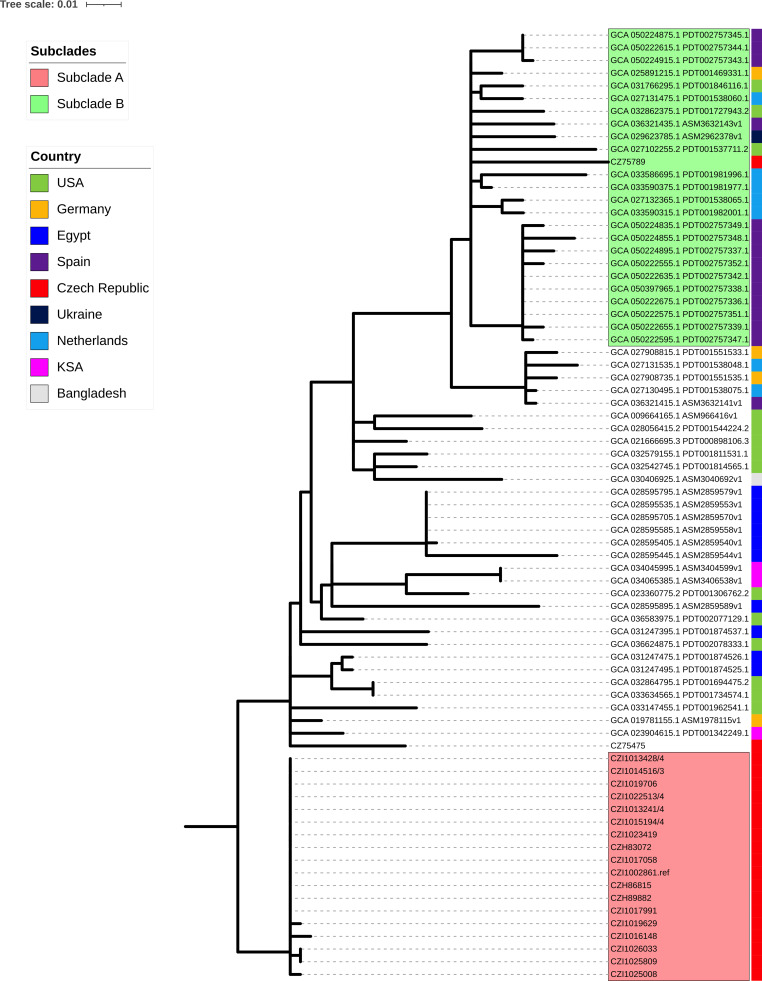 Fig 1
Fig 1| Isolate | Sequence type | Resistance genes | Quorum sensing | Immune modulation | Adherence | Toxins |
|---|---|---|---|---|---|---|
| CZI1002861 | 773 |
|
|
|
| |
| 773 | ||||||
| CZI1013241/4 | 773 | |||||
| CZI1013428/4 | 773 | |||||
| 773 | ||||||
| CZI1014516/3 | 773 | |||||
| CZI1015194/4 | 773 | |||||
| CZI1016148 | 773 | |||||
| CZI1017058 | 773 | |||||
| CZI1017991 | 773 | |||||
| 773 | ||||||
| CZI1019629 | 773 | |||||
| CZI1019706 | 773 | |||||
| CZ75475 | 773 | |||||
| CZ75789 | 773 | |||||
| CZI1022513/4 | 773 | |||||
| CZI1023419 | 773 | |||||
| CZI1025008 | 773 | |||||
| CZI1025809/5 | 773 | |||||
| CZI1026033 | 773 |
- —National Institute of Virology and Bacteriology
Peer Reviews
No public reviews on file for this paper yet. If you reviewed it on a platform where reviews are public (OpenReview, ICLR, NeurIPS, ICML), you can paste yours below so the community can read it here.
Videos
No videos yet. Explain this paper in a talk, walkthrough, or lecture? Add one.
Taxonomy
TopicsAntibiotic Resistance in Bacteria · Bacterial biofilms and quorum sensing · Infections and bacterial resistance
OBSERVATION
The worldwide spread of carbapenem-resistant Pseudomonas aeruginosa, which frequently belongs to international epidemic high-risk clones widely disseminated in hospital settings, has become an emerging challenge in the last years (1, 2). The most important mechanisms of resistance to carbapenems in P. aeruginosa are the production of carbapenemases (3, 4). The most frequently described carbapenemases in P. aeruginosa are metallo-beta-lactamases, such as IMP and VIM, and less often NDM (4). In the Czech Republic in 2015, a comprehensive study on 194 carbapenem-resistant P. aeruginosa from 43 health-care facilities confirmed the highest prevalence of IMP metallo-beta-lactamase, followed by VIM type and GES type (3), but no NDM type has been detected. Up to this time, several cases of P. aeruginosa ST773 NDM-1 (PA-NDM-1) spread were described worldwide. The first case was reported by Kocsis et al. in Hungary (5), followed by reports from the USA (6, 7), India (8), Nepal (8), the Netherlands (9), and most recently from Spain (10). In this study, we describe the first case of an imported extremely drug-resistant (XDR) P. aeruginosa isolate of the high-risk clone ST773 harboring the blaNDM-1 gene and causing a local outbreak in a hemato-oncology department of a Czech university hospital.
The first case of a PA-NDM-1 isolate was reported in May 2022 from a rectal swab of a male patient suffering from acute myeloblastic leukemia. He was repatriated from Ukraine and admitted to the hemato-oncology department of the University Hospital in Pilsen. Prior to the admission, he underwent a bone marrow transplantation in Turkey in the spring of 2021 and was subsequently taken back into care in Ukraine. Since the admission in May 2022, a surge in the number of NDM-producing P. aeruginosa isolates has been recorded (up until January 2023). Another 17 patients with PA-NDM-1 were detected in the same hemato-oncology department. Due to the severity of the primary diseases and the limited options of antibiotic therapy, five patients who developed bacterial sepsis died. During the same period, two more cases were detected in other Czech hospitals. The first one was reported from a patient in the University Hospital in Hradec Kralove. The patient, who has been living long-term in Tunisia, was hospitalized there due to a car accident for 10 days and then transferred to Hradec Kralove. The second case was reported from a patient repatriated from Ukraine in a surgery ambulance of Hospital Ceske Budejovice (Table S1).
Species identification was done using MALDI-TOF MS. Antibiotic susceptibility testing was performed using broth microdilution assay according to the EUCAST (2025) guidelines, and results were interpreted according to its 2025 breakpoints criteria (http://www.eucast.org/). Carbapenemase production was confirmed using the MALDI-TOF MS meropenem hydrolysis assay (11), phenotypic detection of carbapenemase type was done using the double-disc synergy test, and the PCR amplification of genes encoding carbapenemases was performed as described previously (12). All isolates were P. aeruginosa harboring blaNDM. All isolates showed an XDR profile showing resistance against most of the tested antibiotics, such as ampicillin-sulbactam, piperacillin-tazobactam, ceftazidime, meropenem, and ciprofloxacin, yet were susceptible against aztreonam, colistin, and cefiderocol (Table S2).
Genomic DNAs from all isolates were sequenced using a short-read sequencing platform on NovaSeq 600 (Illumina, Inc., USA). All reads, assembled using SPAdes v3.14.0 (13), were analyzed using public databases in the Center for Genomic Epidemiology (https://genomicepidemiology.org/) (14) (Table 1). All isolates belonged to sequence type ST773 and harbored genes coding for resistance against ciprofloxacin (qnrVC1), aminoglycoside (rmtB, aph(3’)-llb), sulfamethoxazole (sul1), fosfomycin (fosA), tetracycline (tet(G)), amphenicol (catB7), and beta-lactams, including carbapenems (intrinsic blaPAO and most importantly blaNDM-1). Furthermore, all isolates harbored genes coding for quorum sensing (lasI, lasR, rhlI, rhlR, hdtS) and adherence (such as pilB, pilD-U, pilZ, and fimV). Moreover, isolates harbored genes coding for anti-phagocytosis (alg44, alg8, algA-X, mucA-E, and mucP). These isolates were further tested through analyzing their in vitro virulence by testing the survival of bacteria in pooled human serum (NHS) or heat-inactivated normal human serum (HI-NHS) as described elsewhere (15). We found that all P. aeruginosa isolates, except isolate CZ75789, which is not part of the outbreak, exhibited resistance to killing by complement (Fig. S1).
DNA isolated from the index case strain (CZI1002861) and from another strain (CZI1023419), collected at the end of the collection period (after 6 months), were sequenced on PacBio Sequel I (Pacific Biosciences, USA) to produce complete circular genomes and for the purpose of deep genomic comparison for possible detection of microevolution. Long-read WGS data showed that the blaNDM-1 was inserted into the P. aeruginosa chromosome. The blaNDM-1 gene was located within the integrative and conjugative element (ICE) ICE6600-like, as previously described in the P. aeruginosa strain P-600 (GenBank accession no. CP053917) isolated from South Korea.
Furthermore, the clonality of the isolates of this outbreak was determined by CRISPR array typing as previously described (16). All isolates had the CRISPR/Cas I-E type with an identical CRISPR array (100%).
Finally, SNP-based phylogeny for all P. aeruginosa ST773 in the NCBI database (along with our isolates) was done as described previously (16) (index case was used as a reference). The phylogeny grouped the outbreak isolates into one clade (clade A) (Fig. 1), while the isolate from Hradec Kralove belonged to another clade (clade B) of ST773 isolates. The ST773 isolate from Budejovice wasn’t grouped in any clade. The SNPs between the genomes in comparison with the genome of the index case ranged from 0 to 11 among the isolates of the outbreak. While it was higher with the ones from Hradec Kralove and Budejovice (56 and 333, respectively) (Table S3). These results strongly suggest that the outbreak was caused by one strain.
SNP-based phylogeny for all P. aeruginosa ST773 genomes in the NCBI database. Clades A and B are highlighted in red and green, respectively. The outermost colored bar to the right corresponds to the isolates’ reporting country.
The hospitals implemented immediate infection control measures to control the outbreak through isolation/quarantine of colonized patients separately or in groups, depending on the initial diagnosis of the patient. Moreover, they increased cleaning/sanitary intervention methods, staff and patients education, and continuous consultation with local epidemiologists. These measures managed to limit the dissemination of this clone.
In conclusion, in the current study, we describe the emergence of an outbreak due to the spread of ST773 P. aeruginosa isolates producing NDM-1 carbapenemase in Pilsen hospital. The outbreak took place due to the repatriation of a patient previously hospitalized in Ukraine. Additionally, two sporadic cases of ST773 P. aeruginosa isolates producing NDM-1 were identified in different hospitals. These findings, which are in agreement with the increased reports in literature reporting the isolation of ST773 P. aeruginosa isolates producing NDM-1 in several countries, highlight the development of ST773 as a high-risk clone.
The reference list from the paper itself. Each links out to its DOI / PubMed record.
- 1Oliver A, Mulet X, López-Causapé C, Juan C. 2015. The increasing threat of Pseudomonas aeruginosa high-risk clones. Drug Resist Updat 21:41–59. doi:10.1016/j.drup.2015.08.00226304792 · doi ↗ · pubmed ↗
- 2Woodford N, Turton JF, Livermore DM. 2011. Multiresistant Gram-negative bacteria: the role of high-risk clones in the dissemination of antibiotic resistance. FEMS Microbiol Rev 35:736–755. doi:10.1111/j.1574-6976.2011.00268.x 21303394 · doi ↗ · pubmed ↗
- 3Papagiannitsis CC, Medvecky M, Chudejova K, Skalova A, Rotova V, Spanelova P, Jakubu V, Zemlickova H, Hrabak J, Czech Participants of the European Antimicrobial Resistance Surveillance Network. 2017. Molecular characterization of carbapenemase-producing Pseudomonas aeruginosa of Czech origin and evidence for clonal spread of extensively resistant sequence type 357 expressing IMP-7 metallo-β-lactamase. Antimicrob Agents Chemother 61:10–1128. doi:10.1128/AAC.01811-17PMC 570031928993328 · doi ↗ · pubmed ↗
- 4Tenover FC, Nicolau DP, Gill CM. 2022. Carbapenemase-producing Pseudomonas aeruginosa–an emerging challenge. Emerg Microbes Infect 11:811–814. doi:10.1080/22221751.2022.204897235240944 PMC 8920394 · doi ↗ · pubmed ↗
- 5Kocsis B, Gulyás D, Szabó D. 2021. Diversity and distribution of resistance markers in Pseudomonas aeruginosa International high-risk clones. Microorganisms 9:359. doi:10.3390/microorganisms 902035933673029 PMC 7918723 · doi ↗ · pubmed ↗
- 6Alamarat ZI, Babic J, Tran TT, Wootton SH, Dinh AQ, Miller WR, Hanson B, Wanger A, Gary JL, Arias CA, Pérez N. 2020. Long-term compassionate use of cefiderocol to treat chronic osteomyelitis caused by extensively drug-resistant Pseudomonas aeruginosa and extended-spectrum-β-lactamase-producing Klebsiella pneumoniae in a pediatric patient. Antimicrob Agents Chemother 64:10–1128. doi:10.1128/AAC.01872-19PMC 717926031871075 · doi ↗ · pubmed ↗
- 7Singh S, Pulusu CP, Pathak A, Pradeep BE, Prasad KN. 2021. Complete genome sequence of an extensively drug-resistant Pseudomonas aeruginosa ST 773 clinical isolate from North India. J Glob Antimicrob Resist 27:244–246. doi:10.1016/j.jgar.2021.10.01034710632 · doi ↗ · pubmed ↗
- 8Takahashi T, Tada T, Shrestha S, Hishinuma T, Sherchan JB, Tohya M, Kirikae T, Sherchand JB. 2021. Molecular characterisation of carbapenem-resistant Pseudomonas aeruginosa clinical isolates in Nepal. J Glob Antimicrob Resist 26:279–284. doi:10.1016/j.jgar.2021.07.00334284125 · doi ↗ · pubmed ↗