Combining Problem-Based Learning Methods With the WeChat Platform in Teaching Ophthalmology: Randomized Controlled Trial
Fang Fang, Bing Bu, Wenmin Jiang

TL;DR
A study found that using WeChat for problem-based learning in ophthalmology improved students' understanding and skills compared to traditional teaching.
Contribution
The study introduces a WeChat-based PBL model for ophthalmology education and demonstrates its effectiveness in enhancing learning outcomes.
Findings
Students using WeChat-based PBL showed better understanding and knowledge application than traditional teaching.
WeChat-based PBL improved collaboration, motivation, and problem-solving skills among students.
Despite lower memorization scores, WeChat-based PBL led to stronger clinical reasoning and self-learning abilities.
Abstract
Ophthalmology poses distinct learning challenges for medical students due to the complex anatomy of the eye and the requirement of essential hands-on skills. Problem-based learning (PBL), a student-centered approach, fosters clinical reasoning and self-directed learning. To address the time and logistical constraints of traditional teaching methods, this study implemented a WeChat-based PBL model that leveraged the platform’s efficiency and interactivity to enhance student engagement and skill acquisition in ophthalmology. This study aimed to evaluate the effectiveness of WeChat-based PBL in ophthalmology education, focusing on its impact on students’ self-perception of learning and clinical skills compared to traditional teaching methods. This study involved 108 undergraduate students who successfully passed the Chinese National Entrance Examination. Among them, 54 (50%) were…
Genes, proteins, chemicals, diseases, species, mutations and cell lines named across the full text — each resolved to its canonical identifier and authoritative record.
Click any figure to enlarge with its caption.
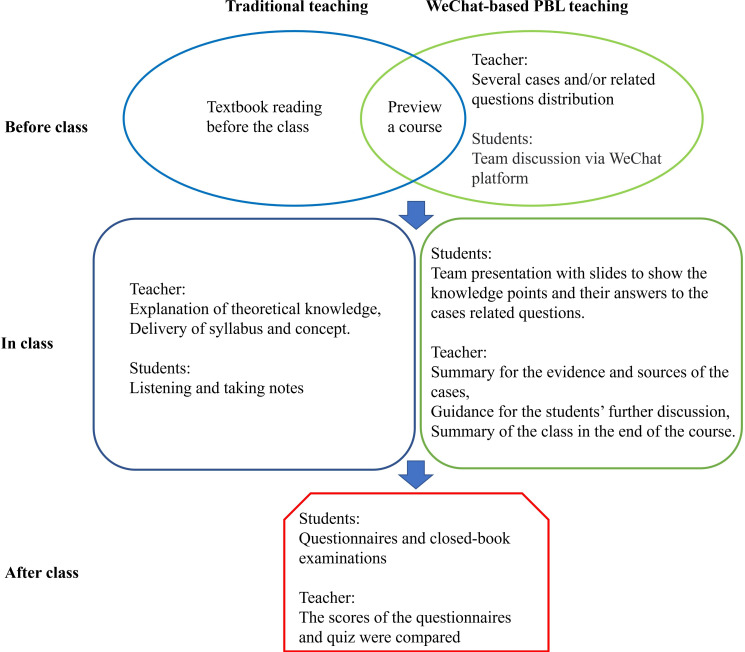 Figure 1
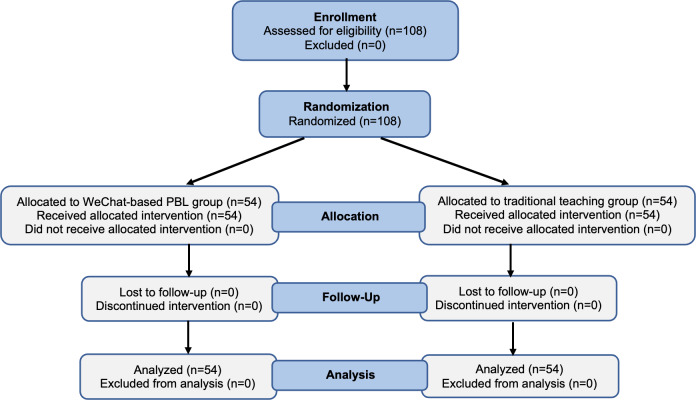 Figure 2
| Week | Activity | Duration (h) | Learning objectives |
|---|---|---|---|
| 1 | The instructor posts guiding questions and students form study groups | 2 | Students are randomly assigned to study groups of 10 and establish WeChat groups, through which group members communicate about the study content |
| 2 | Explore contributing factors | 4 | Identify and explain major factors and search for medical literature and books on your own to find the answers to the guiding questions provided by the instructor |
| 3 | Apply concepts to scenarios | 4 | Apply learned concepts to hypothetical scenarios and communicate with group members and the instructor through the WeChat group |
| 4 | Solve the guiding problems and present the key points | 5 | Students create relevant course Microsoft PowerPoint presentations according to the assigned groups, which cover all the answers to the instructor’s guiding questions and the knowledge points obtained from self-study of the teaching content of this course |
| 5 | Evaluate proposed solutions | 4 | Evaluate the effectiveness of various solutions by presenting them to each other during the formal class |
| Topic area | Questions |
|---|---|
| The course improves my learning motivation |
“Can you analyze the impact of the study findings on the field?” |
| The course helps me to acquire knowledge |
“Can you define the main terms used in the study?” |
| The course is helpful for passing the final examination |
“What are your thoughts on the effectiveness of the methods used in the study?” |
| The course encourages me to express my opinions |
“In this course, do you feel that your opinions are respected?” “In this course, do you often take the initiative to express your opinions?” |
| This course occupies too much of my spare time |
“How much time do you spend in WeChat-based problem-based learning by using this method to communicate with teachers and group members?” |
| The course improves my communication skills |
“During discussions, does the instructor give you sufficient time to express your opinions?” |
| The course improves my self-learning skills |
“What are the key concepts discussed in the study material?” |
| The course improves my clinical thinking ability |
“How would you apply the concepts learned to a real-world scenario?” |
| The course improves my ability to analyze and solve problems |
“How much do you agree that this course has provided you with the tools and techniques to effectively solve problems?” “How often have you used the analytical skills you learned in the course to solve real-world problems outside the classroom? |
| Characteristics | WeChat-based PBL (n=54) | Traditional teaching (n=54) | |
|---|---|---|---|
| Age (y), mean (SD) | 20.426 (0.602) | 20.296 (0.571) | .12 |
| Sex, n (%) | .48 | ||
| Male | 23 (42.6) | 22 (40.7) | |
| Female | 31 (57.4) | 32 (59.3) | |
| Questions | WeChat-based PBL, mean (SD) | Control (traditional teaching), mean (SD) | Mann-Whitney | Effect size | |
|---|---|---|---|---|---|
| The course improves my learning motivation | 1.8333 (0.5746) | 3.5741 (0.7915) | 1012 | .004 | 2.5169 |
| The course helps me to acquire the knowledge | 1.8704 (0.7017) | 3.6667 (0.7770) | 914 | <.001 | 2.4264 |
| The course is helpful for passing the final examination | 2.7593 (0.7507) | 3.2593 (0.8284) | 975.5 | <.001 | 0.6325 |
| The course encourages me to express my opinions | 1.9630 (0.5482) | 3.5556 (0.7181) | 963 | .001 | 2.4930 |
| This course occupies too much of my spare time | 3.3148 (0.8201) | 3.7963 (0.7618) | 714 | <.001 | 0.6083 |
| The course improves my communication skills | 1.7222 (0.5961) | 3.8889 (0.8393) | 725 | <.001 | 2.9765 |
| The course improves my | 1.8519 (0.4917) | 3.5741 (0.7673) | 930.5 | <.001 | 2.6725 |
| The course improves my clinical thinking ability | 1.9630 (0.6132) | 2.9444 (0.8777) | 1072 | .012 | 1.2964 |
| The course improves my ability to analyze and solve problems | 1.8519 (0.5287) | 3.2037 (0.6553) | 932 | .001 | 2.2706 |
Peer Reviews
No public reviews on file for this paper yet. If you reviewed it on a platform where reviews are public (OpenReview, ICLR, NeurIPS, ICML), you can paste yours below so the community can read it here.
Videos
No videos yet. Explain this paper in a talk, walkthrough, or lecture? Add one.
Taxonomy
TopicsOphthalmology and Visual Health Research · Problem and Project Based Learning · Innovations in Medical Education
Introduction
Medical education increasingly incorporates innovative strategies in undergraduate training to better prepare students for the challenges of clinical practice. Key strategies such as problem-based learning (PBL) [12], case-based learning [3], team-based learning [4], flipped classroom–based learning [56], and competency-based medical education [7] have been emphasized to bridge the gap between theoretical knowledge and clinical skills. These strategies are particularly relevant in fields such as ophthalmology, which represents a distinct and highly specialized discipline within clinical medicine [8]. The intricate anatomy of the eye and the nonintuitive nature of its structure necessitate the use of specialized equipment and tests for accurate diagnosis and management [9]. These factors contribute to the considerable hurdles medical students encounter while attempting to master this subject. Therefore, effective teaching methodologies are vital for adequately preparing students for clinical practice and developing their competencies as future clinicians [10].
The conventional teacher-centered educational model often relies on the passive transmission of knowledge from instructors to students. While efficient for delivering core knowledge, especially in large classes common in China, this method can limit students’ engagement and active learning [11]. As a result, students may struggle to operate ophthalmic instruments or perform fundus examinations, thereby diminishing their confidence in applying ophthalmology skills. Moreover, although textbooks provide detailed descriptions of the clinical manifestations and signs of ophthalmic diseases, students frequently encounter challenges when attempting to apply this theoretical knowledge to real-world clinical scenarios [12].
PBL, which inherently starts with a clinically based problem as its name, is an active learning strategy that fosters student-centered engagement [13]. Evidence shows that PBL enhances learning motivation, promotes self-guided learning, and improves the integration of theoretical knowledge with clinical practice [1415]. Students exposed to PBL report greater satisfaction and participation compared with those in traditional learning settings [1617]. In today’s digital era, college students are adept at using the internet and mobile networks to access information, helping to overcome the temporal and spatial limitations of traditional PBL methods. With the advancement of mobile networks, WeChat has become a popular social networking platform in China [18]. It supports multiple modes of interaction—including texting, voice messages, images, and multimedia—similar to WhatsApp in Western countries [1920]. Moreover, WeChat is widely used for disseminating knowledge to medical students due to its convenience and the extensive availability of information [2122].
This study addresses the challenges faced in conventional ophthalmology education, where passive learning hinders the development of practical skills and confidence among undergraduate medical students. It aims to evaluate the effectiveness and acceptability of a WeChat-based PBL approach in enhancing students’ self-perceptions of learning, initiative, organization, clinical skills, and knowledge mastery. The central research question guiding this inquiry is: How does the integration of WeChat in PBL influence the learning outcomes of medical students in ophthalmology? This randomized controlled trial will involve the comparison of student outcomes between those engaged in traditional teaching methods and those using the WeChat platform for online PBL, allowing for a robust assessment of the intervention’s effectiveness. We hypothesize that the use of WeChat for online PBL will significantly improve student engagement and competency in ophthalmology. The findings of this study will provide valuable insights for medical educators, curriculum developers, and policymakers seeking to improve medical education methodologies in China and beyond.
Methods
Ethical Considerations
This study was conducted in accordance with the Declaration of Helsinki and received approval from the institutional review board and ethics committee of the Second Xiangya Hospital (Z0005-01). In accordance with institutional guidelines for educational research, the intervention was classified as minimal risk and considered part of the routine evaluation of teaching quality. All participants were informed of the study’s purpose, procedures, and the planned use of the collected data, and all provided written informed consent before participation. Participant anonymity was strictly protected, with all data deidentified and analyzed only in aggregated form. No study procedures posed risks beyond those ordinarily encountered in standard educational activities.
Study Participants
A total of 108 fifth-year undergraduate students from Xiangya Medical College of Central South University, all of whom had passed the Chinese National Entrance Examination, participated in the study. The cohort consisted of 42 (38.9%) male and 66 (61.1%) female participants, aged 20 to 22 years. Participants were randomly assigned into 6 groups of 18 students each using Microsoft Excel to generate random numbers to ensure unbiased distribution. In this study, students were informed of their group assignments due to the nature of the teaching intervention, but evaluators responsible for assessing the examination results were blinded to group allocation to minimize assessment bias. The new teaching methods were implemented outside their regular class schedules, primarily during evenings and weekends. This approach presented unique challenges, including an increased workload for both students and instructors, as it required students to allocate additional time beyond their standard academic hours to participate in the study. Additionally, coordinating schedules among all faculty members and students involved posed challenges, which required careful planning and communication to ensure participation without conflicting with existing institutional educational policies. Both intervention and control groups received instruction in dedicated classrooms at the hospital, which facilitated a conducive learning environment (Table 1).
Research Methods
We selected primary angle-closure glaucoma (PACG) as the topic for applying the WeChat-based PBL approach in this study, as the diagnosis and treatment of PACG represent crucial skills that students must acquire. The textbook used for this study was Ophthalmology, 9th edition, published by the People’s Medical Publishing House [23].
WeChat-Based PBL
Establishment of Learning Groups
Three groups (18 students for each group) were randomly selected to take part in the WeChat-based PBL program. In each group, 1 volunteer self-selected by students was responsible for recording each student’s speech and the outcomes of the panel discussions.
Problem Introduction Phase
In alignment with the national syllabus and the ophthalmology textbook, 3 representative clinical cases were selected from the 2022-2023 glaucoma service database of the Second Xiangya Hospital. Each vignette depicted a distinct stage or mechanism of PACG (including asymptomatic primary angle closure, acute angle closure attack, and plateau-iris configuration) covering the essential diagnostic and therapeutic spectrum required for undergraduate training. To guide case selection and design, chapter-level learning objectives were first extracted, encompassing (1) anterior-chamber anatomy and angle structures, (2) the pathophysiology of pupillary-block versus nonpupillary-block mechanisms, (3) biometric risk factors, (4) gonioscopic and imaging diagnosis, (5) laser and surgical indications, and (6) emergency management of acute attacks. Each objective was then translated into a practical key decision point (eg, interpreting a gonioscopy record, determining when laser peripheral iridotomy is indicated, or choosing between phacoemulsification and trabeculectomy). All selected cases, provided by the instructors, were distributed to students 1 week prior to the lecture to facilitate preparatory discussion and independent learning.
Preclass Guidance Phase
Instructors provided curated readings including key sections drawn from the textbook, supplemented with selected review articles, clinical guidelines (eg, Asia-Pacific Glaucoma Guidelines, 3rd Edition), and representative case reports from the hospital’s glaucoma database. Additionally, each vignette was accompanied by inquiry-based questions that directed students to identify risk factors, compare pathogenic mechanisms, and determine appropriate management strategies, encouraging active and evidence-based learning. These questions could direct students’ literature searches toward key concepts and clinical decision-making points related to PACG. Each group participating in the WeChat-based PBL established its own discussion team on the WeChat platform, fostering an environment of active participation. To encourage full student engagement, instructors emphasized the importance of collaboration and implemented a system that recognized contributions, motivating students to prepare thoroughly before classes. Through this platform, instructors and students engaged in interactive discussions on the provided cases, sharing their diagnostic reasoning, proposing treatment plans, and exploring the latest global developments in disease management. For example, instructors could prompt a discussion by asking specific diagnostic questions, thereby guiding students to reflect critically. During class sessions, instructors monitored and reviewed the discussions and the online outputs, often projecting key discussion points or summaries from WeChat onto a shared screen for collective evaluation and real-time feedback.
Discussion and Summarization Phase
Each WeChat-based PBL session lasted 2 hours and was supported by the platform’s features for sharing text, images, voice recordings, videos, and documents, which enabled immediate and efficient communication. All instructors followed a structured facilitator’s guide, identical across groups, and distributed 1 week before the session. The guide provided a minute-by-minute timetable covering the entire 2-hour process (10 min recap, 45 min group presentation, 30 min cross-groups challenge, 25 min instructor synthesis, and 10 min reflection), ensuring balanced pacing and consistent coverage across groups.
At the beginning of each session, a representative student from each group presented their understanding of the assigned disease and summarized unresolved problems identified during preclass discussions. This was followed by an open, interactive discussion in which students from other groups exchanged perspectives and clinical reasoning. To maintain alignment with curricular standards, the instructor’s guide specified 5 “must-cover” learning objectives mapped to the national ophthalmology syllabus (eg, explain the mechanism of pupillary block, justify the timing of laser iridotomy, and interpret ultrasound biomicroscopy images). It also included prompt questions addressing common misconceptions identified during the pilot phase, and a 1-slide “take-home” summary that instructors were required to display at the end of the session.
After the session, instructors completed a structured checklist to document which objectives had been achieved. They were instructed to intervene only when discussion drifted more than 2 minutes off task or when critical misconceptions arose; otherwise, they guided students by inquiry-based questioning to ensure that all checklist objectives were discussed. The structured facilitation process, combined with WeChat’s interactive features, fostered active participation, peer collaboration, and efficient knowledge integration, greatly enhanced the PBL learning experience.
Traditional Teaching Group
The traditional teaching model involved the instructor predominantly delivering comprehensive explanations of foundational knowledge, adhering to a prescribed multimedia teaching outline. In this model, students were not divided into smaller groups and were not required to give formal presentations during the course. Both groups completed the same quizzes and questionnaires, and the results did not affect course grades or performance. The study design is summarized in Figure 1.
The flowchart shows the 2 different models of teaching and learning in ophthalmology for Chinese medical students. PBL: problem-based learning.
Teaching Efficacy Evaluation and Statistical Analysis
The efficacy and satisfaction of both teaching methods were evaluated through a combination of questionnaire surveys for subjective assessment and examinations for objective evaluation.
Subjective Evaluation
The questionnaire (Table 2) was designed and modified based on the Course Experience Questionnaire by Ramsden [24] and the Study Process Questionnaire by Biggs [25]. All the students completed questionnaires to assess their perceptions and self-evaluated competence at the end of the teaching course.
Objective Evaluation
Both groups then undertook an identical closed-book examination comprising essay questions, true or false questions, judgment questions, and case analyses to assess students’ memory, comprehension, and clinical application abilities. The examination questions were formulated based on the 9th edition of Ophthalmology, an ophthalmology textbook published by the People’s Medical Publishing House [23]. Notably, both the examination format and evaluation criteria were standardized across both groups. To maintain objectivity in scoring the theoretical examination, 3 instructors performed a blinded evaluation of the students’ responses.
Statistical analyses were performed using SPSS (version 11.0; IBM Corp) software. Measurement data were expressed as means (SDs). Questionnaire data were analyzed using the Mann-Whitney U test, and examination scores across the two groups were compared using the independent samples 2-tailed t test. A P value <.05 was considered statistically significant.
Results
Participants’ Demographic Data
Figure 2 shows a flowchart of participation for the 108 medical students in this study. Among them, 54 (50%) students were randomly selected to participate in the WeChat-based PBL, while the other 54 (50%) received traditional teaching. Among the participants, there were 42 (38.9%) male and 66 (61.1%) female individuals who were aged 20 to 22 years. The mean age of the WeChat-based group was 20.426 (SD 0.602) years, and the mean age of the traditional teaching group was 20.296 (SD 0.571) years. There was no significant difference in gender and average age between the two groups (Table 3).
Consolidated Standards of Reporting Trials (CONSORT) flowchart.
Comparison of the WeChat-Based PBL Method and Traditional Teaching Method
The closed-book examination was administered 1 week after course completion to allow students sufficient time for review while minimizing long-term memory effects. This clarification has been included in the revised manuscript. Examination questions were designed by 3 instructors and included 6 types of questions: single-choice questions, multiple-choice questions, noun definitions, short-answer questions, essay questions, and comprehensive questions. The exam assessed 3 cognitive levels—memorization, understanding, and application, which accounted for 50%, 20%, and 30% of the total score, respectively. The memorization section evaluated students’ ability to recall fundamental facts, definitions, and terminology. The understanding section assessed their capacity to interpret information, explain concepts in their own words, and demonstrate deeper comprehension beyond simple recall. The application section examined students’ ability to apply their knowledge and understanding to new or practical situations, such as problem-solving, formula application, and case analysis. Notably, the sections on understanding and application emphasized students’ flexible mastery of knowledge and its practical implementation. The goal was to enable students to apply theoretical knowledge in clinical contexts, thereby improving their diagnostic and treatment skills as well as their ability to analyze and solve clinical problems.
Our analysis indicated that although students in the WeChat-based PBL group scored marginally lower in memorization compared to their peers in the traditional teaching group (traditional vs WeChat groups: 37.6, SD 2.8 vs 32.0, SD 4.1; t106=-8.426; P=.006; n=54), they exhibited markedly superior levels of understanding (traditional vs WeChat groups: 24.1, SD 1.8 vs 28.0, SD 1.3; t106=12.753; P=.007; n=54) and knowledge application (traditional vs WeChat groups: 24.3, SD 1.9 vs 27.6, SD 1.3; t106=10.899; P=.008; n=54). However, when considering the total score, there was no significant difference between the two groups (traditional vs WeChat: 85.8, SD 4.9 vs 87.4, SD 5.1; t106=1.694; P=.60; n=54).
All 108 (100%) students responded to the questionnaire for the comparison of students’ perceptions between the WeChat-based PBL and lecture-based class (Table 4). More students believed (rather than did not believe) that the WeChat-based PBL class enhanced their learning motivation (traditional group: mean 3.5471, SD 0.7915; WeChat group: mean 1.8333, SD 0.5746; P=.004), helped them acquire knowledge (traditional group: mean 3.6667, SD 0.7770; WeChat group: mean 1.8704, SD 0.7017; P<.001), and improved their performance on the final examination (P=.001). They also believed that it encouraged them to express opinions (traditional group: mean 3.5556, SD 0.7181; WeChat group: mean 1.9630, SD 0.5482; P=.001), enhanced their communication skills (traditional group: mean 3.8889, SD 0.8393; WeChat group: mean 1.7222, SD 0.5961; P<.001), improved their self-learning ability (traditional group: mean 3.5741, SD 0.7673; WeChat group: mean 1.8519, SD 0.4917; P<.001), improved their clinical thinking (traditional group: mean 2.9444, SD 0.8777; WeChat group: mean 1.9630, SD 0.6132; P=.012), and enhanced their ability to analyze and resolve problems (traditional group: mean 3.2037, SD 0.6553; WeChat group: mean 1.8519, SD 0.5287; P=.001). However, a majority of students in the WeChat-based PBL class felt that the course occupied too much of their spare time (traditional group: mean 3.7963, SD 0.7618; WeChat group: mean 1.9630, SD 0.5482; P<.001).
Discussion
Principal Findings
This study aimed to assess the effectiveness of WeChat-based PBL in ophthalmic education compared with traditional teaching methods. Our analysis revealed that while students in the WeChat-based PBL group exhibited slightly lower scores in memorization than those in the traditional teaching group, they demonstrated significantly higher levels of understanding and application of knowledge. This suggests that the WeChat-based PBL approach fosters deeper engagement, allowing students to grasp critical concepts more effectively, despite having less focus on rote memorization. Moreover, students in the WeChat group reported enhanced collaboration, motivation, and willingness to participate actively in their learning process.
WeChat has been used as a platform for PBL because of its time efficiency and convenience [26-28]. Students were able to present questions and engage in discussions with instructors at any time and from any location via WeChat. Moreover, it allows the sharing of images, videos, links, and other related resources. This capability greatly aids discussion and ensures that all members can access case-related or problem-related resources promptly. Everyone can share their opinions and suggestions, receiving feedback from others anytime and anywhere. This timely and efficient communication via WeChat offers a better understanding among team members [262729]. Successful collaboration guarantees the productivity of the team, and instructors can actively participate in students’ discussions and debates, responding to questions and offering advice to enhance the efficiency of the learning process [2627].
Although the primary benefit of WeChat-based PBL is time-saving and convenience, as traditional PBL can be a time-intensive approach [30], the perception that WeChat-based PBL occupied too much spare time underscores the need for careful consideration of time management and workload in educational program design. One of the reasons could be the additional time dedicated to self-learning [31] and discussion among the team members increased the pressure and burden on the students. Increased preparation time can lead to deeper understanding and better retention of the material as students engage with content more thoroughly before class discussions. This proactive approach enhances participation during PBL sessions and ultimately improves learning outcomes. To optimize learning efficiency while preventing overload, several refinements are warranted. Specifically, preclass materials should be streamlined to emphasize key concepts and reduce redundancy, and brief in-class reviews can help reinforce complex topics, minimizing postclass study demands. Periodic guided learning sessions can also be scheduled to help balance students’ independent study and supervised learning time. These refinements aim to alleviate cognitive load while maintaining the effectiveness of the teaching model. Moreover, it is essential to refine the new teaching approach to effectively integrate the advantages of the PBL model with the interactive capabilities of the WeChat platform. Furthermore, instructors should also receive appropriate training to embrace this innovative teaching approach [32]. Dolmans and Wolfhagen [33] have highlighted that a tutor’s actions significantly influence both the productivity and effectiveness of a PBL group’s efforts. To enhance the effectiveness of tutors in PBL tutorials, ongoing training that encourages reflective practice on their development as educators is recommended [3435]. These efforts can effectively strike a balance between optimal learning outcomes and manageable student workload.
At the same time, the increase in students’ out-of-class learning hours also implied additional workload for instructors. Although instructor workload in asynchronous chat facilitation was not quantitatively measured, informal feedback indicated a moderate increase. Instructors reported spending an additional 15 to 20 minutes per day monitoring discussions and providing timely feedback. Despite this, they generally considered this extra time acceptable and valuable, as it enabled closer observation of students’ reasoning and early identification of misconceptions. The main challenges involved balancing prompt responses with other duties and managing message overload during peak activity. Nonetheless, most instructors agreed that the improved engagement and learning outcomes justified the additional effort. A rotating instructor schedule for online facilitation and setting clearer expectations for response timelines may help balance instructional workload while maintaining effective student-teacher interaction.
Our statistical analysis revealed that the WeChat-based PBL group exhibited slightly lower scores in memorization than the traditional teaching group. However, their levels of understanding and application of knowledge were higher than the traditional teaching group. This discrepancy may be attributed to the engagement of students in the WeChat-based PBL group with a broader array of relevant information, extending beyond textbook content. Consequently, while the WeChat-based PBL group demonstrated a better performance in understanding and application of knowledge, their memorization of textbook-specific information was slightly weaker. Nevertheless, the WeChat-based PBL group showed advantages in mastering key knowledge points and achieving higher total scores.
However, several factors must be considered while implementing WeChat-based PBL. For instance, it is advisable to keep the number of students in each team small, as smaller groups facilitate easier administration and instruction. Teachers should contact students at least 1 week in advance to provide questions or case reports, ensuring both teachers and students are well prepared to achieve optimal educational outcomes. By adapting to real-time situations, teachers can enhance students’ interest in learning, invigorate the classroom dynamics, and correct students’ misconceptions. Teachers should act as a resource and facilitator, responding promptly to students’ inquiries throughout their research. Overall, the WeChat-based PBL model marks a significant departure from the traditional didactic “cramming education” approach, fostering a more engaging and active learning environment. Therefore, WeChat-based PBL should be increasingly incorporated into future ophthalmology education to enable continuous identification and refinement of relevant issues [36].
Limitations
There are several limitations that should be acknowledged. First, while students covered the same core content on PACG, differences in teaching methodologies could have influenced memorization outcomes and overall comprehension. This research was performed targeting a single textbook chapter on PACG. Therefore, the conclusion requires further verification in other subject fields. Second, questionnaire results indicated that students in the WeChat-based PBL group spent more extracurricular time preparing course materials. Therefore, understanding their perceptions and attitudes toward this additional workload is particularly important. However, as the students involved in this study have already graduated, it was not possible to collect further feedback from them. This limitation prevents a more comprehensive understanding of their long-term perceptions of the learning burden and its potential impact on sustained engagement and clinical competency development. Future research will include longitudinal follow-up surveys or interviews to further evaluate students’ attitudes, learning experiences, and workload perceptions. Third, the necessity for student participation in additional discussions and presentations may have affected their independent study time and overall academic performance. Fourth, the lack of blinding may have introduced biases, as awareness of the teaching method could have influenced both students’ and instructors’ expectations and engagement levels. Fifth, the generalizability of our findings is also limited by the single-institution context and the sample size of 108 fifth-year undergraduate medical students, which may not reflect broader educational settings or diverse student populations. Finally, in our study, we did not compare the effects of traditional PBL and WeChat-based PBL methods. Further research should compare the functions between these two approaches in future studies. Moreover, future research should explore the long-term impacts of WeChat-based PBL on learning outcomes across different medical disciplines and institutions. Further empirical testing is necessary to assess the effectiveness of this approach in various contexts and to identify best practices for implementation. Optimizing digital communication tools such as WeChat holds great promise for enhancing educational experience and fostering collaborative learning in medical education.
Conclusions
In summary, compared to traditional teaching, integrating PBL methods combined with WeChat as a communication platform improved the effectiveness of ophthalmic education. Although students invested more time in preclass, they did not perceive it as a waste of their spare time. Instead, they recognized that the WeChat-based PBL mode facilitated more effective communication among students and between students and teachers. It enhanced their motivation to learn; promoted knowledge acquisition; encouraged expression of opinions; and improved self-learning abilities, clinical reasoning, and problem-solving. This innovative teaching mode may represent a superior alternative to conventional teaching methods. However, further exploration to optimize the students’ spare time for effective online communication is warranted. This new method merits continued refinement and evaluation based on the findings of this study.
The reference list from the paper itself. Each links out to its DOI / PubMed record.
- 1Jin J Bridges SM Educational technologies in problem-based learning in health sciences education: a systematic review J Med Internet Res Dec 1020141612 e 251doi 10.2196/jmir.3240 Medline 25498126 PMC 4275485 · doi ↗ · pubmed ↗
- 2Wyer PC Evidence-based medicine and problem based learning a critical re-evaluation Adv Health Sci Educ Theory Pract Dec 2019245865878 doi 10.1007/s 10459-019-09921-5Medline 31617018 · doi ↗ · pubmed ↗
- 3Thistlethwaite JE Davies D Ekeocha S et al The effectiveness of case-based learning in health professional education. A BEME systematic review: BEME Guide No. 23Med Teach 2012346 e 421e 444doi 10.3109/0142159 X.2012.680939 Medline 22578051 · doi ↗ · pubmed ↗
- 4Burgess A Ayton T Mellis C Implementation of team-based learning in year 1 of a PBL based medical program: a pilot study BMC Med Educ Feb 420161649 doi 10.1186/s 12909-016-0550-3Medline 26846425 PMC 4743090 · doi ↗ · pubmed ↗
- 5Han E Klein KC Pre-class learning methods for flipped classrooms Am J Pharm Educ Feb 20198316922 doi 10.5688/ajpe 6922 Medline 30894772 PMC 6418854 · doi ↗ · pubmed ↗
- 6Park KH Park KH Chae SJ Experiences of medical teachers in flipped learning for medical students: a phenomenological study Korean J Med Educ Jun 201830291100 doi 10.3946/kjme.2018.84Medline 29860775 PMC 5990898 · doi ↗ · pubmed ↗
- 7Succar T Mc Cluskey P Grigg J Enhancing medical student education by implementing a competency-based ophthalmology curriculum Asia Pac J Ophthalmol (Phila)2017615963 doi 10.22608/APO.2016102 Medline 28161917 · doi ↗ · pubmed ↗
- 8Gostimir M Sharma RA Bhatti A Status of Canadian undergraduate medical education in ophthalmology Can J Ophthalmol Oct 2018535474479 doi 10.1016/j.jcjo.2017.11.015Medline 30340714 · doi ↗ · pubmed ↗