Correction to “N‐Acetylcysteine Reduces ROS‐Mediated Oxidative DNA Damage and PI3K/Akt Pathway Activation Induced by Helicobacter pylori Infection”

Abstract
Genes, proteins, chemicals, diseases, species, mutations and cell lines named across the full text — each resolved to its canonical identifier and authoritative record.
Click any figure to enlarge with its caption.
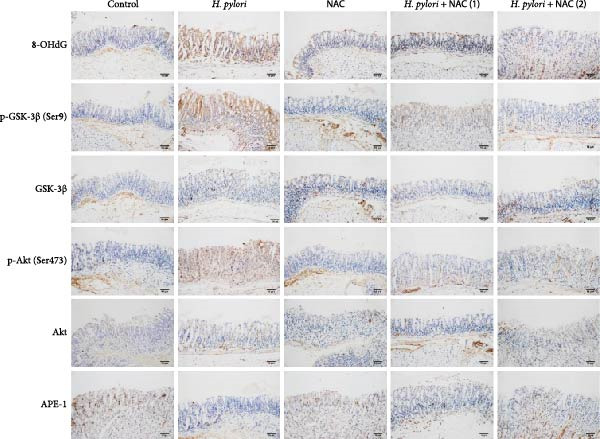 Figure 1
Peer Reviews
No public reviews on file for this paper yet. If you reviewed it on a platform where reviews are public (OpenReview, ICLR, NeurIPS, ICML), you can paste yours below so the community can read it here.
Videos
No videos yet. Explain this paper in a talk, walkthrough, or lecture? Add one.
Taxonomy
TopicsHelicobacter pylori-related gastroenterology studies · NF-κB Signaling Pathways · Inflammatory mediators and NSAID effects
C. Xie, J. Yi, J. Lu, M. Nie, M. Huang, J. Rong, Z. Zhu, J. Chen, X. Zhou, B. Li, H. Chen, N. Lu, and X. Shu, “N‐Acetylcysteine Reduces ROS‐Mediated Oxidative DNA Damage and PI3K/Akt Pathway Activation Induced by Helicobacter pylori Infection,” Oxidative Medicine and Cellular Longevity, (2018): 1874985, https://doi.org/10.1155/2018/1874985.
In the article, there is an error in Figure 4. Specifically, there is a duplication between representative images of GSK‐3β in the H. pylori group and the H. pylori + NAC(2) group.
The correct Figure 4 is shown below:
We apologize for this error.