Time‐Dependent Predictive Accuracy Metrics in the Context of Interval Censoring and Competing Risks
Zhenwei Yang, Dimitris Rizopoulos, Lisa F. Newcomb, Nicole S. Erler

TL;DR
This paper introduces two methods to evaluate prediction models for time-to-event outcomes in the presence of interval censoring and competing risks.
Contribution
The study proposes a model-based and IPCW approach for time-dependent accuracy metrics in interval-censored competing risk settings.
Findings
The model-based approach uses all subjects in the risk set for accuracy evaluation.
The IPCW approach focuses only on subjects with known event status in the interval of interest.
Both methods were tested using simulations and a prostate cancer surveillance cohort.
Abstract
Evaluating the performance of a prediction model is a common task in medical statistics. Standard accuracy metrics require the observation of the true outcomes. This is typically not possible in the setting with time‐to‐event outcomes due to censoring. Interval censoring, the presence of time‐varying covariates, and competing risks present additional challenges in obtaining those accuracy metrics. In this study, we propose two methods to deal with interval censoring in a time‐varying competing risk setting: a model‐based approach and the inverse probability of censoring weighting (IPCW) approach, focusing on three key time‐dependent metrics: area under the receiver‐operating characteristic curve, Brier score, and expected predictive cross‐entropy. The evaluation is conducted over a medically relevant time interval of interest, [t,Δt). The model‐based approach includes all subjects in…
Genes, proteins, chemicals, diseases, species, mutations and cell lines named across the full text — each resolved to its canonical identifier and authoritative record.
Click any figure to enlarge with its caption.
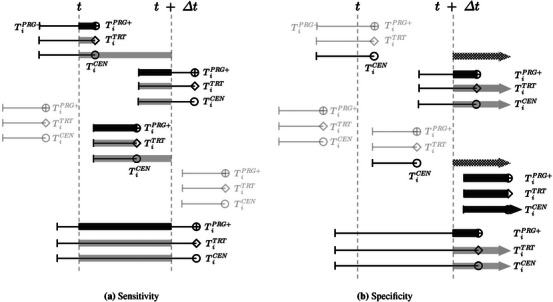 Figure 1
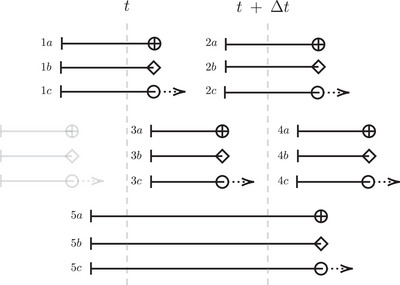 Figure 2
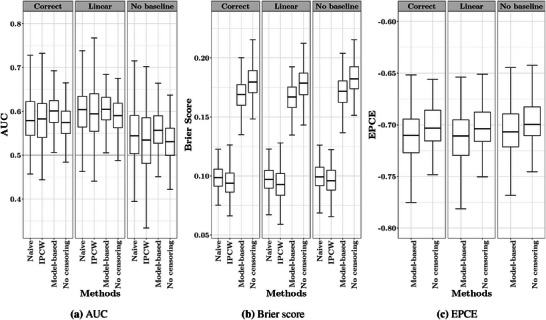 Figure 3
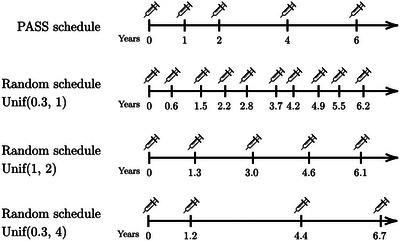 Figure 4
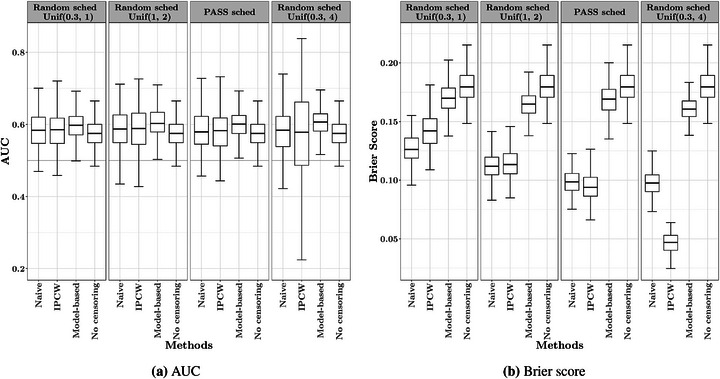 Figure 5
Peer Reviews
No public reviews on file for this paper yet. If you reviewed it on a platform where reviews are public (OpenReview, ICLR, NeurIPS, ICML), you can paste yours below so the community can read it here.
Videos
No videos yet. Explain this paper in a talk, walkthrough, or lecture? Add one.
Taxonomy
TopicsStatistical Methods and Inference · Advanced Causal Inference Techniques · Explainable Artificial Intelligence (XAI)