The Role of Estrogen Receptor–Targeted PET with 16α-18F-Fluoro-17β-Estradiol in Predicting Response to Endocrine Therapies in Metastatic Breast Cancer: A Metaanalysis
Jennifer M. Specht, Jasper J.L. van Geel, Shaoli Song, Cheng Liu, Daniel S. Hippe, Nicholas A. DiGregorio, Christine J. Brand, Hannah M. Linden

TL;DR
This study shows that [18F]FES PET/CT imaging can predict how well patients with metastatic breast cancer will respond to endocrine therapy by measuring estrogen receptor activity.
Contribution
The study introduces a new method using [18F]FES PET/CT imaging to predict endocrine therapy response based on lesion-level heterogeneity and SUVmax thresholds.
Findings
Patients with higher baseline SUVmean values were more likely to respond to endocrine therapy.
Lesion-level [18F]FES heterogeneity was strongly associated with shorter progression-free survival.
An SUVmax threshold of 1.8 was more effective in predicting outcomes than higher thresholds.
Abstract
[18F]16α-fluoro-17β-fluoroestradiol ([18F]FES) PET/CT imaging enables whole-body assessment of functional estrogen receptor (ER) expression in metastatic breast cancer (mBC). Identifying imaging biomarkers that predict endocrine therapy (ET) response remains a critical need in optimizing treatment selection. Our objective was to assess the predictive utility of [18F]FES PET/CT imaging in determining response to ET, with a focus on interlesional heterogeneity and individual patient outcomes. Methods: A systematic literature review and metaanalysis were conducted using 6 major databases through April 2024. Ten studies met inclusion criteria based on quantitative SUV reporting, use of FES PET/CT in mBC, and correlation with clinical outcomes. All patients had ER-positive mBC and received ET. Primary endpoints included progression-free survival (PFS) and response to ET. Patients were…
Genes, proteins, chemicals, diseases, species, mutations and cell lines named across the full text — each resolved to its canonical identifier and authoritative record.
Click any figure to enlarge with its caption.
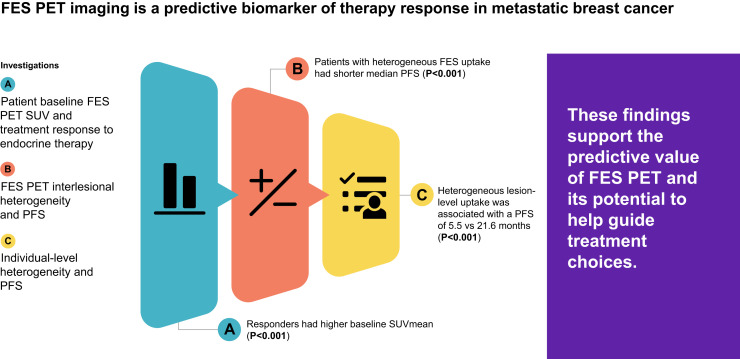 Figure 1
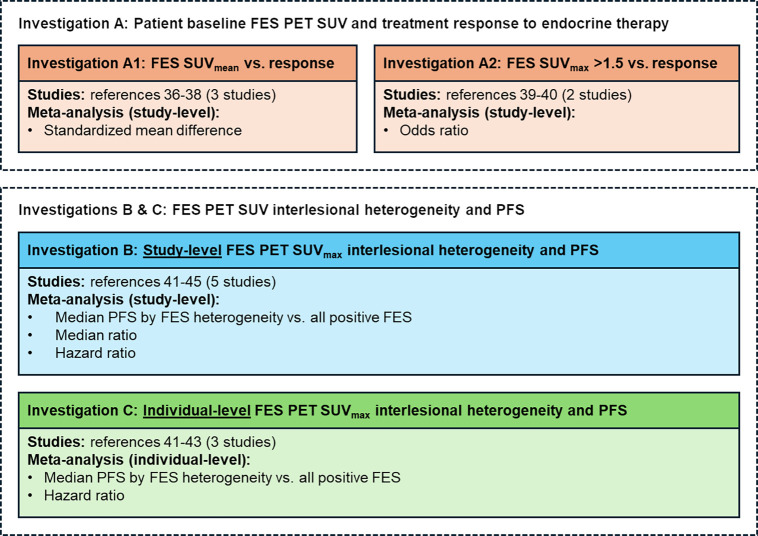 Figure 2
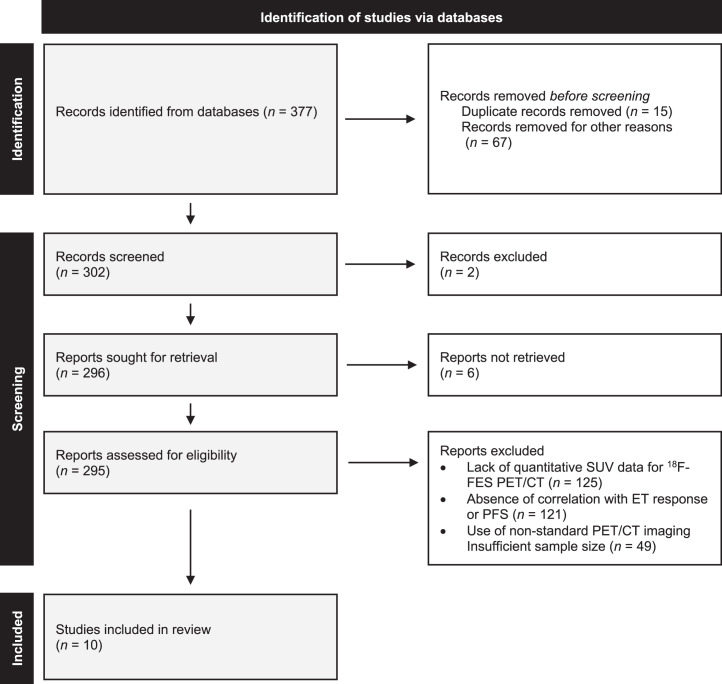 Figure 3
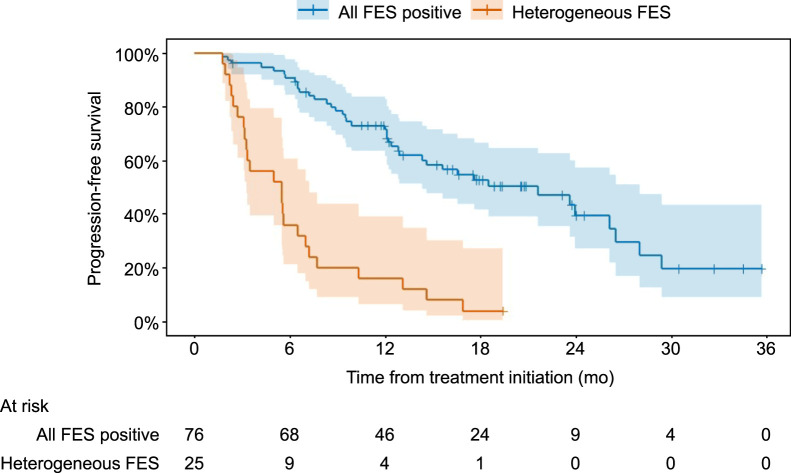 Figure 4
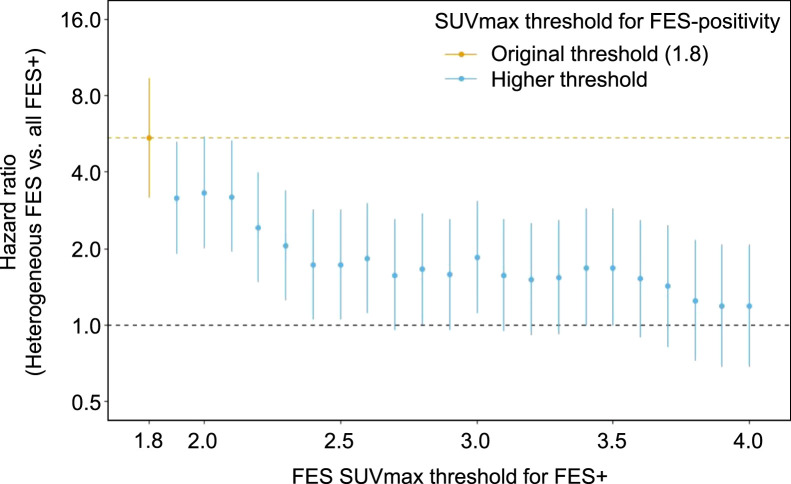 Figure 5
Peer Reviews
No public reviews on file for this paper yet. If you reviewed it on a platform where reviews are public (OpenReview, ICLR, NeurIPS, ICML), you can paste yours below so the community can read it here.
Videos
No videos yet. Explain this paper in a talk, walkthrough, or lecture? Add one.
Taxonomy
TopicsMedical Imaging Techniques and Applications · Breast Cancer Treatment Studies · Estrogen and related hormone effects