Recycling of Polyurethane Waste: Facile Hydrothermal Conversion Using Acidic and Basic Additives
Hongqi Wang, Himanshu Gupta, N. Raveendran Shiju

TL;DR
This study shows how polyurethane waste can be efficiently recycled into monomers using hydrothermal treatment with organic amine catalysts under mild conditions.
Contribution
The use of organic amines, particularly ethylenediamine, is shown to significantly improve polyurethane depolymerization efficiency compared to inorganic catalysts.
Findings
Ethylenediamine achieved a TDA yield of 13.6 wt% and 28.2% PU conversion at 180°C.
Organic amines outperformed inorganic acids and bases due to zwitterion interactions and phase distribution.
Hydrothermal treatment with organic catalysts enables selective PU depolymerization under mild conditions.
Abstract
Polyurethane (PU) is a widely utilised plastic material due to its versatile properties. The chemical recycling, especially by hydrothermal treatment, is an effective way to achieve the circular use of PU. This article reports the results of hydrothermal treatment of PU with and without the use of acidic and basic catalysts. Both non‐catalytic and catalytic approaches showed that PU could be depolymerised to the monomers using hydrothermal treatment. The use of a catalyst improved PU conversion and 2,4‐toluenediamine (TDA) yield. An organic amine showed better catalytic activity than inorganic base NaOH, inorganic acid H2SO4, and organic acid acetic acid. Among the catalysts tested, the organic amine ethylenediamine exhibited the highest activity, achieving a TDA yield of 13.6 wt% and a PU conversion of 28.2% at 180°C. Organic bases outperformed inorganic acids and bases, such as H2SO4,…
Genes, proteins, chemicals, diseases, species, mutations and cell lines named across the full text — each resolved to its canonical identifier and authoritative record.
Click any figure to enlarge with its caption.
 Figure 1
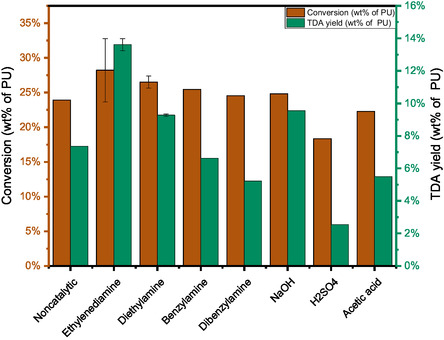 Figure 2
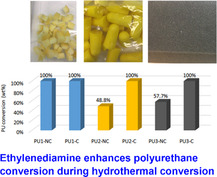 Figure 3
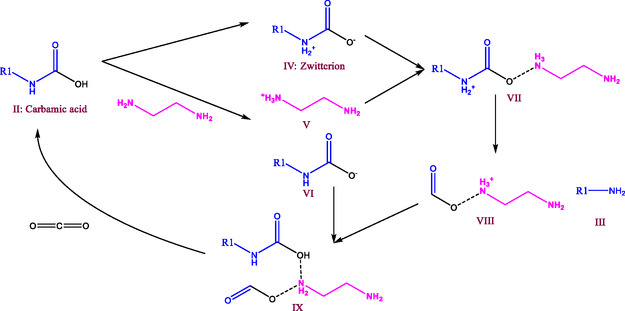 Figure 4
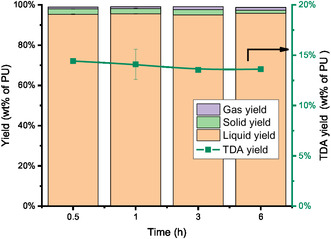 Figure 5
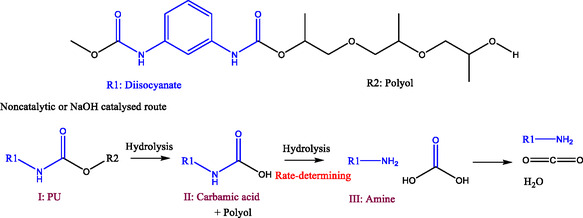 Figure 6
 Figure 7
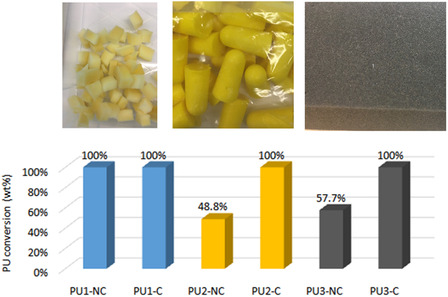 Figure 8
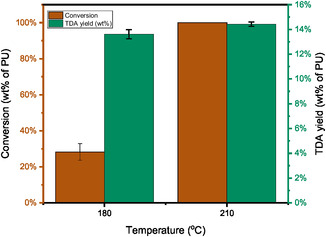 Figure 9
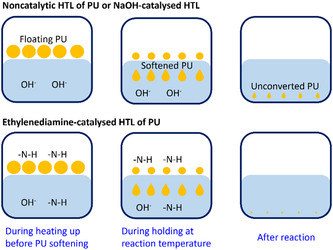 Figure 10
Peer Reviews
No public reviews on file for this paper yet. If you reviewed it on a platform where reviews are public (OpenReview, ICLR, NeurIPS, ICML), you can paste yours below so the community can read it here.
Videos
No videos yet. Explain this paper in a talk, walkthrough, or lecture? Add one.
Taxonomy
TopicsPolymer composites and self-healing · Carbon dioxide utilization in catalysis · Polymer crystallization and properties