Factors Associated with Retention in Routine Well-Care Visits Among Children of Adolescent Mothers Living With and Without HIV: A Community-Based Study in the Eastern Cape, South Africa
Camille Wittesaele, Elona Toska, Lucie D. Cluver, Helen A. Weiss, Aoife M. Doyle

TL;DR
This study examines factors affecting regular well-care visits for children of adolescent mothers in South Africa, finding that rural location and higher maternal education improve retention.
Contribution
The study identifies specific factors associated with retention in well-care visits for children of adolescent mothers, including maternal education and geographic location.
Findings
Retention in well-care visits was highest in rural areas compared to urban areas.
Children of mothers with secondary education had better retention than those with primary education.
Food security and child support grants showed weak but positive associations with retention.
Abstract
To describe well-care visit attendance among children of adolescent mothers living with HIV and HIV-negative adolescent mothers and identify factors associated with optimal retention in the well-care visit schedule up to 18 months. Cross-sectional data were used from a community-based observational cohort study of adolescent mothers (10–19 years; n=481) and their children (≥19 months old; n=502) in the Eastern Cape, South Africa. Optimal well-care visit retention up to 18 months was defined as attending visits within 4 weeks of the recommended child age, attending the 18-month visit and missing no more than one scheduled visit. Attendance was highest at the 6-week visit (88.4%; 95% confidence interval (CI) 85.6% to 91.3%) and lowest at the 18-month visit (58.0%, 95% CI 53.6% to 62.3%). About one-third (36.1%; 95% CI 31.8% to 40.3%) of children were retained to 18 months. Retention…
Genes, proteins, chemicals, diseases, species, mutations and cell lines named across the full text — each resolved to its canonical identifier and authoritative record.
Click any figure to enlarge with its caption.
 Figure 1
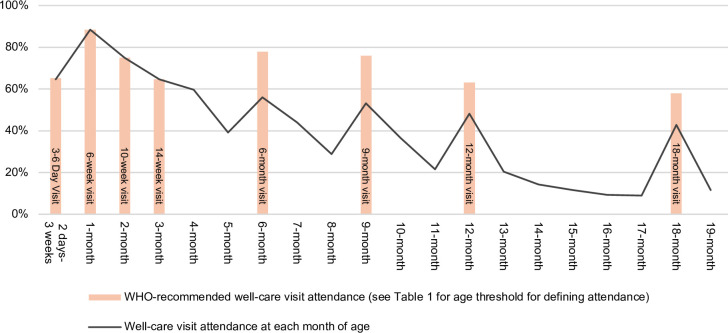 Figure 2
Peer Reviews
No public reviews on file for this paper yet. If you reviewed it on a platform where reviews are public (OpenReview, ICLR, NeurIPS, ICML), you can paste yours below so the community can read it here.
Videos
No videos yet. Explain this paper in a talk, walkthrough, or lecture? Add one.
Taxonomy
TopicsHIV/AIDS Research and Interventions · Adolescent Sexual and Reproductive Health · Poverty, Education, and Child Welfare