Using posterior probability informed thresholds to develop best practice recommendations for MorphoPASSE using the innominate, cranial, and combined traits
Kate M. Lesciotto, Alexandra R. Klales

TL;DR
This study improves the MorphoPASSE program by recommending optimal thresholds and trait sets for accurate sex estimation in forensic casework.
Contribution
The paper introduces posterior probability informed thresholds and recommends best practices for using MorphoPASSE in forensic sex estimation.
Findings
Using a PPIT of 0.85–1.00 achieved 97.3% accuracy with innominate traits and 90.2% with cranial traits.
The combined set of traits with a PPIT of 0.75–1.00 achieved 99.6% accuracy and corrected prior misclassifications.
The study recommends using the combined trait model with a PPIT of 0.75–1.00 for forensic sex estimation.
Abstract
MorphoPASSE is a free program that estimates sex based on morphological traits of the innominate, cranium, or a combined set of traits; however, MorphoPASSE does not provide recommendations on which set of traits performs best or recommend a posterior probability (PP) threshold for sex classification in modern forensic casework. The goals of this study were to compare accuracy rates when using different sets of traits and when imposing posterior probability informed thresholds (PPITs). Innominate and cranial trait score data were collected from four modern US documented skeletal collections (n = 285). Accuracy rates for five mutually exclusive PP intervals were calculated, and PP intervals that were significantly different from chance were condensed into PPITs. Using a PPIT of 0.85–1.00 produced high accuracy rates of 97.3% for the innominate traits and 90.2% for the cranial traits.…
Genes, proteins, chemicals, diseases, species, mutations and cell lines named across the full text — each resolved to its canonical identifier and authoritative record.
Click any figure to enlarge with its caption.
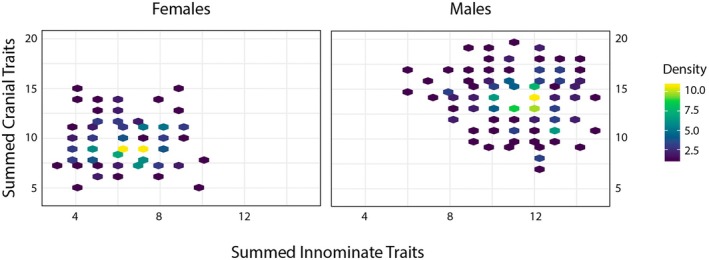 Figure 1
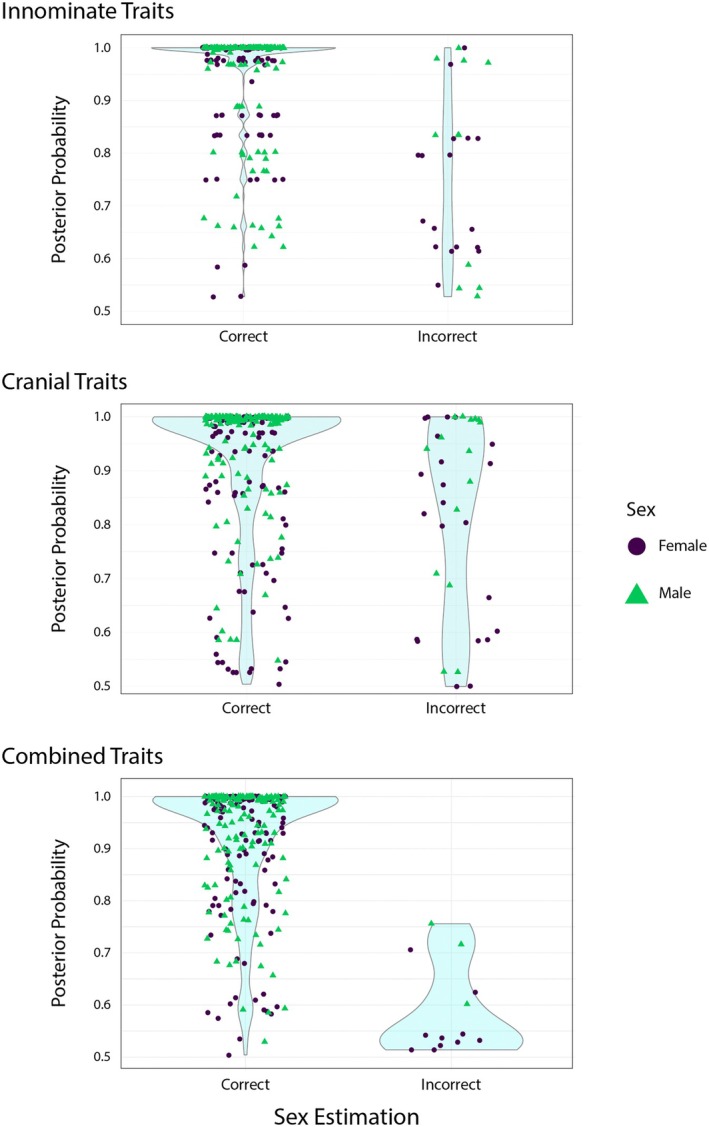 Figure 2
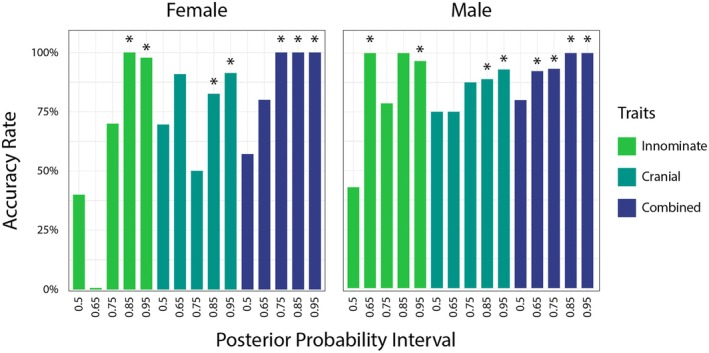 Figure 3
Peer Reviews
No public reviews on file for this paper yet. If you reviewed it on a platform where reviews are public (OpenReview, ICLR, NeurIPS, ICML), you can paste yours below so the community can read it here.
Videos
No videos yet. Explain this paper in a talk, walkthrough, or lecture? Add one.
Taxonomy
TopicsForensic Anthropology and Bioarchaeology Studies · Forensic and Genetic Research · Autopsy Techniques and Outcomes