Estimating shared polygenicity identifies novel druggable genes for Alzheimer's disease
Noah J Lorincz‐Comi, Feixiong Cheng

TL;DR
This paper introduces a Bayesian method to identify genes uniquely linked to Alzheimer's disease or shared with other conditions, helping find safer drug targets.
Contribution
A novel Bayesian method is introduced to estimate shared polygenicity and identify AD-exclusive and AD-pleiotropic genes.
Findings
At least 367 genes independently associate with Alzheimer's disease, with only 17 being AD-exclusive and druggable.
APOA2 is identified as a repurposable candidate for AD prevention due to its high posterior probability for AD and Bipolar Disorder.
The genetic correlation between AD and Bipolar Disorder was 0.22, suggesting shared mechanisms and potential drug repurposing.
Abstract
Identifying genes which are associated only with Alzheimer's disease (‘AD exclusive’) vs those which are additionally associated with other phenotypes (‘AD pleiotropic’) has been historically challenging because of a lack of inferential approaches. AD exclusive genes may be potential drug targets because of their lower potential for off‐target side effects, and AD pleiotropic genes may be repurposable drug candidates if the directions of association are in protective directions for the other traits and AD. We introduce a general Bayesian method which returns posterior probabilities (PP) that a gene is AD exclusive or AD pleiotropic by estimating its shared polygenic architecture with multiple other phenotypes. This method requires only gene‐based association test statistics from summary level genome‐wide association study (GWAS) data. We searched for AD exclusive and pleotropic genes…
Genes, proteins, chemicals, diseases, species, mutations and cell lines named across the full text — each resolved to its canonical identifier and authoritative record.
Click any figure to enlarge with its caption.
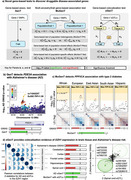 Figure 1
Peer Reviews
No public reviews on file for this paper yet. If you reviewed it on a platform where reviews are public (OpenReview, ICLR, NeurIPS, ICML), you can paste yours below so the community can read it here.
Videos
No videos yet. Explain this paper in a talk, walkthrough, or lecture? Add one.
Taxonomy
TopicsGenetic Associations and Epidemiology · Bioinformatics and Genomic Networks · Alzheimer's disease research and treatments