Antimicrobial stewardship in long term care facilities: evidence based interventions, implementation tools, and impact metrics
Tristan T. Timbrook, Chelsea Campbell, Pamela Bailey

TL;DR
This paper reviews antimicrobial stewardship programs in nursing homes, focusing on effective interventions and tools to improve antibiotic use.
Contribution
The paper provides a synthesis of evidence-based interventions and practical tools for implementing antimicrobial stewardship in long-term care.
Findings
High compliance rates may not reflect true clinical effectiveness in antimicrobial stewardship.
Evidence-based interventions and tools can guide stewardship in resource-variable nursing homes.
Proposed metrics aim to measure the impact of stewardship programs.
Abstract
While Centers for Medicare and Medicaid Services-mandated Antimicrobial Stewardship Programs are now in place across U.S. skilled nursing facilities, reported high rates of compliance may mask persistent gaps in clinical effectiveness. This review summarizes evidence-based antimicrobial stewardship interventions, their impact, and practical tools to support implementation. Resources from Centers for Disease Control and Prevention, Agency for Healthcare Research and Quality, other frameworks, and proposed metrics are highlighted to guide effective stewardship in resource-variable nursing home settings.
Genes, proteins, chemicals, diseases, species, mutations and cell lines named across the full text — each resolved to its canonical identifier and authoritative record.
Click any figure to enlarge with its caption.
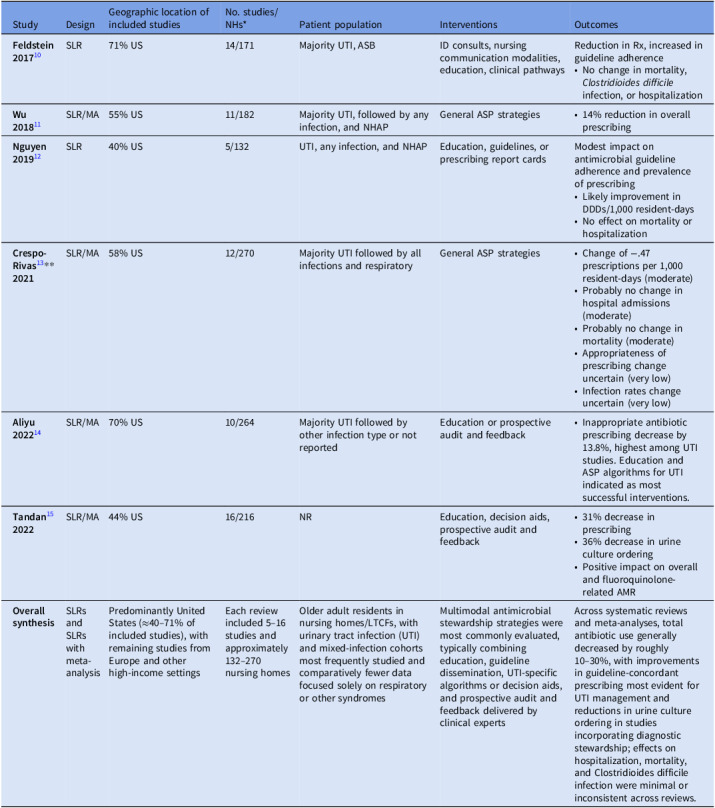 Figure 1
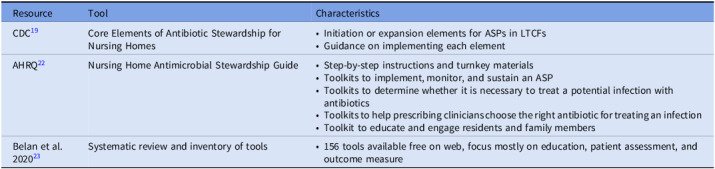 Figure 2
Peer Reviews
No public reviews on file for this paper yet. If you reviewed it on a platform where reviews are public (OpenReview, ICLR, NeurIPS, ICML), you can paste yours below so the community can read it here.
Videos
No videos yet. Explain this paper in a talk, walkthrough, or lecture? Add one.
Taxonomy
TopicsUrinary Tract Infections Management · Antibiotic Use and Resistance · Infection Control in Healthcare