Development and pilot of a tool evaluating community-engaged group processes and community-centered impact for institutional level advisory boards
Michele Allen, Yasamin Graff, Caroline Carlin, Antonia Apolinario-Wilcoxon, Paulette Baukol, Kristin Boman, LaPrincess Brewer, Roli Dwivedi, Milton Eder, Susan Gust, Mikow Hang, Walter Novillo, Luis Ortega, Shannon Pergament, Chris Pulley, Rebecca Shirley, Sida Ly-Xiong

TL;DR
This paper introduces a new evaluation tool for community-academic advisory groups, using mixed methods to assess group processes and community-centered outcomes.
Contribution
The novel contribution is a participatory mixed-method evaluation approach for institutional advisory groups, co-developed with community and academic partners.
Findings
The survey identified positive assessments of group process outcomes like shared values and community-centeredness.
Storytelling sessions revealed concerns about power-sharing, decision-making, funding equity, and trust-building.
The evaluation approach proved useful for highlighting discrepancies and improving community-academic collaboration.
Abstract
While evaluation approaches for community-academic research groups are established, few tools exist for academic institutional advisory groups across multi-core centers and research, education, and clinical care missions. Institutional advisory group evaluation should consider group processes and their impact on community-centered outcomes. This study describes the community-engaged development of a mixed-method evaluation approach to address this gap and presents pilot outcomes across an NIH-funded center. We utilized a Community of Practice model to co-develop a survey with 14 community and academic representatives of four advisory groups. The final survey included five categories of group process and four categories of outcomes. Storytelling sessions with community partners explored areas where the survey identified discrepancies in perspectives between community and academic team…
Genes, proteins, chemicals, diseases, species, mutations and cell lines named across the full text — each resolved to its canonical identifier and authoritative record.
Click any figure to enlarge with its caption.
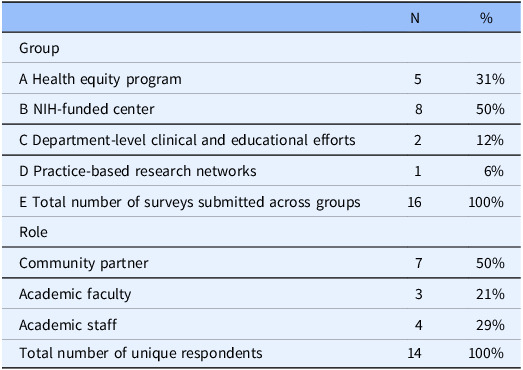 Figure 1
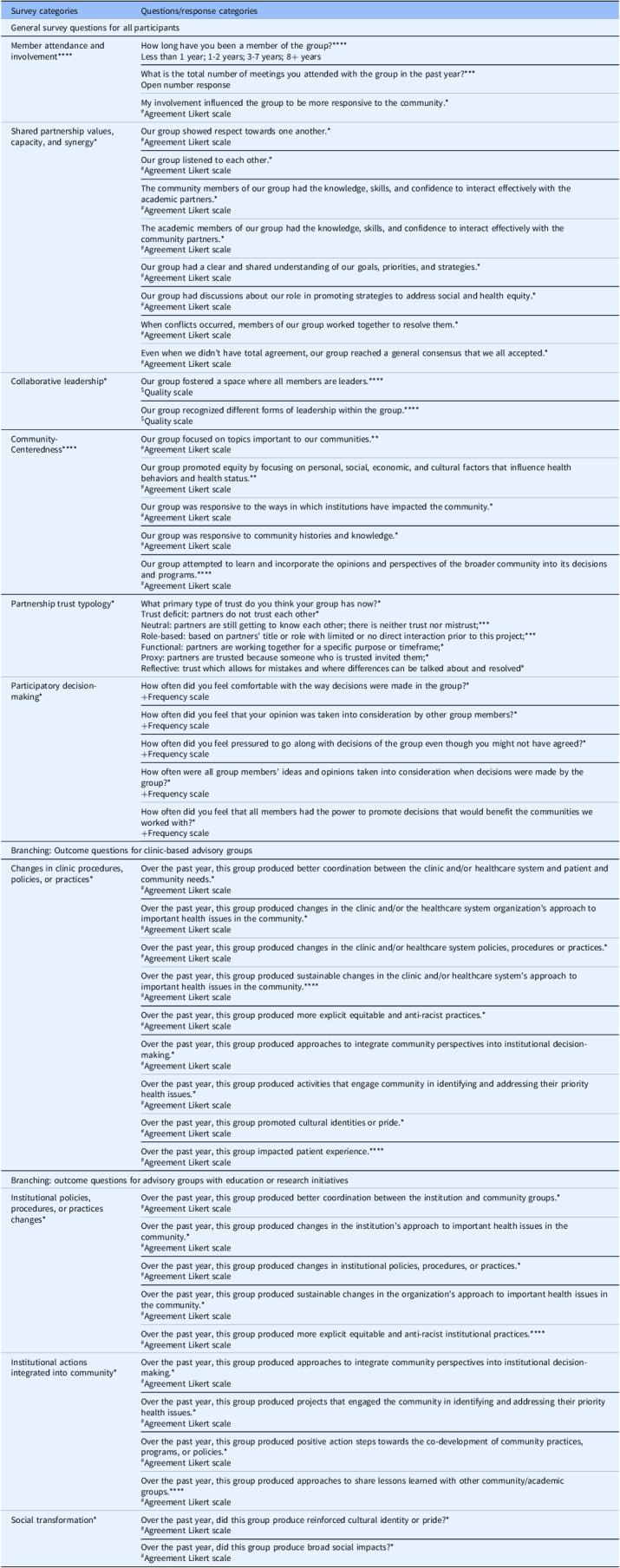 Figure 2
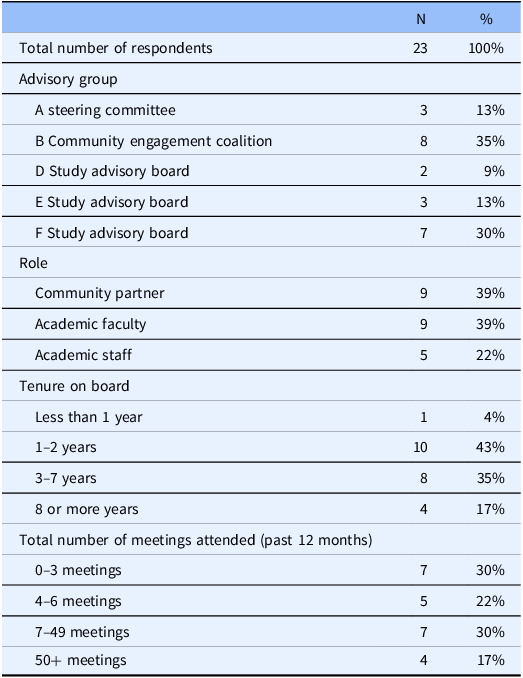 Figure 3
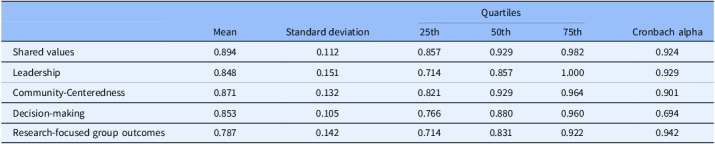 Figure 4
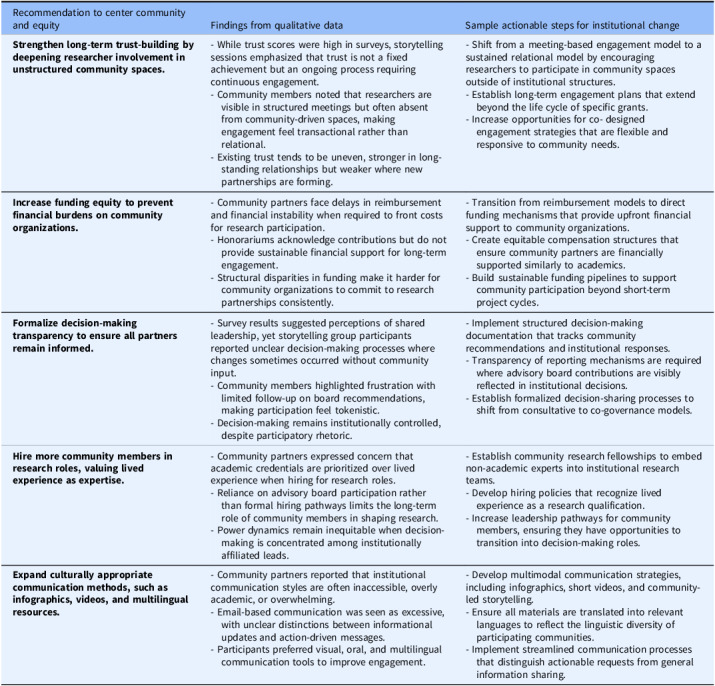 Figure 5
Peer Reviews
No public reviews on file for this paper yet. If you reviewed it on a platform where reviews are public (OpenReview, ICLR, NeurIPS, ICML), you can paste yours below so the community can read it here.
Videos
No videos yet. Explain this paper in a talk, walkthrough, or lecture? Add one.
Taxonomy
TopicsCommunity Health and Development · Community and Sustainable Development · Evaluation and Performance Assessment