Adaptive modelling approach for predicting causes of death: insights from verbal autopsy data in Tanzania
Mahadia Tunga, James Chambua, Juma Lungo

TL;DR
This paper introduces a machine learning model that improves accuracy in predicting causes of death using verbal autopsy data from Tanzania.
Contribution
The study introduces an adaptive Bayesian networks model with a CoD decision flow, which has not been previously operationalized in VA research.
Findings
The model achieved 97% accuracy, outperforming Support Vector Machine and Naïve Bayesian models.
It demonstrated high specificity (97%) and sensitivity (94%), indicating strong performance in CoD classification.
The model's adaptability allows for improved predictions as datasets expand.
Abstract
The World Health Organization (WHO) has approved the use of a verbal autopsy (VA), a survey-based approach to generate out-of-hospital causes of death (CoDs). Through this study, an adaptive Bayesian networks machine learning model was developed and tested. The model is scalable and adaptable for predicting new causes as the dataset expands. The 2016 WHO questionnaire was used to collect data from Iringa, Tanzania, and data augmentation was performed using the Synthetic Minority Oversampling Technique for nominal features to increase the dataset size and reduce bias in the CoD classification. The model development was guided by a CoD decision flow that integrates essential factors and steps for accurate CoD prediction. To our knowledge, no previous study has provided this operational guide for VA cause of death prediction. The model was evaluated using accuracy, sensitivity,…
Genes, proteins, chemicals, diseases, species, mutations and cell lines named across the full text — each resolved to its canonical identifier and authoritative record.
Click any figure to enlarge with its caption.
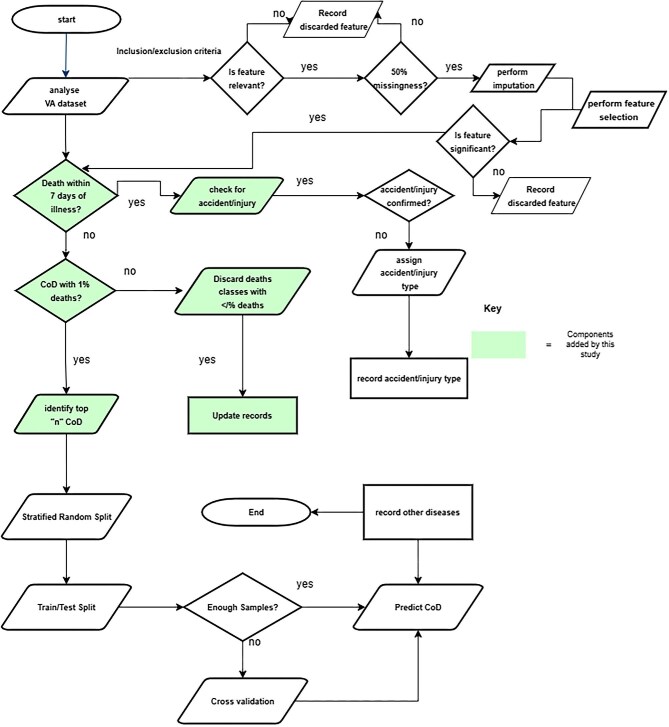 Figure 1
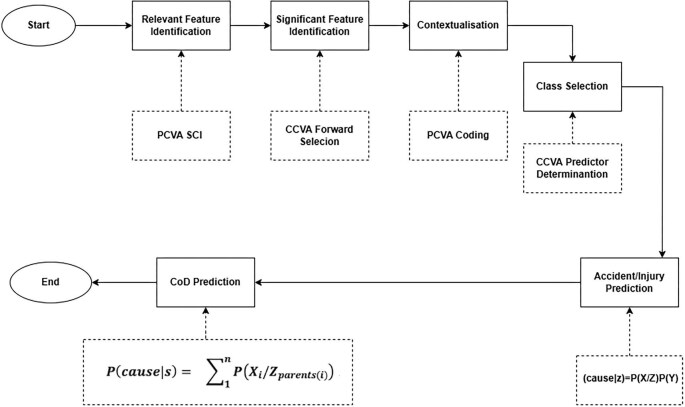 Figure 2
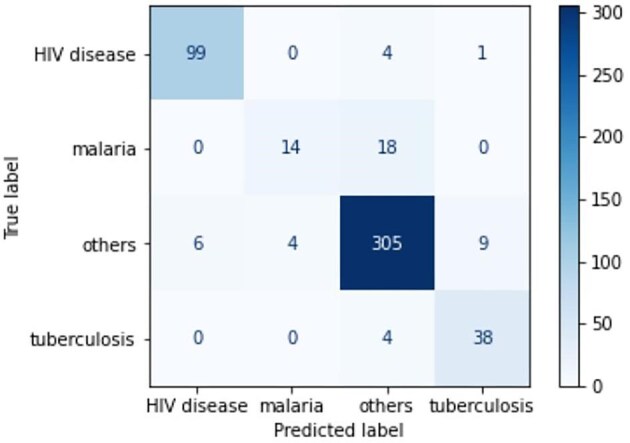 Figure 3
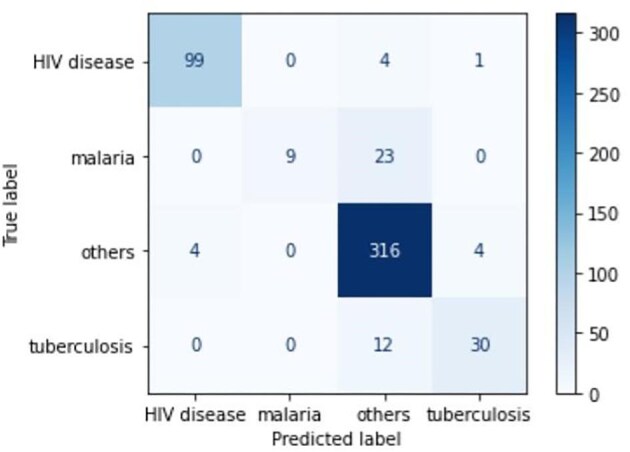 Figure 4
Peer Reviews
No public reviews on file for this paper yet. If you reviewed it on a platform where reviews are public (OpenReview, ICLR, NeurIPS, ICML), you can paste yours below so the community can read it here.
Videos
No videos yet. Explain this paper in a talk, walkthrough, or lecture? Add one.
Taxonomy
TopicsMachine Learning in Healthcare · Artificial Intelligence in Healthcare and Education · Autopsy Techniques and Outcomes