Efficacy and safety of perospirone as adjunctive therapy in major depressive disorder patients with inadequate response to antidepressants: a randomized clinical trial
Jin Liu, Sirui Gao, Bangshan Liu, Yumeng Ju, Mei Liao, Li Zhang, Zexuan Li, Qianqian Zhang, Xiaotian Zhao, Hao Tang, Ruhong Jiang, Jian Zhou, Danfeng Yan, Zhiren Wang, Yixiong Zheng, Duanfang Cai, Ning Wei, Yunshu Zhang, Han Yu, Lijun Ding, Binhong Wang, Guangya Liu, Keqing Li

TL;DR
This clinical trial tested perospirone as an add-on treatment for depression when antidepressants alone aren't enough, finding it improved remission rates but not overall response.
Contribution
The study provides new evidence on perospirone's efficacy and safety as an adjunctive treatment for major depressive disorder.
Findings
Perospirone improved remission rates compared to placebo in MDD patients.
Adverse events were mild and comparable between groups.
Clinical response rates were similar between perospirone and placebo.
Abstract
Adjunctive therapy with a second-generation antipsychotic (SGA) represents a treatment option for major depressive disorder (MDD) patients with inadequate response to antidepressants. Evidence suggests that early initiation of adjunctive SGA treatment may yield greater benefits. This study aimed to investigate the efficacy, safety, and tolerability of adjunctive therapy with perospirone initiated after 4 weeks of antidepressant treatment in MDD patients with inadequate response. This phase IV, multi-center, randomized, double-blind, placebo-controlled trial assessed the efficacy, safety and tolerability of perospirone as an adjunct to serotonin norepinephrine reuptake inhibitors (SNRIs) or selective serotonin reuptake inhibitors (SSRIs) in patients with MDD who showed inadequate response to SSRIs/SNRIs. Patients with moderate-to-severe depression (defined as a baseline…
Genes, proteins, chemicals, diseases, species, mutations and cell lines named across the full text — each resolved to its canonical identifier and authoritative record.
Click any figure to enlarge with its caption.
 Figure 1
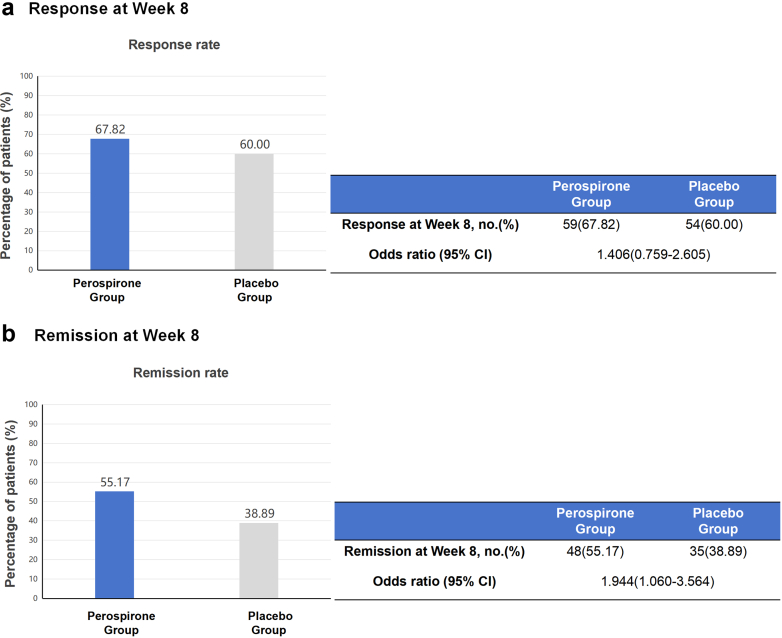 Figure 2
Peer Reviews
No public reviews on file for this paper yet. If you reviewed it on a platform where reviews are public (OpenReview, ICLR, NeurIPS, ICML), you can paste yours below so the community can read it here.
Videos
No videos yet. Explain this paper in a talk, walkthrough, or lecture? Add one.
Taxonomy
TopicsTreatment of Major Depression · Tryptophan and brain disorders · Pharmacological Receptor Mechanisms and Effects