Positively and negatively charged additives modulate microbial-induced carbonate precipitation (MICP) for lead-contaminated loess remediation
Jihua Gao, Wenle Hu, Pengli He, Longping Luo, Shixu Zhang, Zifeng Hui, Chongyang Zhang, Kangwei Wang, Rong Fan

TL;DR
This study explores how charged additives affect microbial-induced carbonate precipitation to strengthen and stabilize lead-contaminated soil.
Contribution
The study introduces a novel approach using charged additives to regulate MICP for Pb-contaminated loess remediation.
Findings
Graphene oxide (GO) significantly improved mechanical strength and Pb immobilization in loess.
Calcium lignosulfonate (Ca-Ls) provided moderate improvements in strength and Pb leaching reduction.
Chitosan (CS) suppressed microbial activity and resulted in higher Pb leaching levels.
Abstract
The remediation of heavy metal-contaminated loess remains a critical environmental and geotechnical challenge. In this study, microbial-induced carbonate precipitation (MICP) was applied to Pb-contaminated loess with three representative additives: graphene oxide (GO), calcium lignosulfonate (Ca-Ls) and chitosan (CS). Mechanistic evaluation combined zeta potential analysis, scanning electron microscopy (SEM), unconfined compressive strength (UCS) tests and Pb2+ leaching experiments under freeze–thaw cycles. Results show that GO enhanced surface charge density, with zeta potential reaching about minus sixteen millivolts, contracted the diffuse double layer, and produced dense carbonate bridges. This treatment yielded the highest UCS, reaching about four hundred and sixty kilopascals initially and maintaining about three hundred and fifty kilopascals after nine freeze–thaw cycles. Pb2+…
Genes, proteins, chemicals, diseases, species, mutations and cell lines named across the full text — each resolved to its canonical identifier and authoritative record.
Click any figure to enlarge with its caption.
 Figure 1
 Figure 2
 Figure 3
 Figure 4
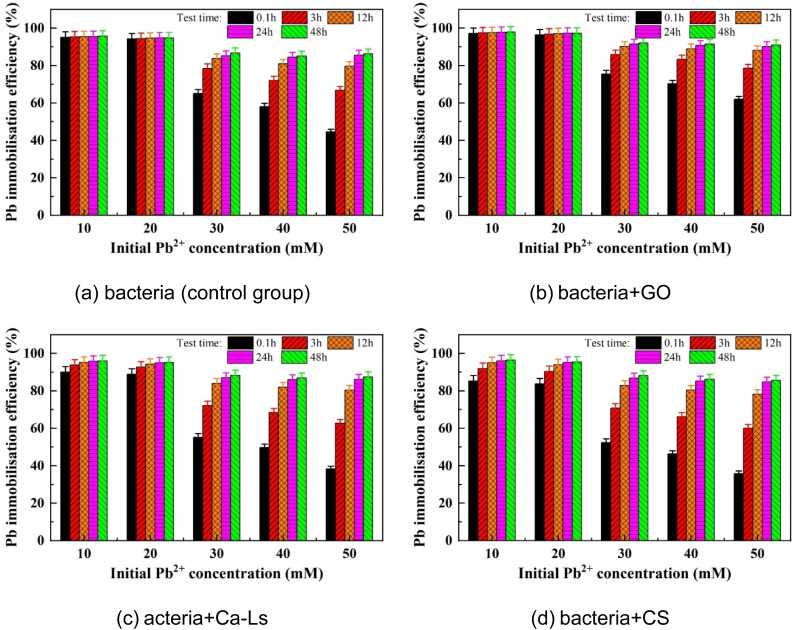 Figure 5
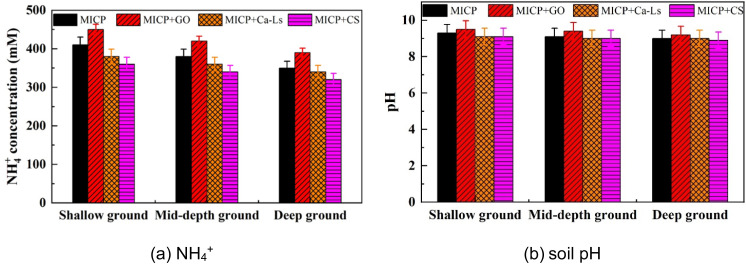 Figure 6
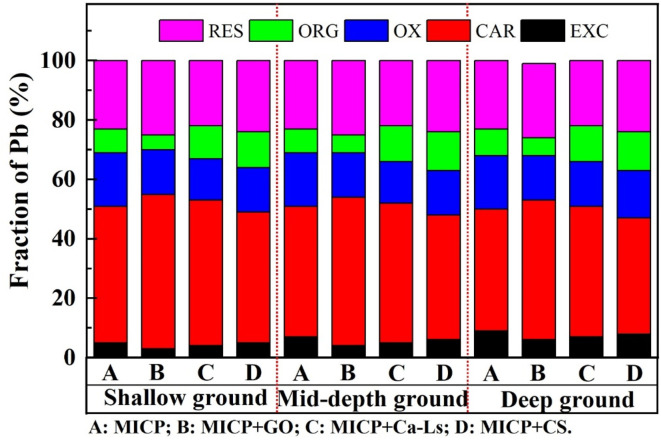 Figure 7
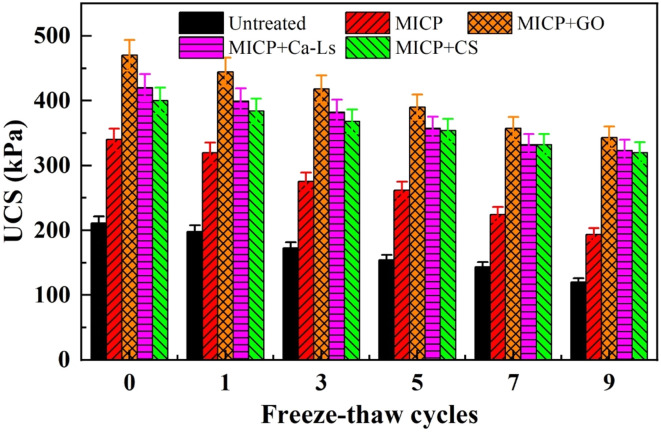 Figure 8
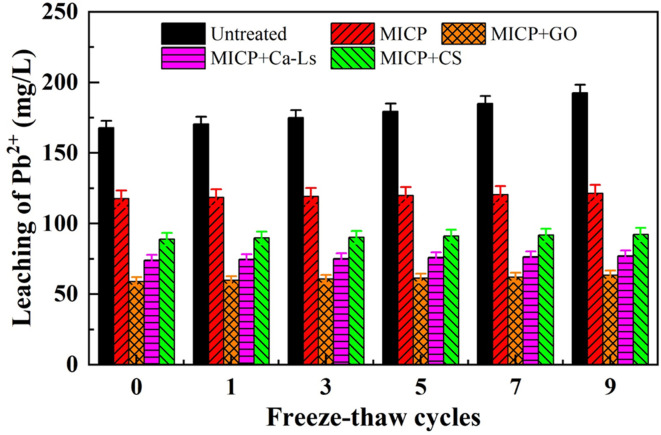 Figure 9
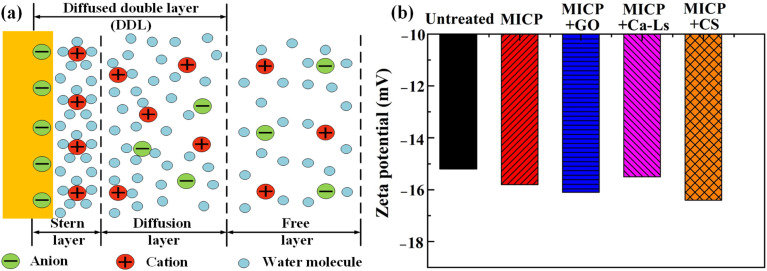 Figure 10
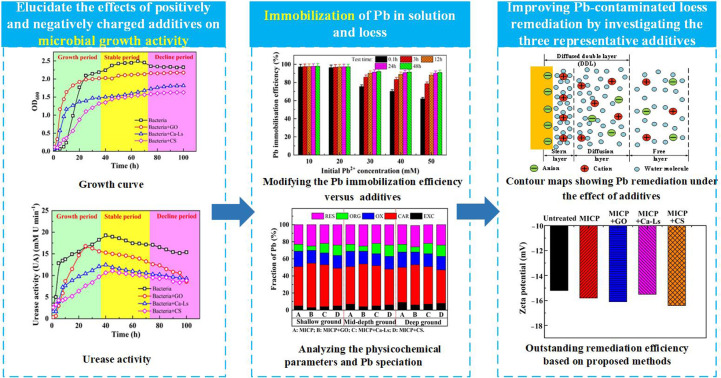 Figure 11
Peer Reviews
No public reviews on file for this paper yet. If you reviewed it on a platform where reviews are public (OpenReview, ICLR, NeurIPS, ICML), you can paste yours below so the community can read it here.
Videos
No videos yet. Explain this paper in a talk, walkthrough, or lecture? Add one.
Taxonomy
TopicsMicrobial Applications in Construction Materials · Concrete and Cement Materials Research · Microbial bioremediation and biosurfactants