Percutaneous Pulmonary Valve Perforation in Pulmonary Atresia With Intact Ventricular Septum: Multicenter Comparison of Radiofrequency Versus Chronic Total Occlusion Wires
Arash Salavitabar, Sara Conroy, Isaac Kistler, Asaad Beshish, Ryan Callahan, Matthew A. Crystal, Howaida El-Said, Bryan Goldstein, Michael Hainstock, Ray Lowery, Amr Matoq, Daniel McLennan, George T. Nicholson, Brian P. Quinn, Shyam Sathanandam, Jessica Tang, Sara M. Trucco

TL;DR
This study compares two techniques for a high-risk heart procedure in newborns and finds similar success rates but potential differences in complications.
Contribution
The study provides a multicenter comparison of RF and CTO wires for pulmonary valve perforation in PA/IVS.
Findings
Procedural success rates were similar between RF and CTO wires at 94%.
CTO wire use was associated with smaller balloons and more frequent use of multiple balloons.
RF wire cases had higher complication rates compared to CTO wire cases, though not statistically significant.
Abstract
Percutaneous radiofrequency (RF) wire pulmonary valve perforation (PVP) in pulmonary atresia/intact ventricular septum (PA/IVS) is a high-risk procedure. This study compared procedural efficacy and complications between RF and chronic total occlusion (CTO) wire PVP. This multicenter study included patients with PA/IVS who had PVP attempted at 13 centers. Outcomes of interest were efficacy and complications. Univariable logistic regression models were used to estimate odds ratios and risk differences. PVP was attempted in 206 patients; median age 3.0 days (1.0-6.0) and weight 3.1 kg (2.7-3.5). The RF PVP was attempted first in 165 (80.0%) patients, CTO in 27 (13.1%), and stiff end of the coronary wire in 14 (6.8%). The procedural success rate of 94% was similar between wire types. CTO group utilized smaller initial valvuloplasty balloons (2.25 mm [2-3] vs 4 mm [3-6]) and >2 balloons in…
Genes, proteins, chemicals, diseases, species, mutations and cell lines named across the full text — each resolved to its canonical identifier and authoritative record.
Click any figure to enlarge with its caption.
 Figure 1
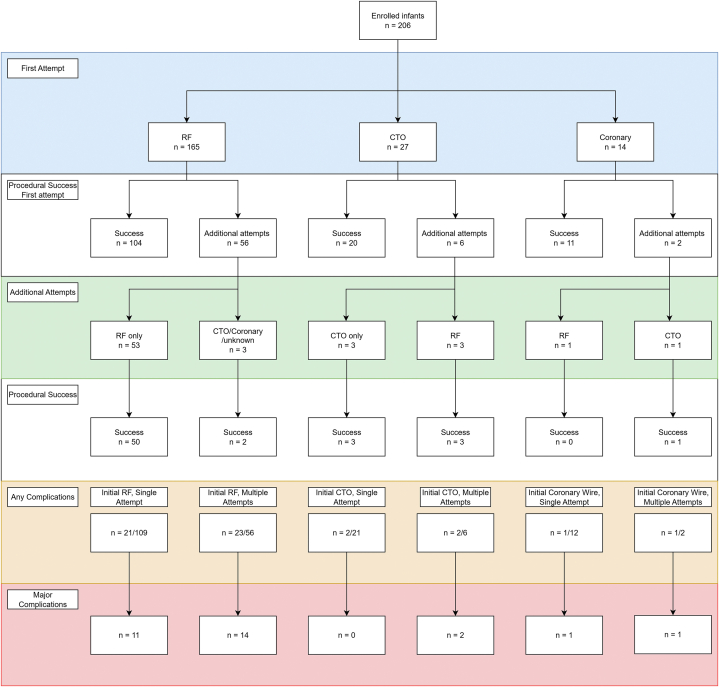 Figure 2
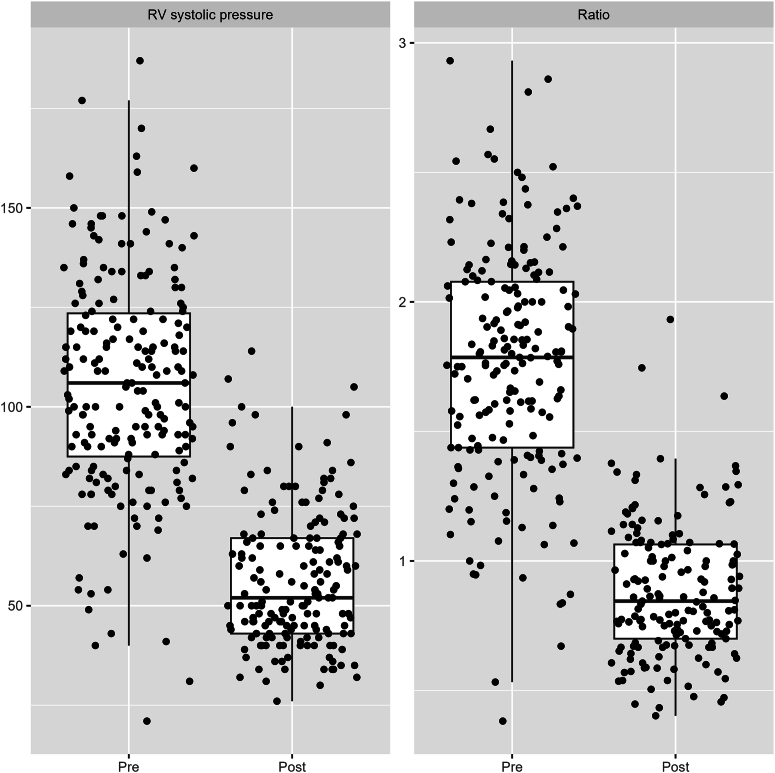 Figure 3
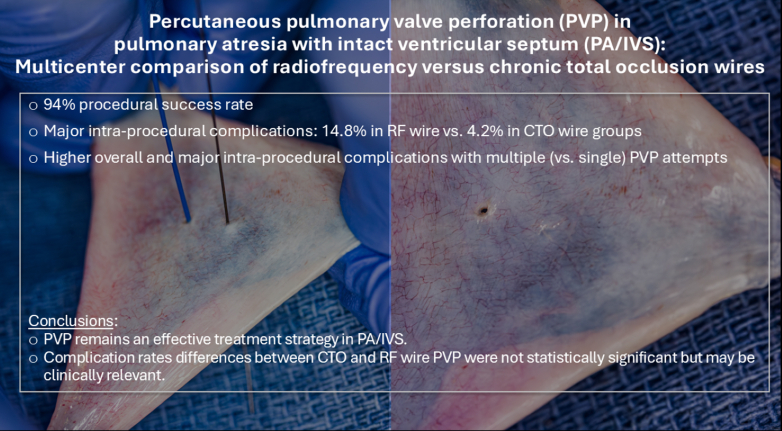 Figure 4
Peer Reviews
No public reviews on file for this paper yet. If you reviewed it on a platform where reviews are public (OpenReview, ICLR, NeurIPS, ICML), you can paste yours below so the community can read it here.
Videos
No videos yet. Explain this paper in a talk, walkthrough, or lecture? Add one.
Taxonomy
TopicsCongenital Heart Disease Studies · Cardiac Valve Diseases and Treatments · Congenital Diaphragmatic Hernia Studies