Identifying health conditions in older adults in textual health records using deep learning-based natural language processing
Jake Lin, Anna Kuukka, Tomi Korpi, Anna Tirkkonen, Antti Kariluoto, Juho Kaijansinkko, Maija Satamo, Hanna Pajulammi, Markus J. Haapanen, Sergei Häyrynen, Eetu Pursiainen, Daniel Ciovica, Mikaela B. von Bonsdorff, Juulia Jylhävä

TL;DR
This study uses deep learning to find health issues like falls and incontinence in older adults from unstructured medical records, showing better results than traditional methods.
Contribution
The novel use of deep learning-based NER to identify underreported health conditions in older adults from free-text health records.
Findings
NER models outperformed diagnostic codes in identifying falls and incontinence with F1 scores above 0.80.
NER-identified conditions showed stronger mortality hazard ratios compared to diagnostic codes.
The study highlights the potential of NER to improve patient care by uncovering hidden health risks in unstructured data.
Abstract
Many clinically significant health conditions in older adults are underreported or only recorded in unstructured health records. These records, however, contain valuable information for patient care and prognosis. This study utilized 10.6 million free-text entries from the electronic health records of 102,525 patients aged 50–80 across various care settings in Finland from 2010 to 2022. A deep learning-based natural language processing model was employed to perform named entity recognition (NER) to identify falls, incontinence, loneliness, and mobility limitations from the free-text entries. The performance of the NER models was evaluated by precision, recall and F1 scores. Diagnostic codes for incontinence and falls were collected for comparisons. Cox regression models were used to assess the predictive value of the identified conditions for all-cause mortality. The NER models…
Genes, proteins, chemicals, diseases, species, mutations and cell lines named across the full text — each resolved to its canonical identifier and authoritative record.
Click any figure to enlarge with its caption.
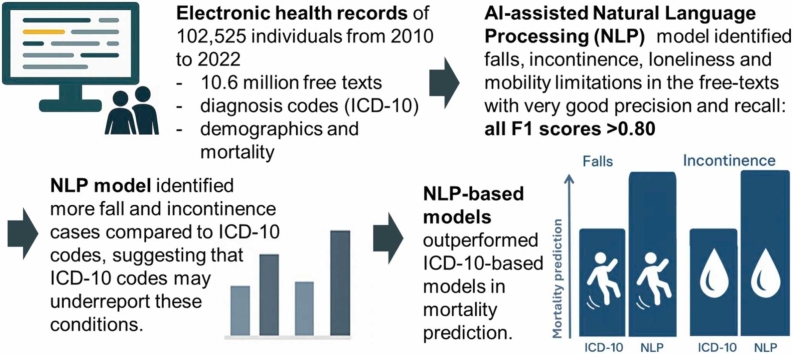 Figure 1
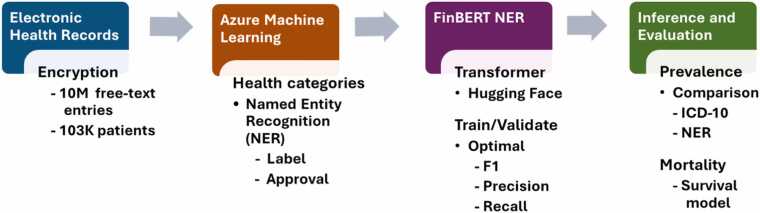 Figure 2
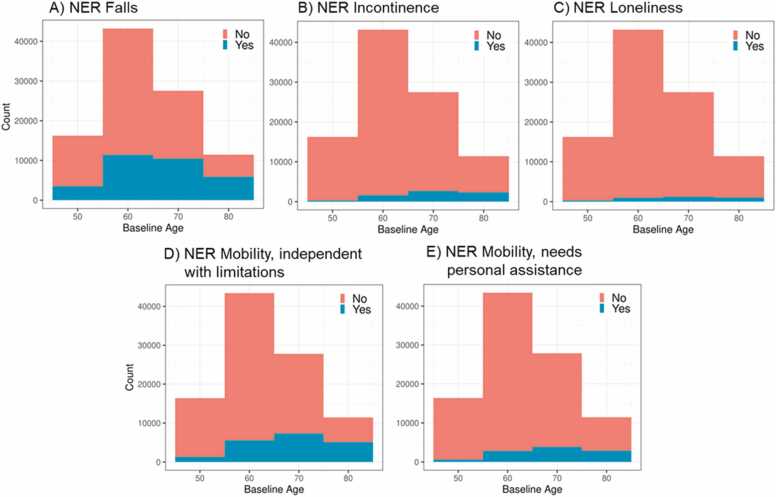 Figure 3
Peer Reviews
No public reviews on file for this paper yet. If you reviewed it on a platform where reviews are public (OpenReview, ICLR, NeurIPS, ICML), you can paste yours below so the community can read it here.
Videos
No videos yet. Explain this paper in a talk, walkthrough, or lecture? Add one.
Taxonomy
TopicsMachine Learning in Healthcare · Topic Modeling · Artificial Intelligence in Healthcare