Near infrared light controlled gene editing
Mikhail Y. Berezin

TL;DR
This paper introduces a new CRISPR system controlled by near infrared light for precise and noninvasive gene editing in living organisms.
Contribution
A novel CRISPR system using near infrared light and a cleavable dimer for deeper tissue penetration and low toxicity.
Findings
The system enables precise and rapid gene regulation with minimal background activity.
It offers deeper tissue penetration and low toxicity compared to previous light-driven systems.
The platform is suitable for preclinical and clinical gene editing applications.
Abstract
A novel NIR light-activated CRISPR-dCas9/Cas9 system achieves precise and rapid gene regulation in living organism using a chemically cleavable rapamycin dimer. Unlike previous light-driven systems, this approach offers deeper tissue penetration, low toxicity, fast response, and minimal background activity. This platform opens new directions for highly efficient, targeted, noninvasive, and spatially confined gene editing for a great number of preclinical and clinically translatable applications.
Genes, proteins, chemicals, diseases, species, mutations and cell lines named across the full text — each resolved to its canonical identifier and authoritative record.
Click any figure to enlarge with its caption.
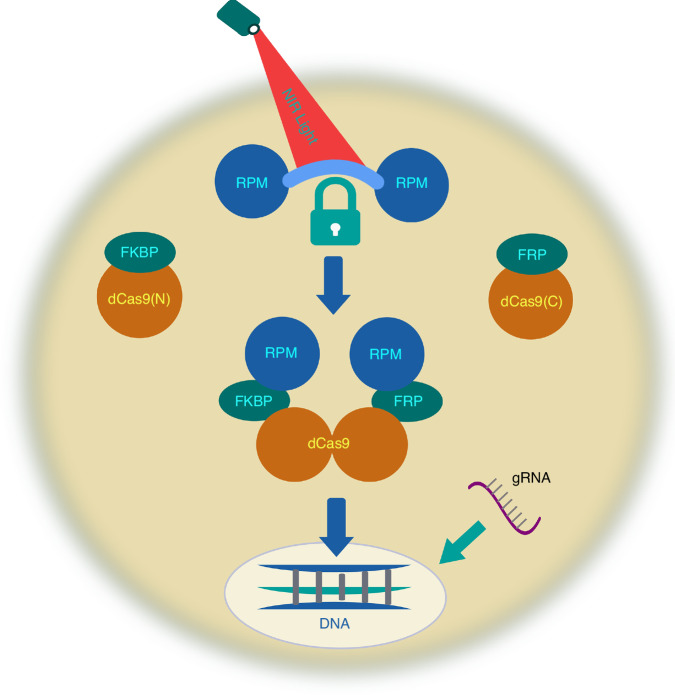 Figure 1
Peer Reviews
No public reviews on file for this paper yet. If you reviewed it on a platform where reviews are public (OpenReview, ICLR, NeurIPS, ICML), you can paste yours below so the community can read it here.
Videos
No videos yet. Explain this paper in a talk, walkthrough, or lecture? Add one.
Taxonomy
TopicsCRISPR and Genetic Engineering · Photochromic and Fluorescence Chemistry · Light effects on plants