Perineural Invasion Worsens Long-Term Outcomes of Pancreatic Neuroendocrine Tumors Following Surgical Resection
Hui Xu, Jing-Jing Hou, Jun-Xi Xiang, Alexandra G. Lopez-Aguiar, George Poultsides, Flavio Rocha, Sharon Weber, Ryan Fields, Kamran Idrees, Cliff Cho, Shishir K. Maithel, Yi Lv, Xu-Feng Zhang, Timothy M. Pawlik

TL;DR
Perineural invasion in pancreatic neuroendocrine tumors is linked to worse long-term survival after surgery, even in early-stage cases.
Contribution
This study identifies perineural invasion as an independent prognostic factor for pancreatic neuroendocrine tumors after resection.
Findings
Perineural invasion was associated with higher tumor grade, more advanced T stage, and more nodal metastasis.
Patients with perineural invasion had significantly worse overall and disease-free survival.
Perineural invasion remained a strong independent risk factor even in early-stage, completely resected tumors.
Abstract
To define the impact of perineural invasion (PNI) on long-term survival of patients following curative-intent resection of pancreatic neuroendocrine tumors (pNETs). Patients with pNETs who underwent curative-intent resection (R0/R1) between 2000 and 2020 were identified from a multi-institutional database. The impacts of PNI on overall survival (OS) and disease-free survival (DFS) were analyzed. Among 700 patients, 171 (n = 24.4%) had a pNET with PNI. The presence of PNI was associated with higher tumor grade (G3, 8.2% vs. 2.5%, p < 0.001), more advanced AJCC T disease (T3–T4, 58.5% vs. 15.9%, p < 0.001), and a higher incidence of nodal metastasis (52.6% vs. 21.2%, p < 0.001) versus patients with no PNI. Patients with PNI had a worse OS (median, with PNI 115.9 months vs. no PNI not reached, p < 0.001) and DFS (median, with PNI 51.9 vs. no PNI 115.4 months, p < 0.001) versus patients…
Genes, proteins, chemicals, diseases, species, mutations and cell lines named across the full text — each resolved to its canonical identifier and authoritative record.
Click any figure to enlarge with its caption.
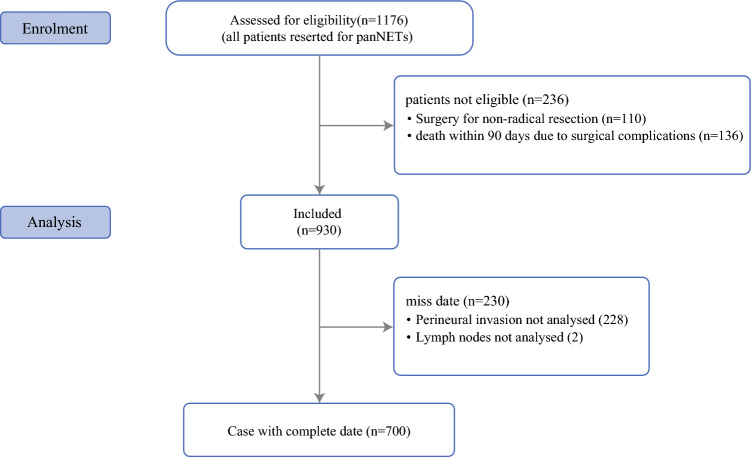 Figure 1
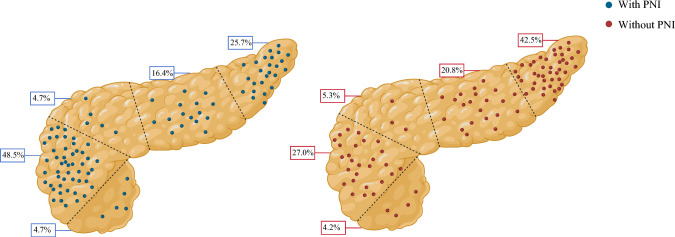 Figure 2
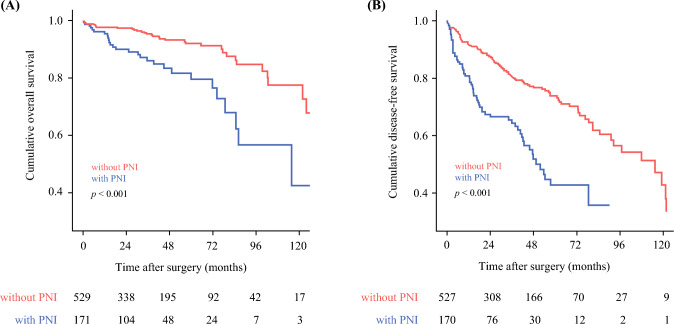 Figure 3
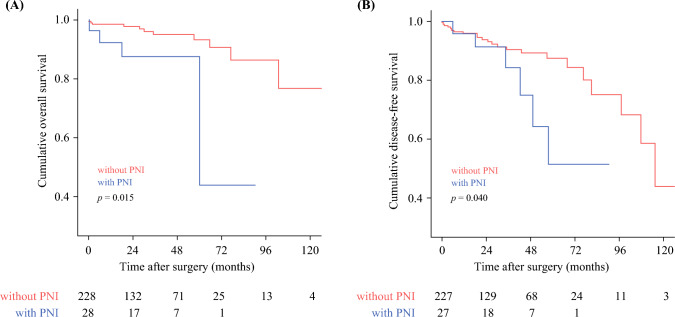 Figure 4
Peer Reviews
No public reviews on file for this paper yet. If you reviewed it on a platform where reviews are public (OpenReview, ICLR, NeurIPS, ICML), you can paste yours below so the community can read it here.
Videos
No videos yet. Explain this paper in a talk, walkthrough, or lecture? Add one.
Taxonomy
TopicsNeuroendocrine Tumor Research Advances · Neuroblastoma Research and Treatments · Lung Cancer Research Studies