Liver biopsy quality criteria to exclude cirrhosis in case of suspicion of porto-sinusoidal vascular disorder
Chloé de Broucker, Valérie Paradis, Maria Luisa Botero, Miguel Albuquerque, Audrey Payancé, Aurélie Plessier, Laure Elkrief, François Durand, Sophie Hillaire, Paul-Emile Zafar, Juan Carlos Garcia Pagan, Pierre-Emmanuel Rautou

TL;DR
The study determines the minimum liver biopsy length and staining method needed to rule out cirrhosis when diagnosing porto-sinusoidal vascular disorder.
Contribution
The study provides evidence-based criteria for liver biopsy length and staining to exclude cirrhosis in porto-sinusoidal vascular disorder diagnosis.
Findings
A 15 mm biopsy with a 10 mm fragment is sufficient to exclude cirrhosis in PSVD.
Picrosirius red staining performs slightly better than Masson’s trichrome for this purpose.
Percutaneous biopsies have higher sensitivity than transjugular biopsies for cirrhosis exclusion.
Abstract
Baveno VII guidelines based porto-sinusoidal vascular disorder (PSVD) diagnosis on a liver biopsy excluding cirrhosis. However, evidence-based quality criteria for liver biopsy are lacking. This study aimed to determine biopsy length and staining appropriate to rule out cirrhosis. Liver explants from 12 patients with cirrhosis and 12 with PSVD were selected. Slides were stained with Picrosirius red or Masson’s trichrome. A total of 36,000 virtual liver biopsies were randomly generated, including different biopsy widths (572 and 1,000 μm corresponding to transjugular and percutaneous biopsies, respectively) and lengths (5 mm, 10 mm, 15 mm, 20 mm, 25 mm; fragmented 5 + 10 mm and 5 + 5 + 5 mm). Biopsies were assessed by an expert pathologist for the presence or absence of cirrhosis. Overall sensitivity of percutaneous biopsies for the diagnosis of cirrhosis was 85%, higher with…
Genes, proteins, chemicals, diseases, species, mutations and cell lines named across the full text — each resolved to its canonical identifier and authoritative record.
Click any figure to enlarge with its caption.
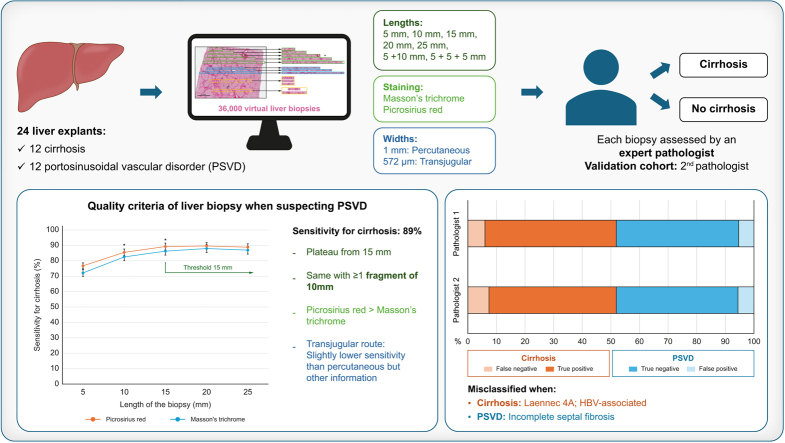 Figure 1
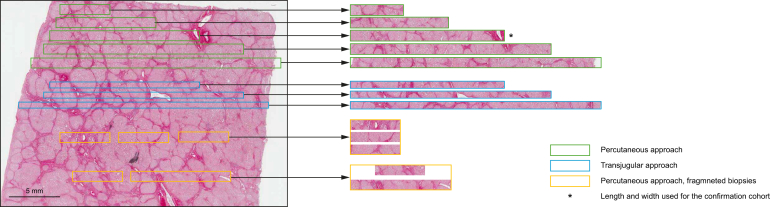 Figure 2
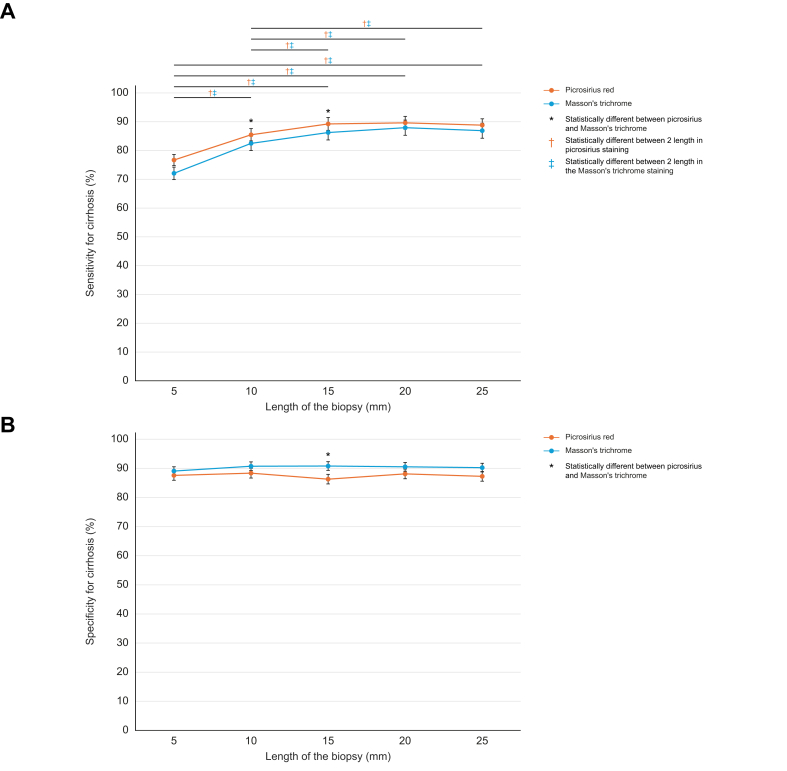 Figure 3
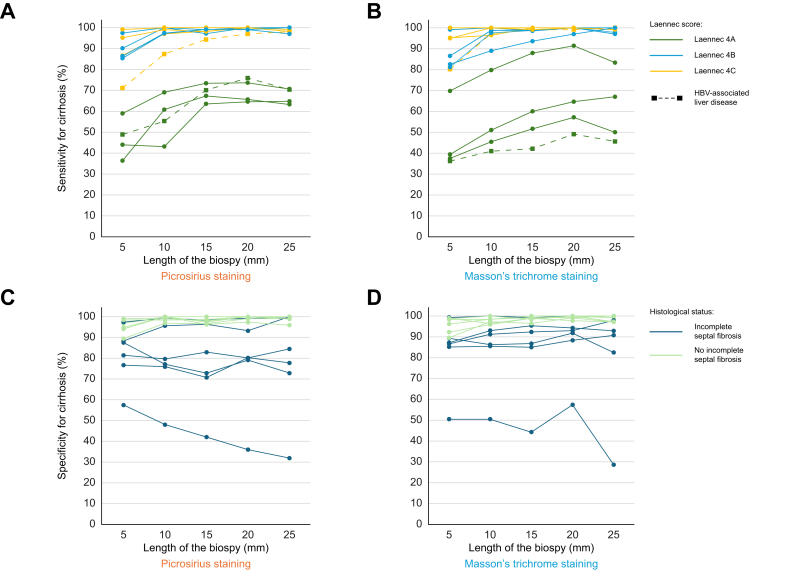 Figure 4
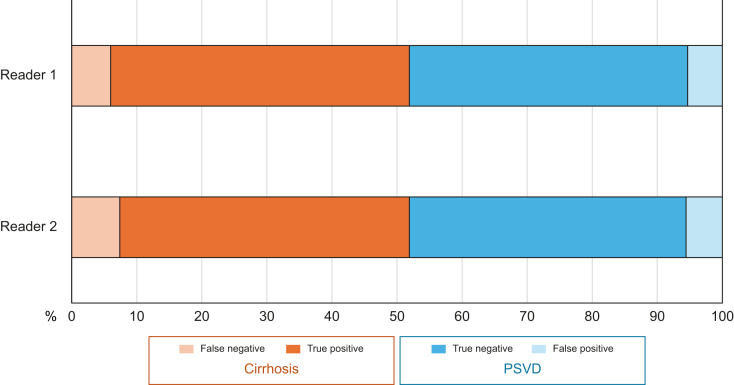 Figure 5
Peer Reviews
No public reviews on file for this paper yet. If you reviewed it on a platform where reviews are public (OpenReview, ICLR, NeurIPS, ICML), you can paste yours below so the community can read it here.
Videos
No videos yet. Explain this paper in a talk, walkthrough, or lecture? Add one.
Taxonomy
TopicsLiver Disease and Transplantation · Liver Diseases and Immunity · Liver Disease Diagnosis and Treatment