Defining patient‐centered amyloid PET thresholds for the onset of tauopathy in Alzheimer's disease
Zeyu Zhu, Anna Steward, Amir Dehsarvi, Sebastian N. Roemer‐Cassiano, Anna Dewenter, Davina Biel, Fabian Hirsch, Lukas Frontzkowski, Julia Pescoller, Madleen Klonowski, Johannes Gnörich, Michael J. Pontecorvo, Sergey Shcherbinin, Michael Schöll, Rachel Buckley, Rik Ossenkoppele

TL;DR
This study identifies personalized amyloid PET thresholds to detect early tauopathy in Alzheimer's disease, considering age and sex differences.
Contribution
The paper introduces patient-centered amyloid PET thresholds for predicting tauopathy onset based on age and sex.
Findings
Younger men show faster amyloid-related tau accumulation.
Amyloid PET thresholds predict earlier tauopathy onset and cognitive decline in women.
Crossing amyloid PET thresholds is linked to progressive tau deposition and cognitive decline.
Abstract
Amyloid‐induced tauopathy drives clinical decline in Alzheimer's disease (AD). Because age and sex shape tau trajectories, defining patient‐centered amyloid thresholds for tauopathy onset could facilitate pre‐tauopathy AD identification and aid treatment decisions and prognosis. By including two samples (Alzheimer's Disease Neuroimaging Initiative [ADNI, n = 301]; and 18F‐AV‐1451‐A05 [A05, n = 143]), we explored whether age and sex affect tauopathy transition and determined patient‐centered amyloid positron emission tomography (PET) thresholds that mark tauopathy onset. We found a consistent amyloid PET × age interaction on global tau PET increase in men (ADNI/A05: p = 0.0078/0.018), with younger men showing faster amyloid‐associated tau accumulation. We then established patient‐centered, amyloid PET–inferred tauopathy transition cut‐offs. Women reached this transition at lower…
Genes, proteins, chemicals, diseases, species, mutations and cell lines named across the full text — each resolved to its canonical identifier and authoritative record.
Click any figure to enlarge with its caption.
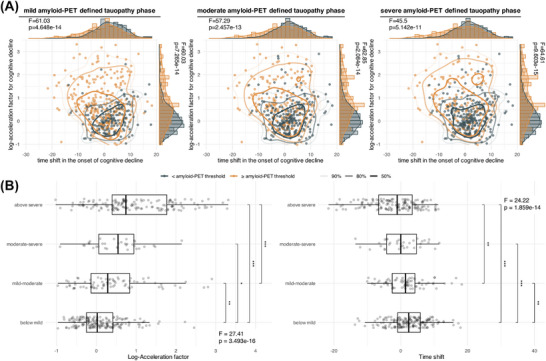 Figure 1
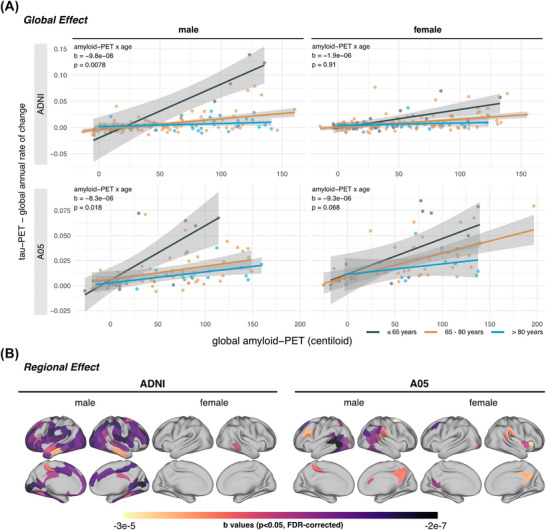 Figure 2
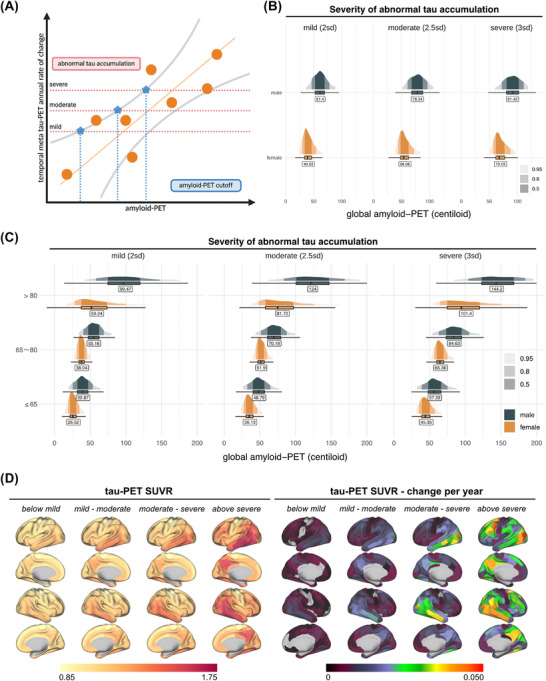 Figure 3
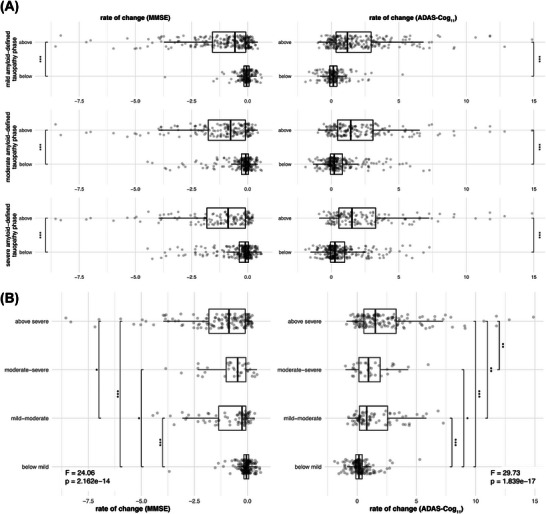 Figure 4
Peer Reviews
No public reviews on file for this paper yet. If you reviewed it on a platform where reviews are public (OpenReview, ICLR, NeurIPS, ICML), you can paste yours below so the community can read it here.
Videos
No videos yet. Explain this paper in a talk, walkthrough, or lecture? Add one.
Taxonomy
TopicsDementia and Cognitive Impairment Research · Alzheimer's disease research and treatments · Intensive Care Unit Cognitive Disorders